
Pioneering a thermodynamically coherent, multiscale view of gut motility, from fundamental science to translational impact.
Introduction: a new frontier in gastrointestinal biomechanics
Gastrointestinal (GI) disorders are a major global health concern; yet, the underlying physiopathology of gut motility remains among the least understood domains in human biomechanics. While cardiovascular bioengineering has advanced rapidly over the past two decades, modelling the stomach and intestine still lags far behind in theoretical consistency, experimental resolution and clinical translation.
The ERC Consolidator Grant MiGEM (Modelling Inter-Scale Energetics in GastroIntestinal ElectroMechanics) takes on this challenge. Led by Prof. Alessio Gizzi at Università Campus Bio-Medico di Roma (UCBM) in collaboration with the Auckland Bioengineering Institute (ABI) at the University of Auckland, MiGEM is a five-year (2025–2030) project designed to build the first inter-scale, thermodynamically coherent, multiphysics model of GI motility.
From electromechanics to energetics: why MiGEM is different
Traditional GI models often mimic rubber-like materials or treat the gut as a passive tube. MiGEM moves beyond this by embedding living tissue energetics into realistic and reliable electromechanical modelling and simulations. The project assimilates high-resolution electroanatomical data into active strain electromechanics frameworks, develops the first calorimetric measurements of GI tissues to quantify smooth muscle energy expenditure, and creates anatomically realistic simulations of gut motility at the organ scale, validated against imaging and in vivo data.
International collaboration and network building
A hallmark of MiGEM is the strong UCBM–ABI partnership. ABI brings decades of experience in high-resolution GI mapping and muscle energetics, including the world’s only flow-through calorimeter for cardiac trabeculae, now being adapted for GI tissue.
The project also assembles a diverse team of senior and junior scientists across Europe, Oceania and the Americas. This network ensures cross-fertilisation between theory and experiment, promoting gender balance and methodological transfer from senior to junior researchers.
Milestones achieved: ICCB 2025 and the MiGEM workshop
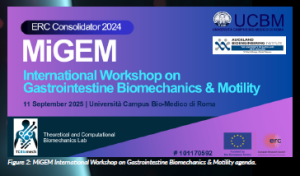
As part of its outreach and knowledge-dissemination objectives, MiGEM played a central role in organising the XI International Conference on Computational Bioengineering (ICCB 2025) held in Rome (see iccb2025.org). ICCB 2025 brought together more than 150 researchers in biomechanics, mechanobiology and computational modelling from 26 countries and five continents. Hot on the heels of ICCB 2025, MiGEM convened a focused workshop at UCBM on 11 September 2025: the International Workshop on Gastrointestinal Biomechanics & Motility, in collaboration with ABI. The agenda featured sessions from leading researchers and a roundtable discussion to catalyse collaborations between Europe, Oceania and South America.
The gastrointestinal system is one of the most important organs in the human body. Like the heart, it is an active tissue capable of generating and propagating its own electrical signal to trigger coordinated mechanical contraction. The intestine combines complex electrical and mechanical activity whose role is to propel its contents while ensuring the absorption of essential nutrients. At the cellular level, this activity begins with the electrical activation produced by the interstitial cells of Cajal, natural pacemakers distributed throughout the tissue. Their signal propagates through the organ, excites the smooth muscle cells, and triggers the contraction of the muscle fibres that structure and drive the intestinal wall (see Figure 3).
Our goal is to describe this phenomenon at the scale of the whole organ.
This requires linking cellular mechanisms to their macroscopic expression through a multiscale modelling approach.
Starting from experiments, we first build up a realistic geometry of the duodenum. Then, we simulate the electrophysiology and generate the muscle fibre directions that guide contraction and build the activation tensor responsible for the mechanical response. An additional level of complexity arises from contact mechanics. During strong contractions, the intestine may experience internal self-contact, and certain medical procedures—such as the insertion of an inflatable balloon—introduce contact with an external device.
An additional level of complexity arises from contact mechanics. During strong contractions, the intestine may experience internal self-contact (Figure 3), and certain medical procedures—such as the insertion of an inflatable balloon—introduce contact with an external device (Figure 3).
Modelling these conditions requires describing not only tissue deformation but also the interaction between contacting surfaces, significantly increasing the complexity of the model.
Together, electrophysiology, fibre architecture, activation mechanics, self-contact, and external-contact simulation form the complete framework necessary to faithfully represent intestinal behaviour and to better understand its associated pathologies.
Conclusion: from bench to bedside through multiscale energetics
MiGEM represents a bold step towards an integrated, physics-based understanding of gastrointestinal motility. By coupling high-resolution experimental data with thermodynamically grounded computational models, it promises not just incremental progress but a paradigm shift—similar to what has already transformed cardiac modelling.
With its combination of theoretical rigour, experimental innovation and international collaboration, MiGEM is poised to unlock new horizons in gastrointestinal biomechanics and motility—fulfilling the ERC’s vision of high-risk, high-gain research for Europe and beyond.
Publications on ERC MiGEM
Djoumessi, R.T., Lenarda, P., Gizzi, A., Giusti, S., Alduini, P. and Paggi, M. (2024) ‘In silico model of colon electromechanics for manometry prediction after laser tissue soldering’, Computer Methods in Applied Mechanics and Engineering, 426, 116989. doi: 10.1016/j.cma.2024.116989.
Djoumessi, R.T., Lenarda, P., Gizzi, A. and Paggi, M. (2025). ‘A self-contact electromechanical framework for intestinal motility’, Computational Mechanics, doi: 10.1007/s00466-025-02692-4.
Henke, M.S., Brandstaeter, S., Fuchs, S.L., Aydin, R.C., Gizzi, A., and Cyron, C.J. (2026) ‘Electromechanical computational model of the human stomach’, Computer Methods in Applied Mechanics and Engineering, 449, 118549. doi: 10.1016/j.cma.2025.118549.
Project summary
MiGEM aims to develop greater knowledge of gastrointestinal pathologies, such as dysrhythmias, gastroparesis and paralytic ileus (affecting more than 60% of the adult population), with the final aim of understanding the causes that generate these disorders and identifying more effective therapeutic strategies than the current ones. The project will involve the development of theoretical and computational digital models based on innovative experiments, capable of measuring for the first time in the world the heat generated by the gastrointestinal wall and mapping its movement. MiGEM examines gastrointestinal pathologies from the perspective of preventing them, identifying therapeutic strategies in silico through the optimisation of existing devices, enhancing their efficiency or better use, or by proposing new therapeutic strategies not yet available.
Project lead profile
Prof. Alessio Gizzi is Full Professor of Structural Mechanics at the Departmental Faculty of Engineering, Campus Bio-Medico University of Rome since 2025. He conducts research in various areas of theoretical and computational biomechanics, with over 100 scientific papers in high-impact factor international journals.
He is a reviewer and editor for various scientific journals in biomechanics, mechanobiology, and theoretical and computational modelling. He is the author of the textbook Building Science for Biomedical Engineering, CittaStudi, 2023.
Project contacts
Prof. Alessio Gizzi
Università Campus Bio-Medico di Roma
Email: a.gizzi@unicampus.it
Web: https://tcbiomech.unicampus.it
Funding
This project has received funding from the European Research Council (ERC) under the European Union’s Horizon Europe research and innovation programme. Grant agreement No. 101170592.
Views and opinions expressed are, however, those of the author(s) only and do not necessarily reflect those of the European Union or the ERC. Neither the European Union nor the granting authority can be held responsible for them.
Figure legends
Figure 1: XI International Conference on Computational Bioengineering. https://iccb2025.org/.
Figure 2: MiGEM International Workshop on Gastrointestine Biomechanics & Motility agenda.
Figure 3: Patient specific GI electro-contact-mechanics.