
Pedro V. Martínez-Culebras1, Laura Hernández-García1, Maialen Fayanas3, Agustín García3, Carlos Adelantado3, Francisco J. Barba1,2
1 Innovative Technologies for Sustainable Food (ALISOST), Department of Preventive Medicine and Public Health, Food Science, Toxicology and Forensic Medicine, Faculty of Pharmacy, Universitat de València
2 CIBER de Enfermedades Infecciosas (CIBERINFEC), Instituto de Salud Carlos III, Madrid, Spain
3 Isanatur Spain SL, Navarre, Spain
The global food system is facing major environmental and nutritional challenges driven by climate change, population growth, and pressure on natural resources, making the transition towards healthier and more sustainable diets a key scientific and societal priority. In this context, plant-based foods have emerged as promising alternatives due to their lower environmental impact compared with animal-derived products.
Cereals play a central role in sustainable food systems, with wheat being one of the world’s most important staple foods because of its high consumption, nutritional value, and relevance in daily diets. Wheat-based products are emerging as sustainable and functional alternatives to dairy foods due to their nutritional value, bioactive compounds, and absence of lactose and milk allergens. However, their gluten content may limit consumption among individuals with celiac disease or gluten-related disorders. These characteristics, together with the growing demand for plant-based food alternatives, have increased interest in developing innovative wheat-based fermented beverages and food products with added functional value.
Fermentation as a bridge between tradition and future food innovation
Fermentation represents one of the oldest and most successful biotechnological strategies used in food processing. For thousands of years, fermented foods have contributed to food preservation, flavour development, and nutritional enhancement across different cultures and civilisations. Today, fermentation is attracting renewed scientific attention because of its potential to support the transition towards more sustainable and resilient food systems.
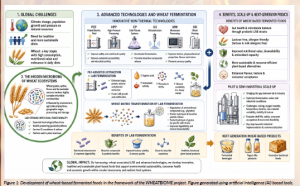
Recent advances in food microbiology, biotechnology, and microbiome science are creating new opportunities for the development of next-generation fermented foods. Fermentation can significantly improve the digestibility and nutritional profile of wheat matrices through the metabolic activities of microorganisms, particularly lactic acid bacteria (LAB). These microorganisms contribute to the degradation of anti-nutritional compounds such as phytates, thereby increasing mineral bioavailability, while also enhancing protein digestibility through the hydrolysis of cereal proteins and the release of bioactive peptides. LAB fermentation can also increase antioxidant activity by promoting the liberation of phenolic compounds and the production of beneficial metabolites. Importantly, certain LAB strains possess proteolytic systems capable of partially hydrolysing gluten proteins, reducing their immunoreactivity and contributing to the development of wheat-based products with improved digestibility and potential suitability for individuals with gluten sensitivity. In addition, LAB fermentation not only improves the nutritional and functional value of these products, but also modifies their physicochemical and sensory properties, influencing consumer acceptance. In particular, the production of organic acids, volatile compounds, and exopolysaccharides by LAB contributes to improving the texture, stability, and organoleptic profile of the final product, promoting a sensory experience closer to that of traditional dairy products. Furthermore, the incorporation of probiotic strains provides additional functional value, with potential beneficial effects on gut health and microbiota balance. Altogether, these properties make LAB valuable biotechnological tools for the development of healthier and more functional wheat-derived foods and beverages.
The hidden microbial diversity associated with wheat ecosystems
The selection of appropriate LAB is a key factor in the development of fermented plant-based foods, as strains naturally associated with wheat ecosystems may be better adapted to cereal matrices and therefore exhibit improved fermentative and functional properties. Wheat grains, spikes, flours, and related environments harbour complex and still partially unexplored microbial communities shaped by environmental conditions, agricultural practices, geographical origin, processing technologies, and storage conditions. In addition to their technological role in fermentation, some LAB may provide health benefits through probiotic properties, making them particularly attractive for the development of functional foods.
The WHEATBIOME project aims to contribute to healthier and more sustainable food systems by exploring naturally occurring LAB associated with wheat ecosystems. The project focuses on identifying microbial resources with both technological and probiotic potential that can be used to develop innovative wheat-based fermented foods and beverages. Recent studies carried out within the project isolated and characterised 45 LAB strains from wheat grains and spikes collected in Spanish cereal-producing regions. These strains belonged to 8 species, including Lactiplantibacillus plantarum, Pediococcus acidilactici, Pediococcus pentosaceus, Lacticaseibacillus casei, and Loigolactobacillus coryniformis. Several isolates showed promising probiotic-related characteristics, such as tolerance to simulated gastrointestinal conditions, strong auto-aggregation capacity and high surface hydrophobicity (Gao et al., 2026a).
To identify the most suitable starter cultures, WHEATBIOME is currently evaluating a wide range of technological properties, including tolerance to temperature and salt stress, autolytic activity, exopolysaccharide production, antimicrobial activity, enzymatic profiles, and carbohydrate fermentation capacity. This comprehensive characterisation is essential for selecting strains that can combine probiotic functionality with efficient fermentation performance in cereal-based matrices.
The identification of wheat-derived LAB with both technological and probiotic potential represents an important step towards the development of starter cultures specifically adapted to cereal fermentations. Such microorganisms could improve fermentation efficiency, flavour development, and the nutritional quality of fermented wheat products. Based on these findings, and together with nutritional and sensory evaluations, the project is developing wheat-based fermented beverages and yogurt-like products with enhanced functional, sensory, and nutritional properties. More broadly, these innovations may contribute to diversifying plant-based food options, increasing the value of cereal products and supporting more sustainable and circular agri-food systems.
Advanced technologies and wheat fermentation
Modern food innovation increasingly relies on combining traditional fermentation processes with emerging food-processing technologies. In this context, non-thermal technologies such as pulsed electric field (PEF) processing, high-pressure processing (HPP), cold plasma (CP), ultrasonication (US), microwave processing (MW), and ohmic heating (OH) have attracted growing scientific and industrial interest. These approaches offer the potential to improve food safety, nutritional quality, processing efficiency, and functional properties while preserving the sensory attributes of food products. Furthermore, they can enhance fermentation performance by increasing protein digestibility, stimulating microbial growth and metabolic activity, accelerating fermentation rates, promoting the release of bioactive compounds, and improving texture, flavour, colour, and other physicochemical characteristics of fermented foods.
Within the WHEATBIOME project, innovative processing technologies are being explored as a strategy to enhance the fermentation of wheat-based products. Recent studies have investigated the effects of PEF-assisted extraction combined with fermentation using LAB strains isolated from wheat ecosystems (Gao et al., 2026b). In cereal matrices, PEF has shown considerable potential for improving the extraction of sugars, proteins, minerals, and phenolic compounds, thereby increasing the availability of nutrients and substrates required for microbial growth and metabolic activity during fermentation.
The results demonstrated that PEF pretreatment significantly improved fermentation efficiency in malted wheat beverages by accelerating LAB growth and acidification. Among the strains evaluated, Lactiplantibacillus plantarum exhibited the highest fermentative performance, achieving rapid acidification and enhanced production of organic acids. In addition, the combination of PEF and LAB fermentation promoted the release of bioactive compounds, increased antioxidant activity, and altered the metabolic profile of the fermented beverages. Notably, this combined approach led to higher concentrations of phenolic compounds and short-chain fatty acids, improved mineral bioavailability, and reduced levels of heavy metals.
These findings highlight the potential synergy between innovative non-thermal processing technologies and microbial fermentation, opening new opportunities for the development of wheat-based fermented foods and beverages with enhanced nutritional, functional, and sensory properties. The integration of such technologies within the WHEATBIOME project may therefore contribute to the design of next-generation plant-based products that better respond to current consumer demands for healthy, sustainable, and high-quality foods.
Pilot and semi-industrial scale-up of wheat-based fermented products
The scale-up of fermented foods represents a major challenge in food biotechnology, as microbial behaviour and product characteristics observed at laboratory scale are not always reproducible under industrial processing conditions. Consequently, pilot-scale studies are essential to bridge the gap between laboratory research and industrial application, allowing the optimisation and standardisation of fermentation processes before commercial production. In this context, scaling up the production of these wheat-based fermented beverages and yogurt-like products to pilot and semi-industrial level constitutes a critical stage for validating their technological feasibility and commercial potential.
Within the WHEATBIOME project, selected fermented beverages and yogurt-like products are currently undergoing pilot and semi-industrial scale-up as a key step towards their future industrial implementation. Although LAB strains may show excellent performance under laboratory conditions, fermentation behaviour can vary significantly at larger scales due to changes in mixing efficiency, oxygen transfer, temperature gradients, and fermentation kinetics. Moreover, scale-up processes involve important technological challenges, including maintaining microbial viability and metabolic activity, preserving desirable sensory attributes, and ensuring adequate texture and product stability during processing and storage.
In cereal-based matrices, additional difficulties such as raw material variability, lower protein content and the tendency of plant-based products to exhibit phase separation make process optimisation particularly relevant during semi-industrial production. Pilot-scale production also enables the evaluation of shelf life, microbiological stability, and consumer acceptance under conditions closer to industrial reality. In addition, it provides valuable information regarding process sustainability, production costs, and industrial scalability. Overall, the transition from laboratory development to pilot and semi-industrial production represents a decisive step towards the commercialisation of innovative wheat-based functional fermented foods with enhanced nutritional and sensory properties.
References
Gao, W. et al. (2026a) ‘Identification, safety evaluation and probiotic potential of lactic acid bacteria isolated from wheat’, International Journal of Food Microbiology, 444, 111436.
Gao, W. et al. (2026b) ‘Pulsed electric field-assisted fermentation enhances nutritional composition and bioactivity in wheat-based beverages’, Food Chemistry, 517, 149412.
Project summary
The WHEATBIOME project gathers 13 partners from academia, industry, food systems and governmental bodies aiming to explore how biotic/abiotic factors impact soil and wheat microbial communities. The project will contribute to the development of novel and healthier food and feed products while enhancing sustainable farming practices for resilient crops and societal perception about microbiomes within food systems.
Project partners
WHEATBIOME consortium includes experts in the human microbiome (LAQV/ REQUIMTE, PT), agro-edaphic microbiomes (UPORTO, PT), plant biochemistry (WUR, NL), microbial biotechnology (UVEG, ES), nutrition (UVIGO, ES), food technology (IBPRS, PL), food production (ISANATUR, ES), sustainability assessment (CTA, ES), animal health (SGGW, PL), food/feed legislation (UVMB, HU), clinical trials (NMS, PT), computer science (BETAVIA, LT), communication/dissemination (CTA, ES), and education/training (EDAGRI, ES).
Project lead profile
LAQV/REQUIMTE is a research institute with a core mission to promote scientific and technological activities aligned with the United Nations Sustainable Development Agenda, and to provide smart and sustainable solutions to governments, industry, and society. With a robust organisational structure, LAQV/REQUIMTE gathers top-notch technical resources coordinated by qualified staff, enhancing the institution’s renowned scientific excellence.
Project contacts
Project Co-ordinators: Susana Soares and Rosa Pérez-Gregorio
Email: wheatbiome@requimte.pt
Web: www.wheatbiome-project.eu
X: @wheatbiome
LinkedIn: /company/wheatbiome-project/
Funding and disclaimers
This project has received funding from the European Union’s Horizon Europe research and innovation programme under grant agreement No. 101084344 (WHEATBIOME).
Views and opinions expressed are, however, those of the author(s) only and do not necessarily reflect those of the European Union or the European Research Executive Agency (REA). Neither the European Union nor the granting authority can be held responsible for them.
Figure legends
Figure 1: Development of wheat-based fermented foods in the framework of the WHEATBIOME project. Figure generated using artificial intelligence (AI) based tools.