
The pieces of CONFETI are beginning to take shape. The project is moving from the validation of individual concepts and materials toward the preparation of functional components for integration testing. The focus is now on that transition: several core technologies are ready to be assessed together before the final integrated system is demonstrated.
Across the project, different building blocks have advanced under defined laboratory or device-relevant conditions. These include bio-based ionogel electrolytes, catalytic platforms for carbon dioxide (CO₂) and nitrogen valorisation, structured electrode and reactor components, soil microbial fuel cells, and compound parabolic collector photoreactors for nitrate conversion. The focus is no longer only on whether each idea can work in isolation, but on whether these parts can begin to operate as elements of a future system.
That shift matters. CONFETI is building a portfolio of experimentally validated and increasingly compatible technologies. These results prepare the ground for the next step: testing how the components behave when coupled into a co-ordinated system.
Capturing the ingredients for urea
Before urea can be made, the right ingredients must be captured and delivered to the reaction site. For the electrochemical route, CONFETI needs materials that do more than capture CO₂ and nitrogen species. They must also help make these reactants available close to the catalytic interface, while maintaining ionic transport, chemical stability, and compatibility with the flow-cell environment.
Earlier CONFETI work identified hybrid solid-state electrolyte membranes as a promising route. These materials combine mechanically robust polymer matrices with tailored ionic components, aiming to bring together sorption capacity, conductivity, and electrochemical compatibility. The current challenge is to translate this material performance into electrode-scale and device-compatible formats.
This shift from small laboratory samples to functional components is central to the project’s pre-integration stage. Capture and activation materials must remain stable, conductive, and processable when assembled with electrodes and reactor interfaces. Their role is therefore not only to capture reactants, but to help connect carbon and nitrogen availability with electrochemical urea synthesis.
Making urea in a flow cell
In CONFETI, the flow cell is where one of the central questions of the project is tested: can carbon and nitrogen compounds be brought together under controlled electrochemical conditions to form urea? Tests carried out at ELCAT have shown that urea can be electrochemically synthesised from nitrate (NO₃⁻) and carbon dioxide (CO₂)-enriched aqueous solutions in a lab-scale flow cell. This result is important because urea formation requires a complex 16-electron transfer process and depends on the correct balance between carbon and nitrogen reaction pathways.
To understand and optimise this process, CONFETI has tested different gas diffusion electrodes, catalyst loadings, nitrate concentrations, electrolyte pH values, flow rates, and applied current densities. In a standalone electrolyser, the best reported conditions so far reached Faradaic efficiencies above 20 % and production rates above 100 mg per day at 10 mA/cm², using a nitrate- and bicarbonate-containing electrolyte. At higher current densities, however, selectivity decreases, and competing ammonia and hydrogen production become more dominant. This makes productivity and urea concentration in the outlet stream a current limitation.
The flow-cell interface is therefore not only a reactor design issue. It is central to controlling mass transport, reactant availability, and selectivity. The best results so far have been obtained in a 10 cm² 3-compartment flow electrolyser using sputtered silver thin films on commercial carbon paper with a 20–30 wt% polytetrafluoroethylene loading. Silver has shown promising selectivity, partly because of its role in supporting carbon monoxide (CO) formation, which is relevant for carbon–nitrogen coupling. At the same time, its cost and critical raw-material status mean that future work must either reduce silver loading or explore alternative catalyst formulations.
CONFETI is also placing emphasis on analytical confidence. Urea is quantified using the diacetyl monoxime-thiosemicarbazide colourimetric method, combined with internal calibration and blank samples. Tests without nitrate or CO₂ showed no urea formation, supporting the conclusion that both reactants are required. The next optimisation step will focus on improving CO₂ availability, including by increasing operational pressure and coupling the electrolyser with capture materials.
Recycling nitrate with sunlight
CONFETI also addresses what happens to nitrogen after fertilisation. Fertiliser that is not taken up by plants can end up as nitrate in soil and water. The project explores whether sunlight-driven photocatalysis can help recover this nitrate and convert it into useful nitrogen products.
This photochemical route has demonstrated nitrate-to-ammonium or nitrate-to-ammonia conversion under sunlight-relevant conditions. The tests used a titanium dioxide (TiO₂)-based photocatalyst combined with a metal oxide. The system was operated in a 25 L compound parabolic collector photoreactor under anoxic conditions and in the presence of glycerol. In natural well water, the maximum ammonium production reported reached 92 % after 600 minutes.
This result is relevant because the work has moved beyond catalyst screening alone. It has been tested in a reactor format closer to practical operation, using a relatively simple and cost-effective photocatalytic approach. For a circular fertiliser concept, this matters because it turns nitrate recovery into an active part of the system design, not a separate environmental afterthought.
At the same time, the photochemical results need a clear boundary between nitrate recovery and urea production. Within CONFETI, photocatalytic urea formation has been validated only at laboratory scale. It has not yet been achieved at pilot plant scale. For this reason, solar nitrate-to-ammonium or nitrate-to-ammonia conversion serves as the validated photochemical result, while photocatalytic urea formation remains a next development step.
Power from soil and sunlight
One of CONFETI’s most distinctive ideas is to power chemistry with energy harvested close to the plant. The challenge is not only to generate renewable energy but also to convert small, irregular energy flows into power that chemical processes can use.
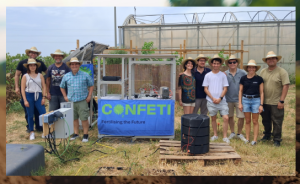
In the project, soil microbial fuel cells have evolved from individual experimental units into scalable biobattery systems designed for field deployment. Under optimised configurations, the systems consistently reach open-circuit voltages above 600 mV after stabilisation. Stack-level configurations have also enabled peak power outputs in the order of tens of milliwatts.
Material and engineering improvements have contributed to this progress. Activated carbon electrodes have accelerated the initial establishment of electroactive biofilms, reducing start-up time and improving early-stage current and power output. Long-term laboratory and field experiments also show sustained operation over several months. Buried configurations have maintained stable electrochemical performance despite changes in temperature, humidity, and soil composition. Replacing conventional connectors with corrosion-resistant materials has addressed another practical barrier for real-world operation.
In the current prototype, ‘self-powered’ refers to an energy platform that combines the continuous low-power contribution of soil microbial fuel cells with the higher, intermittent input of photovoltaic panels. Energy storage is essential. A lithium-ion battery buffers the hybrid input and delivers a stable supply to downstream processes, separating the moment when energy is generated from the moment when it is used.
CONFETI has also developed a power-management architecture for ultra-low-voltage input. An energy harvesting circuit can operate at input levels as low as around 100 mV. The harvested energy is stored in a supercapacitor, monitored through voltage thresholds, and then transferred through a direct current-to-direct current conversion stage. This strategy helps bridge the gap between biological energy generation and usable operation for low-power electrochemical processes.
Checking the environmental footprint early
Calling a technology ‘clean’ is not enough. CONFETI is testing what that claim means before the final system is assembled. The project uses life-cycle thinking, ecodesign criteria, and environmental hotspot analysis to identify where design choices can reduce impacts.
The sustainability team has developed new life cycle inventory datasets for the electrochemical reactor, the biobattery, and the photochemical reactor. Preliminary life cycle assessments have been conducted for each technology. These assessments will be refined in the coming months by integrating improvement scenarios. These results show that environmental assessment is already shaping technology development. Final comparisons with conventional fertiliser production will require the completed life-cycle assessment and the final integrated-system boundaries.
For the electrochemical reactor, preliminary results show that reactor infrastructure dominates all 18 environmental impact categories assessed, except eutrophication. The cathode and pumps are the main contributors. To reduce these impacts, the consortium will further assess extended lifetime scenarios and explore alternative materials for these components.
For the biobattery system, the microbial fuel cell is the main contributor in 13 of the 18 impact categories analysed. The energy storage system dominates the remaining 5 categories, mainly because lithium is a key component of the battery cells. The cell housing material has also been identified as a priority for improvement, and alternatives to acrylonitrile butadiene styrene are being investigated.
For the photochemical reactor, infrastructure has a larger impact than the use phase in 6 of the 8 categories assessed. Further analysis will focus on the lifetime of the installation and the replacement rate of borosilicate tubes. Together, these findings show that environmental evidence is already influencing how CONFETI technologies are being improved.
The next step: putting the pieces together
The next challenge is to see how the parts behave when they meet. CONFETI’s planned assembly and validation campaign will test the compatibility of components that have so far been developed under defined laboratory or device-relevant conditions. The aim is not to optimise each element separately, but to understand how they work together. The validation run will examine reactor coupling, fluidic management, power generation and delivery, control strategies, product quantification, and operational stability. This includes the interaction between electrochemical, photochemical, and bioelectrochemical units. It also includes the energy platform’s ability to support chemical processes in continuous or semi-continuous operation.
At this stage, CONFETI is not claiming final system performance. The value of this phase is to identify how materials, reactors, energy management, and analytical methods interact and where further adjustments are needed.
CONFETI is now at the point where its individual research lines can be brought together and tested as a system. The upcoming integration work will demonstrate how the system performs when its components operate together, identify remaining limitations, and show how the project can contribute to future circular fertiliser production.
Project summary
The EIC-funded CONFETI project aims to develop innovative lab-scale technology that captures and converts CO2 and N2 from air or flue gases into urea using renewable energy, bypassing critical raw materials. It also plans to recycle nitrates into ammonia or urea through sunlight-driven photocatalytic technology, promoting a circular and sustainable carbon and nitrogen economy.
Project partners
Autonomous University of Barcelona (UAB), The Institute of Microelectronics of Barcelona (IMB-CNM-CSIC), Research Centre for Energy, Environment and Technology (CIEMAT), Bioo, the University of Antwerp (UANTWERPEN), University of Pisa (uniPi), French National Centre for Scientific Research (CNRS), University Toulouse III – Paul Sabatier (UPS) and Iowa State University (IOWA).
Project lead profile
Gonzalo Guirado is a full professor at the Universitat Autònoma de Barcelona, specialising in sustainable chemistry, including green valorisation of CO2. He has advised 18 PhD and 33 master’s theses, published over 105 peer-reviewed articles and holds 3 patents. He has co-ordinated or participated in over 32 research projects funded by European, national, regional, university, and industrial sources.
Project contacts
CONFETI Project Co-ordinator: Universitat Autònoma de Barcelona – UAB
Email: gonzalo.guirado@uab.cat
CONFETI Project Communication Manager: Virginia Mata Marcano
Parc de Recerca UAB – PRUAB
Email: virginia.mata@uab.cat
Funding
This project has received funding from the European Union’s Horizon Europe research and innovation programme under grant agreement No. 101115182 (CONFETI).
Views and opinions expressed are, however, those of the author(s) only and do not necessarily reflect those of the European Union or the European Innovation Council (EIC). Neither the European Union nor the granting authority can be held responsible for them.