
Michael Cant
Co-operation is one of the great puzzles of evolutionary biology. Why should individuals work together, share resources, defend one another, or sacrifice their own interests for the good of the group? Classic explanations have focused on forces that operate within groups, such as kinship, reciprocity, and mutual dependence. Yet in humans and many other social animals, life is also shaped by interactions between groups. Groups compete for territories, food, mates, nesting sites, shelter, and safety. They may avoid one another, attack one another, tolerate each other, or even fuse to form a larger social unit. We currently lack a coherent theory to explain why intergroup interactions take such different forms.
The goal of the INTERGROUP project is to develop such a theory, spanning the range from lethal warfare to peace and co-operation between groups, through an integrated programme of theory, field research, and laboratory experiments. In doing so, it aims to advance our understanding of why warfare occurs in some species but not others, and of the evolutionary factors that promote peace.
Compared with co-operation, we know little about the causes and consequences of intergroup conflict. One reason is that intergroup conflict is much harder to study. Co-operation in nature is often predictable in time and space: for example, helping to feed offspring at a nest or contributing to den or nest construction and maintenance. Intergroup fighting, by contrast, often occurs suddenly, and is fast-moving, chaotic, and difficult to record.
We are overcoming these difficulties using 2 study systems: a wild population of banded mongooses, Mungos mungo, in Uganda, and a laboratory population of the dampwood termite, Zootermopsis angusticollis. In the mongoose system, we are using advanced tracking and drones to give early warning of fights and record in exceptional detail the build-up to intergroup fighting and the roles of individuals in battle. In the termite system, we can stage carefully controlled fights in the laboratory. These systems are very different, but together they allow us to ask general questions about how conflict starts, how groups fight as a collective, and what the consequences of intergroup conflict are for individual life histories, fitness, and group success.
Complementing these empirical investigations, we are also developing a series of analytical and computational models to explore more generally the ecological and social conditions under which intergroup warfare evolves and how individual decision-making during fights enables such conflict to persist. We will tailor these general models to our 2 systems for testing, and compare their predictions against observed patterns of movement and behavioural responses to experiments. This combination of theoretical and empirical work will help to establish general principles which explain patterns of conflict and co-operation across different species.
Intergroup conflict in the wild: the banded mongoose system
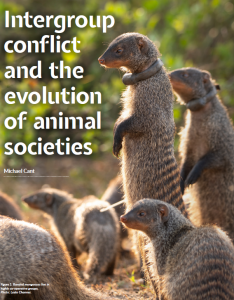
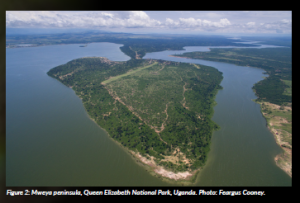
Banded mongooses are small, highly social carnivores that live in mixed-sex groups in sub-Saharan Africa (Figure 1). At the long-term study site on the Mweya Peninsula in Queen Elizabeth National Park, Uganda, we have followed around 12 groups of banded mongooses for the last 30 years (Figure 2). Each group consists of around 20 adults plus their offspring. Banded mongooses are intensely co-operative animals. Females give birth synchronously to communal litters, pups are cared for by babysitters at the den, and older pups form one-to-one caring relationships with adult escorts.
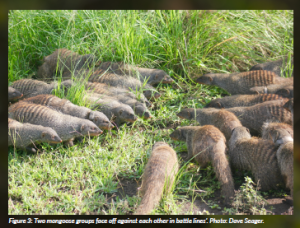
Yet this co-operative society is also one of the most warlike among mammals. Encounters between groups are frequent, violent, and sometimes fatal. Groups advance towards one another in lines before erupting into fast-moving fights in which individuals may be injured or killed (Figure 3). Intergroup conflict is a major source of mortality for both adults and pups.
Banded mongooses provide a rare opportunity to study intergroup conflict in a wild mammal in its natural environment. Our many years of field research have produced a life-history and genetic database containing records on more than 5000 individuals and genetic pedigrees stretching back over 12 mongoose generations. This long-term dataset makes it possible to ask not only what happens during a fight, but how repeated exposure to intergroup conflict affects survival, reproduction, behaviour, and group success over entire lifetimes.
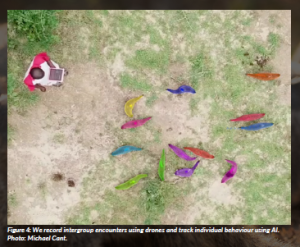
A major innovation of INTERGROUP is the use of advanced tracking and drone technology to capture the build-up, dynamics, and aftermath of intergroup fights. The project is developing live-tracking technologies based on advanced GPS tags, with the aim of monitoring the simultaneous movements of multiple mongoose groups in real time. These systems are being tested in the field for their range, reliability, battery performance, and ability to detect when groups are approaching one another. Alongside this, drone filming is providing high-resolution video of mongoose movement and group behaviour, while the development of a 3D map of the peninsula is helping us place these movements within their ecological and social landscape.
This approach will allow INTERGROUP to answer questions that have previously been almost impossible to study in wild animal societies. Do groups actively seek out conflict, or do fights simply occur when groups meet by chance? Are some individuals responsible for leading groups into danger? How do groups remain cohesive in the chaos of battle, when individuals might be tempted to flee? Do key individuals, such as experienced older males, galvanise the performance of the whole group? Do groups become more united after conflict, or does fighting expose, and intensify divisions within them?
From warfare to fusion: the dampwood termite system
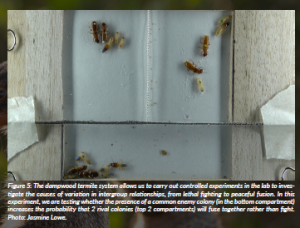
The second study system, Zootermopsis angusticollis, offers a very different window onto the evolution of conflict and co-operation. These dampwood termites live inside rotting logs, which serve as both home and food source. Colonies are founded by a queen and king, and all group members except soldiers retain the capacity to reproduce. As colonies grow, they encounter other colonies sharing the same log, leading to lethal fights in which losing groups may be completely eliminated. Yet in many cases, unrelated colonies fuse rather than fight, forming a new, more genetically diverse collective.
Because colony encounters can be staged under carefully controlled conditions, the termite system is particularly well suited to large-scale experiments on the factors that shift societies from warfare to peace and fusion. Fusion between unrelated colonies is puzzling because it reduces relatedness within the group, which, in principle, should make internal conflict more likely. Yet fusion may also bring benefits. Fused colonies may become stronger competitors in later conflicts or acquire a more diverse or efficient gut microbiome, an especially important possibility in termites, whose ability to digest wood depends on microbial partners.
We have begun to characterise the microbiomes of termite colonies and investigate how fusion affects their composition. These data will allow us to test whether the merging of colonies also involves merging microbial communities and whether this helps explain why fusion occurs. More broadly, the termite experiments will reveal how intergroup conflict shapes the organisation and efficiency of societies, and what factors can drive unrelated groups together to form new functional units.
From observation to theory: building a theory of conflict
The work in the field in Uganda and in the laboratory in Penryn feed into a parallel programme of theoretical modelling, where both mathematical and agent-based models are being used to explore 2 central questions. The first is evolutionary: under what ecological and social conditions does intergroup conflict emerge and become entrenched, rather than giving way to tolerance or co-operation? Here, the models will explore how the structure of populations—the size and isolation of groups, and the scale over which individuals disperse—shapes the conditions that favour warfare over tolerance or peace. The second question concerns the dynamics of conflict itself: how do individual decisions about whether to fight, retreat, or re-engage shape the collective behaviour of groups during a battle? By generating explicit predictions, these models provide a theoretical backbone for the empirical work, and a framework that may ultimately help explain the striking variation in intergroup interactions seen in nature.
The project is still in its early phase, but is gathering pace. Our theoretical modelling work is progressing well. Our field teams are collecting drone footage and testing live-tracking systems in Uganda. Our termite experiments are testing the outcomes of staged contests and fusion events. In the lab, microbiome analyses are beginning to reveal the hidden microbial consequences of group fusion. By combining theoretical predictions with detailed observations of conflict in the wild and controlled laboratory experiments, INTERGROUP will connect moment-by-moment interactions between groups with their long-term consequences for individual lives and the organisation of societies.
Humans are not unique in dividing the world into ‘us’ and ‘them’, nor in experiencing the tension between internal co-operation and external conflict. By studying how these processes operate in other animals, INTERGROUP will provide a new understanding of the ecological and social conditions that drive biological groups towards damaging and destructive conflict, and those that enable them to coexist peacefully.
Project name
INTERGROUP (Intergroup conflict and the evolution of animal societies)
Project summary
INTERGROUP investigates how intergroup conflict shapes animal societies. Using long-term field studies of banded mongooses, laboratory experiments with dampwood termites, and new theoretical models, we examine conflict initiation, collective dynamics, and evolutionary consequences. Combining tracking, drones, AI, and genetics, the project will uncover general principles of conflict, co-operation, and fusion across taxa, with implications for human evolution.
Project partners
Banded mongoose Research Project
Uganda Wildlife Research Training Institute
Bielefeld University
Project lead profile
Professor Michael Cant (University of Exeter) is an evolutionary biologist specialising in co-operation, conflict, and social evolution. Founder of the 30-year banded mongoose field project in Uganda, he has pioneered research on reproductive conflict, intergroup aggression, and life-history evolution. His work integrates theory, long-term field studies, and experiments across mammals and insects.
Project contacts
Project lead: Prof. Michale Cant
Email: m.a.cant@exeter.ac.uk
Project administrator: Emma Davey
Funding
This project has been supported by UK Research and Innovation (UKRI) under the European Union’s Horizon Europe Guarantee programme (Grant agreement No. OPP580).
Views and opinions expressed are, however, those of the author(s) only and do not necessarily reflect those of the European Union or UKRI. Neither the European Union nor the granting authority can be held responsible for them.
.
Figure legends
Figure 1: Banded mongooses live in highly co-operative groups. Photo: Leela Channer.
Figure 2: Mweya peninsula, Queen Elizabeth National Park, Uganda. Photo: Feargus Cooney.
Figure 3: Two mongoose groups face off against each other in battle lines. Photo: Dave Seager.
Figure 4: We record intergroup encounters using drones and track individual behaviour using AI. Photo: Michael Cant
Figure 5: The dampwood termite system allows us to carry out controlled experiments in the lab to investigate the causes of variation in intergroup relationships, from lethal fighting to peaceful fusion. In this experiment, we are testing whether the presence of a common enemy colony (in the bottom compartment) increases the probability that 2 rival colonies (top 2 compartments) will fuse together rather than fight. Photo: Jasmine Lowe.