
From greener demolition to a scalable multi-application industrial platform
Hydraulic systems play a crucial role in high-intensity mechanical applications, yet they are often associated with high energy consumption, environmental impact, and operational inefficiencies. The LIFE PowerCylinder project introduced an innovative solution that integrates pressure amplification into a hydraulic cylinder to improve efficiency and sustainability in demolition equipment.
Building on initial results, the second-generation development represents a significant evolution of the technology. Driven by industrial feedback and new application requirements, the system has transitioned from a single-use solution to a scalable and adaptive industrial platform. This paper presents the key technological advancements, including the transition to a double-effect amplification system, structural reconfiguration, and expanded industrial applications. The results demonstrate improved performance, increased operational speed, reduced energy consumption, and enhanced adaptability across multiple sectors.
Hydraulic systems are fundamental in high-intensity mechanical applications, enabling the conversion of mechanical energy into hydraulic power and delivering high force within compact spaces. They are widely used in sectors such as construction, demolition, recycling, agriculture, and mining, where machinery operates under demanding conditions and high pressure.
However, traditional hydraulic systems present several critical challenges. The construction sector alone accounts for more than one-third of global energy consumption and approximately 39% of energy-related CO₂ emissions. Additionally, hydraulic equipment is often exposed to harsh working environments, leading to wear, oil leakage, and system failures that reduce efficiency and increase safety risks.
To address these issues, the LIFE PowerCylinder project introduced an innovative hydraulic cylinder that integrates a pressure-amplification system directly within the unit. This approach enabled the application of maximum force only when required, improving efficiency while reducing energy consumption and environmental impact.
The first-generation system demonstrated significant advantages, including increased operational speed, improved force output, reduced material usage, and enhanced safety due to the elimination of external high-pressure components.
Building on these results, further development has been driven by operational limitations identified during real-world use and by direct feedback from industrial partners. In particular, constraints in amplified pressure capacity and limited flexibility in system integration highlighted the need for a more advanced and adaptable solution.
Technology evolution
The second-generation development of Smart Cylinder represents both a refinement and a transformation of the original concept.
While the core operating principle has been maintained, the system has evolved from a single-effect to a double-effect pressure amplification mechanism. This transition has significantly enhanced the system’s ability to deliver consistent and higher performance across different operating conditions.
The introduction of the double-effect system has resulted in:
- improved operational efficiency
- increased performance levels
- reduced energy consumption
- enhanced responsiveness during operation.
In addition, the system has been optimised for use on larger-scale machinery, enabling a substantial increase in working speed.
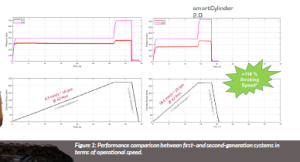
This improvement is particularly relevant in industrial contexts where cycle time directly impacts productivity. A comparison between first- and second-generation systems shows a clear, measurable increase in operational speed, especially under demanding conditions.
Validation activities have played a crucial role in confirming these advancements. The second-generation system has undergone extensive testing both in controlled environments and in real operational contexts at customer sites, using dedicated measurement systems and digital twin technology to validate performance through real-time virtual mirroring.
Structural advancements
One of the most significant developments concerns the structural reconfiguration of the amplification system.
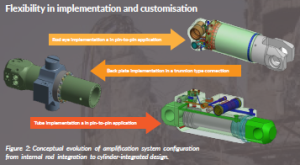
In the first-generation design, the pressure amplifier was integrated within the piston rod. While effective, this configuration introduced limitations in adaptability and installation flexibility.
The second-generation system introduces a redesigned architecture in which the amplification mechanism is integrated directly within the cylinder.
This change represents a major step forward, enabling:
- greater adaptability across different cylinder sizes
- improved compatibility with various machine configurations
- reduction of installation constraints
- increased design flexibility.
The new configuration also allows the system to be applied to both small and large cylinders, significantly expanding its potential use cases.
As a result of these improvements, the technology now exhibits key characteristics of a scalable industrial solution:
- modularity
- adaptability
- ease of integration
- scalability in size and performance.
This evolution marks the transition from a single-purpose component to a configurable system capable of meeting diverse industrial requirements.
Expanded applications
Originally developed for demolition equipment, the SmartCylinder technology has now been extended to a broader range of applications.
The initial focus on demolition provided a strong testing ground for validating the effectiveness of pressure amplification in high-demand scenarios. However, the improved flexibility and performance of the second-generation system have enabled its application in new industrial contexts.
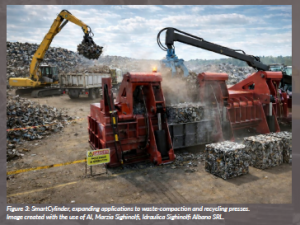
One of the most promising areas is represented by compaction presses, both for waste and other materials, where high-pressure peaks are required. More broadly, the system is now applicable to industrial sectors that demand intermittent high-pressure performance within compact systems.
A key advantage of the second-generation design is its ability to be implemented even in smaller cylinders while maintaining high performance. This opens new opportunities in applications where space constraints previously limited the use of pressure amplification technologies.
The expansion into new sectors demonstrates the versatility of the system and reinforces its potential as a multi-application platform.
Industrial impact
The evolution of the SmartCylinder has generated significant benefits from both an industrial and environmental perspective.
From a production standpoint, simplifying hydraulic components improves manufacturability and reduces system complexity, thereby lowering costs.
A particularly relevant element is represented by the life cycle assessment (LCA), reviewed by TÜV SÜD. The study highlighted that the use phase accounts for by far the most impactful stage in the cylinder’s life cycle, representing the majority of overall energy consumption and associated emissions.
Based on these findings, the second-generation technological developments have been strategically focused on optimising this phase, with the aim of reducing energy consumption and emissions.
Preliminary assessments indicate a substantial reduction in energy demand during operation, with a corresponding decrease in CO₂ emissions compared to conventional hydraulic systems.
From an environmental standpoint, the improved efficiency of the system results in lower energy consumption, contributing to reduced CO₂ emissions. This aligns with European sustainability objectives and supports the transition toward more environmentally responsible industrial processes.
An additional advantage is related to safety: managing high pressure internally within the cylinder reduces the need for external high-pressure components, thereby lowering the risk of leaks and failures.
These factors, combined with the system’s increased efficiency and adaptability, have already generated strong industrial interest, confirming the technology’s strong potential across multiple industrial sectors.
Conclusion and outlook
The second-generation development of the SmartCylinder marks a significant step forward in the evolution of hydraulic systems.
What began as a targeted innovation for demolition applications has evolved into a scalable, adaptable industrial platform capable of addressing a wide range of industrial needs.
The system delivers:
- increased performance
- higher operational speed
- improved energy efficiency
- reduced consumption
- enhanced safety
- greater adaptability.
Looking ahead, further developments are planned, including the integration of oil regeneration systems to further improve efficiency and sustainability.
This ongoing evolution confirms the technology’s potential not only as an innovative component but also as a flexible platform for future industrial applications.
PROJECT SUMMARY
LIFE PowerCylinder aims to demonstrate lower emissions and higher efficiency through innovative, downscaled hydraulic systems in demolition machinery. The project will develop and test 6 demolition attachments fitted with hydraulic cartridge pressure amplifiers. It aims to reduce energy consumption, cut CO₂ emissions and improve performance, contributing to a more sustainable and efficient construction sector.
PROJECT PARTNERS
The LIFE PowerCylinder project brings together PistonPower s.r.o., Idraulica Sighinolfi Albano S.r.l. and Mantovanibenne S.r.l.. PistonPower s.r.o., a Slovakian company specialising in hydraulic systems, contributes its expertise in developing innovative solutions. Mantovanibenne S.r.l., an Italian firm renowned for manufacturing demolition attachments, provides advanced equipment design and production capabilities.
PROJECT LEAD PROFILE
Idraulica Sighinolfi Albano S.r.l., an Italian company with a rich history in producing high-quality hydraulic cylinders, leads the LIFE PowerCylinder project. Its extensive experience and commitment to innovation drive the project’s goal of enhancing efficiency and reducing emissions in demolition machinery through the development of advanced hydraulic systems.
PROJECT CONTACTS
Mr Marco Sighinolfi, Project Manager Idraulica Sighinolfi Albano S.r.l.
Via Provinciale Ovest 100, 41015 Nonantola, Italy
Email: m.sighinolfi@sighinolfi.it
Web: https://www.sighinolfi.it/it/life-power-cylinder.php
LinkedIn: linkedin.com/in/marco-sighinolfi
FUNDING
The LIFE PowerCylinder project has received funding from the LIFE programme of the European Union under grant agreement No. LIFE20 ENV/ SK/000392.
Figure legends
Figure 1: Performance comparison between first- and second-generation systems in terms of operational speed.
Figure 2: Conceptual evolution of amplification system configuration from internal rod integration to cylinder-integrated design.
Figure 3: SmartCylinder, expanding applications to waste‑compaction and recycling presses. Image created with the use of AI, Marzia Sighinolfi, Idraulica Sighinolfi Albano SRL.