
The ageing of society: a health problem that requires quality research interventions to rejuvenate tissue resident stem cells might offer new, important therapeutic avenues. New mechanistic data provided in Mejia-Ramirez et al. (2026) pave the way.
In Western countries, the population aged over 60 will have doubled by 2050, as the World Health Organization has pointed out in their 2025 update. This will lead to an increase in the overall number of patients suffering from ageing-related diseases, since ageing is the main risk factor for cancer, dementia and cardiovascular syndromes (López-Otín et al., 2023). This situation will represent a huge economic burden in many countries, leading to the collapse of health and economic systems. To tackle this, we need quality biomedical research to design treatments that slow down or ameliorate the negative effects of ageing on health, regardless of aesthetic or cosmetic criteria.
Ageing is defined as the deterioration of function over time in an adult organism. Definitive biomarkers for quantifying biological ageing are still under debate, and experts have worked for decades to define specific hallmarks of ageing (López-Otín et al., 2023). Focusing on biological processes and functions that are declining over time, scientists have proposed that a hallmark of ageing should comprise of the following 3 characteristics: 1) time-dependent appearance of deterioration; 2) the possibility of experimentally accelerating the ageing process; and 3) the chance to decelerate, pause or reverse the deterioration by therapeutic treatments on that hallmark (López-Otín et al., 2023). Based on these criteria, there are hallmarks of ageing related to genomic and epigenetic mechanisms, cellular senescence, metabolic regulation, stem cell biology, cell communication, and inflammation, among others, and all of them are interconnected (Mejía-Ramírez and Florian, 2020).
Identifying targets for rejuvenation related to specific hallmarks is the major focus of the work in many scientific laboratories right now. Our lab is focusing on rejuvenation strategies targeting adult stem cells because reverting stem cells to a younger state makes them more capable of regenerating the tissue they belong to and ultimately improves the function of the organism.
Among the different types of adult stem cells, haematopoietic stem cells are responsible for the vital function of continuously producing all types of blood cells: red blood cells (oxygen transporters), megakaryocytes (future platelets) and white blood cells (immune cells, lymphocytes, and macrophages). Haematopoietic stem cells reside in the bone marrow, a highly dynamic and specialised tissue within the cavity of long bones. Haematopoietic stem cell ageing is a main driver of systemic ageing and has been linked to immunosenescence and chronic low-grade inflammation, as well as to several chronic diseases, including cardiovascular and kidney diseases, leukaemia, ulcerative colitis, intestinal inflammation, and neurodegenerative diseases. Our team has provided proof-of-concept data and highlighted the relevance of targeting blood stem cells to prevent or delay ageing of the whole body, suggesting strategies to extend health and lifespan (Andersson, Mejía-Ramírez and Florian, 2025).
Several interventions for stem cell rejuvenation have been proposed, mainly based on exercise, dietary restriction and heterochronic parabiosis (which means sharing blood circulation between a young and an old individual) (Brunet, Goodell and Rando, 2023; Matteini, Montserrat-Vazquez and Florian, 2024). Scientific and medical studies have clinically supported lifestyle changes that influence stem cells and the use of some pharmacological treatments that may qualify as anti-ageing because they help to improve the quality of life and prevent diseases, such as targeting senescent cells or autophagy (Matteini, Montserrat-Vazquez and Florian, 2024).
Our group has been working for more than a decade on investigating targets for the rejuvenation of aged haematopoietic stem cells. In 2022, the ReSinAge project, funded by the European Research Council (ERC), led to the development of a systemic approach for the in vivo administration of CASIN (Cdc42 Activity Specific Inhibitor) in mice. The results demonstrated that systemic treatment with CASIN, by rejuvenating haematopoietic stem cells, increased the average and maximum lifespan of aged mice (Montserrat-Vazquez et al., 2022).
Looking for other mechanisms suitable for intervention in haematopoietic stem cells, we have recently identified a new rejuvenation strategy: treating blood stem cells with the drug Rhosin, a small molecule inhibitor of the small RhoGTPase RhoA (Shang et al., 2012; Dandamudi et al., 2023), which our laboratory has found to be implied in nuclear mechanotransduction and to be highly activated in aged haematopoietic stem cells (Mejía-Ramírez et al., 2026).
Acting on the core of the ageing process: the nucleus of blood stem cells
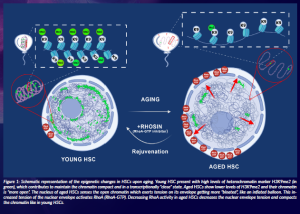
What is happening inside the nucleus of a stem cell upon ageing? In our new research article (Mejía-Ramírez et al., 2026), we reveal that the nucleus of haematopoietic stem cells loses epigenetic marks that keep the chromatin (the DNA, RNA and proteins within the nucleus) tightly wrapped (heterochromatin) upon ageing. Overall, the chromatin is more open, ultimately increasing mechanical tension on the membrane surrounding the nucleus (nuclear envelope). This, in turn, alters DNA transcription at genomic regions mainly enriched for repetitive elements or retrotransposons of the LINE 1 family and contributes to a rise in inflammatory signals and to stem cell functional deterioration. Our team has discovered the key role of RhoA in this process which is the signalling protein reacting to nuclear envelope mechanical changes in aged stem cells (Mejía-Ramírez et al.,
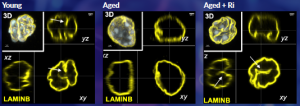
2026). Inhibition of RhoA overactivation by treatment with the small molecule inhibitor Rhosin (Shang et al, 2012) in aged haematopoietic stem cells proved to be a new rejuvenation strategy. We have observed an improvement in aged-related markers such as reduced nuclear tension, increased amount of heterochromatin and a closer chromatin pattern after only 16 hours of ex vivo treatment of aged stem cells with Rhosin. By transplanting ex vivo-treated aged stem cells into mice, we observe remarkable functional rejuvenation of the haematopoietic system: increased regenerative capacity of the bone marrow and improved production of blood cells and lymphocytes compared to untreated aged cells (Mejía-Ramírez et al., 2026).
To demonstrate the impact of Rhosin and RhoA inhibition on the nuclear envelope tension and for the remodelling of chromatin, our study involved multidisciplinary approaches, including the invaluable collaboration with Dr Paula Petrone’s team at the Barcelona Supercomputing Centre (Spain), who actively contributed to the understanding of the chromatin remodelling induced by Rhosin using innovative deep learning pipelines for image analyses. This computational approach has been decisive in demonstrating the rejuvenating effect of Rhosin and has further evolved into the development of a deep learning-based algorithm for evaluating chromatin organisation in stem cells (Picazo et al., 2025).
This project also relies on a long-term collaboration with Prof. Yi Zheng at Cincinnati Children Hospital Medical Center, (USA), who had previously developed and validated Rhosin as a sensitive and specific inhibitor of RhoA (Shang et al., 2012).
These promising results in animal models now pave the way for preclinical experiments to evaluate whether our findings can be translated to humans and whether RhoA-targeting treatment might offer a new strategy to improve the quality of life of the elderly.
References
Andersson, R., Mejía-Ramírez, E. and Florian, M.C. (2025) ‘Haematopoietic ageing in health and lifespan’, Nature Cell Biology, 27(9), pp. 1398–1410. Available at: https://doi.org/10.1038/s41556-025-01739-1.
Brunet, A., Goodell, M.A. and Rando, T.A. (2023) ‘Ageing and rejuvenation of tissue stem cells and their niches’, Nature Reviews Molecular Cell Biology, 24(1), pp. 45–62. Available at: https://doi.org/10.1038/s41580-022-00510-w.
Dandamudi, A. et al. (2023) ‘Structure–Activity Relationship Analysis of Rhosin, a RhoA GTPase Inhibitor, Reveals a New Class of Antiplatelet Agents’, International Journal of Molecular Sciences, 24(4). Available at: https://doi.org/10.3390/ijms24044167.
López-Otín, C. et al. (2023) ‘Hallmarks of aging: An expanding universe’, Cell, 186(2), pp. 243–278. Available at: https://doi.org/10.1016/j.cell.2022.11.001.
Matteini, F., Montserrat-Vazquez, S. and Florian, M.C. (2024) ‘Rejuvenating aged stem cells: therapeutic strategies to extend health and lifespan’, FEBS Letters, 598(22), pp. 2776–2787. Available at: https://doi.org/10.1002/1873-3468.14865.
Mejía-Ramírez, E. and Florian, M.C. (2020) ‘Understanding intrinsic hematopoietic stem cell aging’, Haematologica, 105(1), pp. 22–37. Available at: https://doi.org/10.3324/haematol.2018.211342.
Mejía-Ramírez, E. et al. (2026) ‘Targeting RhoA nuclear mechanoactivity rejuvenates aged hematopoietic stem cells’, Nature Aging, pp. 1–20. Available at: https://doi.org/10.1038/s43587-025-01014-w.
Montserrat-Vazquez, S. et al. (2022) ‘Transplanting rejuvenated blood stem cells extends lifespan of aged immunocompromised mice’, npj Regenerative Medicine, 7, 78. Available at: https://doi.org/10.1038/s41536-022-00275-y.
Picazo, P.I. et al. (2025) ‘Deep learning predicts haematopoietic stem cell ageing from 3D chromatin images’, bioRxiv, p. 2025.12.11.693143. Available at: https://doi.org/10.64898/2025.12.11.693143.
Shang, X. et al. (2012) ‘Rational design of small molecule inhibitors targeting RhoA subfamily Rho GTPases’, Chemistry and Biology, 19(6), pp. 699–710. Available at: https://doi.org/10.1016/j.chembiol.2012.05.009.
Figure Legend
Figure1. Schematic representation of the epigenetic changes in HSCs upon aging. Young HSC present with high levels of heterochromatin marker H3K9me2 (in
green), which contributes to maintain the chromatin compact and in a transcriptionally ”close” state. Aged HSCs show lower levels of H3K9me2 and their chromatin
is “more open”. The nucleus of aged HSCs senses the open chromatin which exerts tension on its envelope getting more “bloated”, like an inflated balloon. This increased tension of the nuclear envelope activates RhoA (RhoA-GTP). Decreasing RhoA activity in aged HSCs decreases the nuclear envelope tension and compacts
the chromatin like in young HSCs.
PROJECT SUMMARY
Elderly cancer patients suffer high haematopoietic toxicity upon chemotherapy. ReSinAge aims to boost haematopoietic recovery and increase the survival after chemotherapy in the elderly by improving the regenerative capacity of the aged haematopoietic stem cell niche. In detail, we aim to disclose the functional interplay between blood stem cells and their niche, and its targeting as an innovative strategy to overcome chemotherapy toxicity and increase the survival of elderly cancer patients.
PROJECT PARTNERS
Francesca Matteini, Alba Ferrer-Perez,
Sara Montserrat-Vazquez,
Dina El Jaramany, Javier Lozano-Bartolomé, Eva Mejia-Ramirez, Maria Carolina Florian,
IDIBELL Roshana Thambyrajah, Jessica Gonzalez,
Patricia Herrero Molinero, Anna Bigas, IMIM
Sascha Jung, CIC bioGUNE
Antonio Del Sol, University of Luxembourg
PROJECT LEAD PROFILE
Dr Florian started her independent career focusing on stem cell ageing as Emmy Noether (DFG) junior group leader at the Institute of Molecular Medicine, University of Ulm (Ulm, Germany) in 2016. At the end of 2018, she was appointed by the Programme for the Clinical Translation of Regenerative Medicine in Catalonia (P-CMRC) and the Programme of Regenerative Medicine at IDIBELL (Barcelona, Spain). In 2023, she became an ICREA Research Professor (ICREA). Dr Florian’s lab focuses on understanding cellular and molecular mechanisms of somatic stem cell ageing, supporting the development of new therapeutic strategies to preserve the regenerative capacity of stem cells over time and to limit or prevent the development of age-related disorders and extend healthspan and lifespan.
PROJECT CONTACTS
Dr M. Carolina Florian
ICREA Research Professor (Group Leader) Stem Cell Ageing,
Regenerative Medicine, IDIBELL
Email: mflorian@idibell.cat
Web: https://p-cmrc.cat/research/florian-group
Web: https://idibell.cat/en/research/regenerative-medicine-area/regenerative-medicine-program/stem-cell-aging/
ICREA: /maria-carolina-florian/
LinkedIn: /in/m-carolina-florian-666bb783
Orcid: orcid.org/0000-0002-5791-1310
FUNDING
This project has received funding from the European Research Council (ERC) under the European Union’s Horizon 2020 research and innovation programme. Grant agreement No. 101002453.
Views and opinions expressed are, however, those of the author(s) only and do not necessarily reflect those of the European Union or the ERC. Neither the European Union nor the granting authority can be held responsible for them.