

Félix Brokering Pinilla
About me
My name is Félix Brokering Pinilla, and I come from Chile. It is there, at the University of Chile in Santiago, that I did all of my training prior to my PhD studies. I obtained a bachelor’s degree in mathematical engineering in 2023 and a master’s degree in mathematics in 2024, both under the supervision of Sebastián Donoso and Rodolfo Gutiérrez-Romo. Since September 2025, I’ve been at the University of Bristol conducting a PhD with Ben Krause.
My research interests lie in topological dynamics and ergodic theory, particularly in the topological and measurable structure of dynamical systems and how it relates to the behaviour of ergodic averages. I am especially fascinated by the intersection of ergodic theory, topological dynamics, harmonic analysis, number theory, and additive combinatorics. My primary research objective at Bristol is to leverage hard-analytic tools to obtain quantitative estimates for the convergence of ergodic averages and to apply these insights to address questions in recurrence and additive combinatorics.
Introduction to ergodic averages
Given a measure preserving system ( 𝑋, µ, 𝑇 ) and a measurable function 𝑓 on 𝑋, the main object of interest is the convergence of the ergodic averages (for a complete picture of the state of the art, see Eisner and Farkas, 2025).

Addressing 𝐿²-convergence is a reasonably simple task as one can show that

and it is not too hard to see that the averages (1) converge in 𝐿² in both parts of the orthogonal decomposition. Moreover, one can identify the limit as the orthogonal projection onto the first part of the decomposition, which is just ∫ 𝑓𝑑 µ when ( 𝑋, µ, 𝑇 ) is ergodic.
On the other side of things, the pointwise almost everywhere convergence of (1) is significantly more delicate. For starters, without boundedness assumptions, it is now not immediately true that the averages converge pointwise for functions of the form 𝑔 𝑇 𝑔 with 𝑔 ∈ 𝐿² (µ). Moreover, even when restricting to

where one has almost sure convergence, it is not straightforward to lift this result to

let alone the entirety of 𝐿² (µ) or 𝐿¹ (µ). What’s missing is quantitative input on how big the averages can get. Concretely, one needs to bound the maximal function
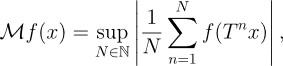
which can be achieved by either leveraging a result in the theory of operator semigroups, or by transferring the problem to the integer model ( ℕ, 𝑛 ↦ 𝑛 + 1, | · | ) and invoking a Vitali-type covering argument. See Krause (2022, Chapter 3) for both approaches.
In summary, although the pointwise almost sure convergence of (1) requires some more intricate work than the 𝐿²convergence, we have a complete picture regarding their behaviour.
Theorem 1. Let ( 𝑋, µ, 𝑇 ) be a measure preserving system.
(1) The averages (1) converge in 𝐿² for every 𝑓∈ 𝐿² (µ) (von Neumann, 1932).
(2) The averages (1) converge pointwise almost everywhere for every 𝑓 ∈ 𝐿¹ (µ) (Birkhoff, 1931).
In both cases, if ( 𝑋, µ, 𝑇 ) is ergodic, the limit of the averages is ∫𝑓𝑑µ.
Weighted ergodic averages
Among the many extensions of the averages (1), the weighted ergodic averages are naturally interesting.
(2)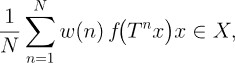
Where 𝑤: ℕ → ℂ is some weight. For instance, taking the Von Mangoldt function

one can recover the ergodic averages over the set of primes ℙ,

which were shown to converge in Wierdl (1988). If, instead, one takes the Möbius function

the behaviour of the corresponding averages
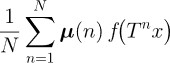
is an important question in modern number theory (see Ferenczi, Kułaga‑Przymus and Lemańczyk, 2018; Kułaga‑Przymus and Lemańczyk, 2020).
For weighted ergodic averages the ordeal is once again more or less simple in the 𝐿²-setting, where we have the following characterisation.
Theorem 2. Let 𝑤: ℕ → ℂ be a bounded weight. The following are equivalent.
(I) For every measure preserving system ( 𝑋, µ, 𝑇 ) and any 𝑓 ∈ 𝐿² (µ) the averages (2) converge in 𝐿².
(II) For every 𝛽 ∈ 𝕋, the averages
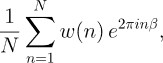
converge in 𝕋.
In the case of pointwise convergence, determining whether or not a weight function 𝑤 is𝐿¹-good, this is, whether or not for every measure preserving system ( 𝑋, µ, 𝑇 ) and any 𝑓 ∈ 𝐿¹ (µ) the averages (2) converge pointwise almost everywhere, is a considerably harder question. Since by the dominated convergence theorem pointwise convergence implies convergence in 𝐿², it is immediate that condition (II) above is necessary for a weight to be 𝐿¹-good. That said, such a condition is far from sufficient, and we actually require uniform quantitative estimates on the rate of convergence.
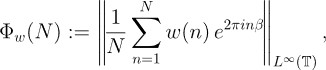
Concretely, if given a weight 𝑤: ℕ → ℂ we let
it can be shown that:
Theorem 3. Let 𝑤: ℕ → ℂ be a bounded weight. Suppose there exists η > 0 and a constant 𝐶 > 0, such that
(3)
for every 𝑁 ≥ 1. Then 𝑤 is 𝐿¹-good. Moreover, the limit is always 0.
The case η > 1 involves a standard square function argument over lacunary times (El Abdalaoui et al., 2017) and η > ½ is just a refinement thereof (Fan, 2019). Getting all the way down to η > 0 requires building on the entropy methods developed by Bourgain in his treatise on double recurrence (Bourgain, 1990) and is addressed in upcoming work by Ben Krause and myself, where we aim to do better than logarithmic decay.
We are also in the process of showing that not just any decay will suffice. Based on an example proposed by Bourgain in unpublished work (Bourgain, 1988a), we are currently working on constructing a weight  , that is not 𝐿¹-good, but such that
  exhibits fast decay. In ongoing work, we are optimising both this construction and the entropy arguments mentioned previously to simultaneously make the decay of
  as fast as possible and loosening the decay condition (3) as much as we can, with the objective of finding a sharp boundary separating 𝐿¹-good weights from those that are not 𝐿¹-good.
Return times, recurrence and times of optimal recurrence
As an application of the aforementioned, we are looking at refinements of Bourgain’s Return Times Theorem presented below.
Theorem 4 (Bourgain, 1988; Bourgain et al., 1989). Let ( 𝑋, µ, 𝑇 ) be a measure preserving system and let 𝑓 ∈ 𝐿∞ (µ). Then, there exists a set 𝑋𝑓 ⊆ 𝑋 with µ ( 𝑋𝑓 ) = 1, such that for every 𝑥 ∈ 𝑋𝑓 the weight

is 𝐿¹-good.
In particular, if we take a measurable set 𝐴 ⊆ 𝑋, a point x ∈ A and consider the set of return times of 𝑥 to 𝐴

then by putting 𝑓 = 𝟙𝐴 in the preceding theorem and noticing that 𝑓(𝑇𝑛𝑥) = 𝟙 𝒩(𝑥,𝐴) (𝑛), we get the following corollary.
Corollary. Let ( 𝑋, µ, 𝑇 ) be a measure preserving system and let 𝐴 ⊆ 𝑋 be a measurable set. Then, for µ-almost every 𝑥 ∈ 𝐴 the weight
𝑤 (𝑛) = 𝟙 𝒩(𝑥,𝐴) (𝑛)
𝐿¹-good.
One interpretation of the above, is that return times possess enough dynamic strength to guarantee pointwise convergence of ergodic averages. There is an immediate way to extend this idea to the concept of recurrence. If 𝑋 is a topological space, µ is a Borel measure, 𝑥 lies in the support of µ and 𝐴 is an open set containing 𝑥, then any time that 𝑥 returns to 𝐴, 𝐴 returns to itself with positive measure, i.e.

It is therefore an interesting question to ask whether the weight
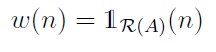
is 𝐿¹-good. By Poincaré’s Recurrence Theorem, the set of recurrence times 𝓡(𝐴) is always non-empty (and in fact infinite) whenever 𝐴 is a measurable set of positive measure, so the question above makes sense even without an underlying topological structure. That said, by taking 𝑓1 one sees that a necessary condition for 𝑤 to be 𝐿¹-good is that 𝓡(𝐴) admits a natural density, which is not always the case, even for ergodic systems. A refinement of the question is then:
Question 1. Is it true that for every weakly mixing measure preserving system ( 𝑋, µ, 𝑇 ) and every 𝐴 ⊆ 𝑋 the weight
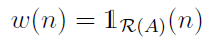
is 𝐿¹-good?
We believe that we can leverage Theorem 2 to give an affirmative answer to Question 1 when the system ( 𝑋, µ, 𝑇 ) giving rise to 𝓡(𝐴) has logarithmic mixing rates; this is, if there exist η, 𝐶 > 0, such that for every 𝑓, 𝑔 ∈ 𝐿¹ (µ) and every 𝑛 ∈ ℕ

We also expect our tools to let us handle times of optimal recurrence, defined for a subset 𝐴 ⊆ 𝑋 and ε > 0 as

By a theorem of Khintchine, 𝒦𝜀 (𝐴) is non-empty and in fact syndetic when µ (𝐴) > 0. Theorem 2 would again yield a positive answer to the logarithmic mixing case of the following question.
Question 2. Is it true that for every weakly mixing measure preserving system ( 𝑋, µ, 𝑇 ), every 𝐴 ⊆ 𝑋 and every ε > 0 the weight
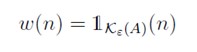
is 𝐿¹-good?
Two drawbacks of the weights proposed in Question 1 and Question 2 is that they are quite rough and require some mixing to make sense. A perhaps natural way to both make them smoother and get rid of mixing assumptions is to consider the correlation sequence itself and wonder about the weights

And

Using Walsh’s Theorem, one can show that ergodic averages weighted by (𝑤 (𝑛))𝑛 ∈ ℕ always converge in 𝐿²; see Host and Kra, (2018, Chapter 23). Leveraging a generalisation of the Wiener-Wintner Theorem due to Host and Kra (2009), one can show that they are even 𝐿¹-good. We anticipate our methods to let us tackle particular cases of the following question.
Question 3. Is the weight (𝑢 (𝑛))𝑛 ∈ ℕ defined above 𝐿¹-good?
References
Birkhoff, G.D. (1931) ‘Proof of the ergodic theorem’, Proceedings of the National Academy of Sciences, 17(12), pp. 656–660. Available at: https://doi.org/10.1073/pnas.17.12.656.
Bourgain, J. (1988a) Return times of dynamical systems. Unpublished manuscript.
Bourgain, J. (1988b) ‘Temps de retour pour les systèmes dynamiques’, Comptes Rendus de l’Académie des Sciences de Paris, Série I, Mathématique, 306(12), pp. 483–485.
Bourgain, J. et al. (1989) ‘Appendix on return‑time sequences’, in Publications Mathématiques de l’IHÉS, 69, pp. 42–45. Available at: https://www.numdam.org/item/PMIHES_1989__69__42_0/.
Bourgain, J. (1990) ‘Double recurrence and almost sure convergence’, Journal für die reine und angewandte Mathematik, 404, pp. 140–161. Available at: https://doi.org/10.1515/crll.1990.404.140.
Eisner, T. and Farkas, B. (2025) A journey through ergodic theorems. Birkhäuser.
El Abdalaoui, E.H. et al. (2017) ‘The Chowla and the Sarnak conjectures from ergodic theory point of view’, Discrete and Continuous Dynamical Systems, 37(6), pp. 2899–2944. Available at: https://doi.org/10.3934/dcds.2017125.
Fan, A.-H. (2019) ‘Weighted Birkhoff ergodic theorem with oscillating weights’, Ergodic Theory and Dynamical Systems, 39(5), pp. 1275–1289. Available at: https://doi.org/10.1017/etds.2017.81.
Ferenczi, S., Kułaga‑Przymus, J. and Lemańczyk, M. (2018) ‘Sarnak’s conjecture: what’s new’, in Ergodic theory and dynamical systems in their interactions with arithmetics and combinatorics. Lecture Notes in Mathematics, vol. 2213. Springer, pp. 163–235.
Host, B. and Kra, B. (2009) ‘Uniformity seminorms on ℓ∞ and applications’, Journal d’Analyse Mathématique, 108, pp. 219–276. Available at: https://doi.org/10.1007/s11854‑009‑0024‑1.
Host, B. and Kra, B. (2018) Nilpotent structures in ergodic theory. Mathematical Surveys and Monographs, vol. 236. American Mathematical Society, pp. x+427. Available at: https://doi.org/10.1090/surv/236.
Krause, B. (2022) Discrete analogues in harmonic analysis: Bourgain, Stein, and beyond. Graduate Studies in Mathematics, vol. 224. American Mathematical Society, pp. xxvi+563. Available at: https://doi.org/10.1090/gsm/224.
Kułaga‑Przymus, J. and Lemańczyk, M. (2020) ‘Sarnak’s conjecture from the ergodic theory point of view’, Encyclopedia of Complexity and Systems Science. Available at: https://doi.org/10.1007/978-3-642-27737-5_735-1.
von Neumann, J. (1932) ‘Proof of the quasi‑ergodic hypothesis’, Proceedings of the National Academy of Sciences of the United States of America, 18(1), pp. 70–82. Available at: https://doi.org/10.1073/pnas.18.1.70.
Wierdl, M. (1988) ‘Pointwise ergodic theorem along the prime numbers’, Israel Journal of Mathematics, 64(3), pp. 315–336. Available at: https://doi.org/10.1007/BF02882425.
Quantitative convergence of weighted ergodic averages
PROJECT SUMMARY
We investigate quantitative conditions on a sequence of weights to ensure pointwise convergence of the corresponding weighted ergodic averages. We provide concrete uniform decay rates in Fourier space that guarantee convergence, construct a counterexample at the boundary and propose applications.
PROJECT PARTNERS
Ben Krause
PROJECT LEAD PROFILE
Félix started his PhD studies at the University of Bristol in September 2025 under the guidance of Ben Krause. Before that, he studied at the University of Chile under Sebastián Donoso and Rodolfo Gutierrez-Romo. Félix is interested in harmonic analysis, the topological and measurable structure of dynamical systems, and how they relate to the behaviour of ergodic averages.
PROJECT CONTACTS
Félix Brokering Pinilla
Department of Mathematics, University of Bristol, Beacon House, Queens Rd, Bristol BS8 1QU
Email: felix.brokeringpinilla@bristol.ac.uk
FUNDING
This project has been funded by UK Research and Innovation (UKRI) under the European Union’s Horizon Europe Guarantee programme (Grant agreement No. EP/Y007336/1).
Views and opinions expressed are however those of the author(s) only and do not necessarily reflect those of the European Union or UKRI. Neither the European Union nor the granting authority can be held responsible for them.