
Loizos Georgiou, RTD TALOS Ltd
As electric vehicles become a defining symbol of Europe’s green transition, attention is increasingly turning to the electric traction motor, the technology that converts electrical energy into motion. While today’s leading designs deliver impressive efficiency and compact performance, many still depend heavily on rare-earth permanent magnets, raising concerns around critical raw materials, supply resilience, and end-of-life recycling.
This is the challenge at the heart of VOLTCAR, the EU-funded Horizon Europe project developing a next-generation electric traction motor for passenger cars and light commercial vehicles.
VOLTCAR is rethinking the electric traction motor as a system that must be efficient, compact, manufacturable, digitally optimised, and far more compatible with Europe’s circular economy ambitions. Now, as the project enters a more advanced phase, it is moving beyond design studies into more tangible activities: prototype assembly, high-speed validation, circularity testing, and full-system demonstration planning.
Compact performance with ambitious targets
VOLTCAR targets a motor with 7 kW/kg specific power and more than 23 kW/l power density, with a continuous-rated power of 120 kW and a peak power above 200 kW. The final motor is designed to remain below 17.14 kg, including housing, and under 5.2 litres in volume, figures that place it firmly among the more ambitious compact traction motor concepts currently under development.
The project follows a staged approach, with an intermediate 50 kW motor platform developed to validate key technologies ahead of the final 120 kW demonstrator. The latter is designed as a high-speed radial-flux machine with 800 V operation, direct liquid cooling, and integration with both a gearbox and an inverter.
The VOLTCAR motor is designed around a high-speed operating strategy. In electric machines, size and mass are closely linked to torque, so reducing the rated torque is one of the most effective ways to reduce the overall size of the machine. To maintain the required power, however, the rotational speed must increase. That is why the VOLTCAR concept is built around a rated speed of 12 000 rpm, with operation extending to 30 000 rpm and tolerance up to 36 000 rpm during acceptance testing. This high-speed approach is central to achieving the project’s compactness and power-density targets and represents a significant step beyond the speed range of many conventional EV traction motors.
A design refined by practical engineering
One of the most revealing aspects of VOLTCAR is that the motor architecture has evolved as the project has progressed. The original concept focused on a permanent-magnet-assisted synchronous reluctance motor (PMaSynRM), selected for its potential to minimise the use of rare-earth permanent magnets. However, as the design matured, it became clear that practical constraints in materials and manufacturability required a different motor concept than originally planned and a somewhat higher use of permanent magnet material to meet the performance targets.
The result was a refined architecture: a reluctance-torque-assisted permanent-magnet synchronous machine (RTaPMSM). Rather than weakening the concept, this evolution reflects the realities of advanced motor development, where ambitious targets must ultimately be balanced with manufacturability, material constraints, and industrial relevance.
Promising progress in prototypes and testing
VOLTCAR has now moved firmly into the prototyping and validation phase, and the progress to date is encouraging.
On the 50 kW platform, 2 motors are already ready, while work continues with the third and fourth assemblies. Testing of the 50 kW motors has begun, including ongoing back-to-back measurements and work on cooling system requirements, providing valuable data for both performance validation and thermal management refinement.
At the same time, one of the project’s most important validation milestones has already been achieved: spin tests of both the 50 kW and 120 kW rotors have been completed successfully. This is particularly significant for a motor concept built around high rotational speed. During spin testing lasting up to 350 hours, both rotor designs successfully completed up to 20 000 cycles across a speed range of 5000–36 000 rpm.
Taken together, these results suggest that the project is making solid progress not only in design but also in the kind of practical validation that will ultimately determine industrial relevance.
Thermal management and vibro-acoustics as enabling technologies
Achieving high specific power in such a compact motor depends heavily on 2 critical engineering areas: cooling and noise/vibration behaviour.
VOLTCAR addresses thermal performance through direct oil cooling, targeting the stator conductors, hollow rotor shaft, and bearings. The project has also refined the external cooling circuit, moving from simplified design models to more realistic component-based approaches, and evaluating multiple circuit configurations.
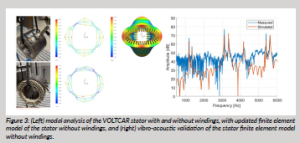
To better understand the structural dynamic behaviour of the motor, the VOLTCAR team has conducted modal and vibro-acoustic measurements on the stator, both with and without windings. Modal analysis helps identify how the structure vibrates and determines its natural frequencies, for assessing noise, vibration, and durability.
The modal results reveal that adding the windings results in a slight reduction in the natural frequency of the first 2 modes, while the high-frequency vibrations are damped. This is consistent with expectations, as the windings introduce additional mass and damping.
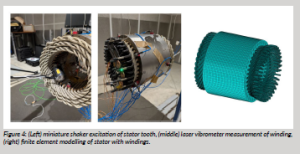
In addition, vibration measurements of the winding base and tips have been carried out (Figure 4) to support and validate the finite element modelling of the stator with windings for fatigue assessment. Further vibro-acoustic measurements and model updates are continuing, helping to strengthen the correlation between simulation and experimental behaviour as the motor design matures.
Circularity built into the motor concept
The project’s ecodesign approach aims to reduce permanent magnet use while improving the ability to reuse, repurpose, and recycle motor materials. Magnets can be reused directly in existing or new motor designs where possible, or their materials can be recovered and remanufactured when direct reuse is not feasible. This includes work on magnet encapsulation, intact magnet removal, and magnet-to-magnet recycling. Future EV sustainability will depend not only on reducing material use, but also on recovering and reusing the valuable materials already embedded in existing drivetrains.
A project with strong potential impact
VOLTCAR’s significance extends well beyond a single demonstrator. The project is contributing to more standardised life cycle assessment (LCA) approaches for traction motors, while advancing practical circularity strategies such as direct magnet reuse and magnet recovery for remanufacturing, including blending with virgin material where needed. It also demonstrates 2 motor designs and one inverter, supported by digital motor-design tools that can reduce development effort and accelerate optimisation.
Crucially, VOLTCAR addresses one of the key trade-offs in future e-mobility: how to combine low mass, high efficiency, and reduced dependence on critical raw materials. If the concept proves successful at scale, the expected benefits are substantial. By combining higher efficiency with lower material use, the project estimates a reduction of 74 kg CO₂eq per motor unit, with a potential cumulative impact of around 582 tonnes CO₂eq by 2030 under mass-production conditions.
Looking ahead
VOLTCAR is still progressing toward its final demonstration phase, but the results so far are promising. Prototype development is advancing, key subsystems are being tested, high-speed rotor validation has been completed successfully, and the project is combining compact motor design, advanced cooling, digital development tools, and practical circularity strategies in a way that is both technically ambitious and industrially relevant.
If the project continues its current trajectory, VOLTCAR could become an important reference point for the next generation of European electric propulsion, showing that future traction motors can be not only powerful and efficient, but also more circular, more resource-conscious, and better prepared for large-scale deployment.
PROJECT SUMMARY
The EU-funded VOLTCAR project develops next-generation electric traction motors with reduced rare earth dependence, high power density, and improved energy efficiency. Using advanced ecodesign, life cycle analyses, digital twins, and X-in-the-loop testing, VOLTCAR creates recyclable, cost-efficient 50 kW and 120 kW prototypes. The project strengthens Europe’s automotive competitiveness, fosters sustainability, and advances circular, low-carbon electromobility.
PROJECT PARTNERS
The VOLTCAR consortium unites 12 partners from 6 European countries, including leading industrial players and top research institutions. With expertise spanning motor design, materials, sustainability, and digitalisation, the consortium integrates strong SME contributions and academic excellence. This multidisciplinary collaboration ensures the successful development of innovative, circular electric traction motors while enhancing Europe’s competitiveness in sustainable mobility technologies.
PROJECT LEAD PROFILE
VTT Technical Research Centre of Finland is one of Europe’s leading applied research institutions, owned by the Finnish state. VTT drives sustainable growth by turning scientific research into practical solutions for industry and society. As VOLTCAR’s coordinator, VTT leads sustainability assessments, magnet circularity, and prototype validation, building on extensive experience in EU-funded research and innovation projects.
PROJECT CONTACTS
Dr Jenni Pippuri-Makelainen Project Coordinator
Email: jenni.pippuri-makelainen@vtt.fi
Web: https://voltcar-project.eu/
LinkedIn: /voltcar-project
X: @VoltcarProject
FUNDING
This project is funded by the European Union (Grant agreement No. 101096557).
Views and opinions, however, are those of the author(s) only and do not necessarily reflect those of the European Union or the European Climate, Infrastructure and Environment Executive Agency (CINEA). Neither the European Union nor the granting authority can be held responsible for them.
Figure legends
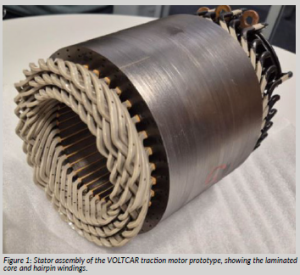
Figure 1: Stator assembly of the VOLTCAR traction motor prototype, showing the laminated core and hairpin windings.
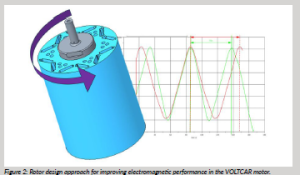
Figure 2: Rotor design approach for improving electromagnetic performance in the VOLTCAR motor.
Figure 3: (Left) modal analysis of the VOLTCAR stator with and without windings, with updated finite element model of the stator without windings, and (right) vibro-acoustic validation of the stator finite element model without windings.
Figure 4: (Left) miniature shaker excitation of stator tooth, (middle) laser vibrometer measurement of winding, (right) finite element modelling of stator with windings.