
The challenge of predictive maintenance
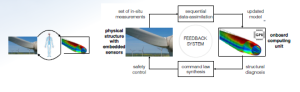
Structural health monitoring (SHM) and predictive maintenance from digital tools, as illustrated in Figure 1, have become a game-changing strategy in all industrial sectors that operate critical engineering structures (transport, energy, manufacturing, healthcare, defence, etc.) (Guemes et al., 2020). Out of enhanced reliability and safety aspects, it drastically reduces operational costs, increases operational performance, and sustains competitiveness by reducing unexpected downtimes and by optimising maintenance interventions.
Offshore wind turbines (OWT) are a typical illustration of the innovation potential of predictive maintenance. The steady increase of the OWT average power rating and rotor size, and severe operating conditions (high winds, wave-induced vibrations, sea corrosion, etc.) are conducive to failure due to the accumulation of fatigue damage. This fact, coupled with remote location, uncertain environment, and lack of feedback on the structural behaviour (e.g. ageing, OWT being quite a new technology), makes efficient monitoring and anticipated maintenance a key element of operating performance (Fox et al., 2022).
Nevertheless, the technical difficulties and the limited efficiency of available methods mean that, today, periodic maintenance is still performed on complex systems. Consequently, the richness of in situ data and physics-based models available on modern structures is not exploited to its full potential nowadays.
There are major limitations in performance and robustness in all current industrial approaches dedicated to monitoring large engineering structures throughout their life cycle. Among the most advanced approaches, based on digital twins fed by in situ data collected from sensors to track defects and avoid failure, many are purely data-driven, relying on the analysis of data alone through statistical methods or machine learning (AI) algorithms (Azimi, Eslamlou and Pekcan, 2020). Such black-box approaches, with no additional knowledge, have restricted capabilities. Due to a lack of explainability and interpretability, these approaches require a large and rich amount of data obtained from representative failure scenarios to perform the training. However, such data is rarely available in practice because data collection is expensive, datasets are always plagued with sensor noise or faults, and past failure data is inherently scarce, as failures are intentionally avoided. Therefore, validity is ensured only for restricted operational conditions that correspond to trained databases. Given the complexity and multiscale nature of detecting and analysing the impact of a local defect in a large structure, purely data-driven approaches become inaccurate and barely applicable for prediction and decision-making far from nominal operational regimes. (e.g. in the case of rare events such as exceptional loads).
Other approaches lean on physics-based modelling and simulation tools, with high-fidelity descriptions of involved phenomena (fatigue damage, crack propagation, etc.), which constitute a sharp prior knowledge developed over decades by researchers and engineers (Ritto and Rochinha, 2021). Even though those approaches have far better extrapolation properties for accidental scenarios, they are computationally very intensive and remain too constrained and rigid, requiring in-depth knowledge of the underlying physics. They are thus inappropriate for very complex structures with interacting components, changing and uncertain environments, and reactive control. Consequently, today there is no existing computer-based technology employed at the industrial level that provides sufficiently effective analysis, prediction, and decision support on the state of real-life engineering structures. This makes it difficult to conduct predictive maintenance on such systems—a critical task to enhance reliability, security, and performance.
Towards smart structures with augmented digital twinning
To fill the gap, the innovative concept we propose is a multifunctional computational platform that continuously integrates heterogeneous sensor data, physics-based modelling, AI algorithms, advanced numerical methods, and engineering know-how, for enhanced structural monitoring and decision support capabilities. It aims to produce a customised virtual twin that reliably mimics real structural behaviour and can seamlessly and dynamically interact with industrial assets in service for diagnosis, prognosis, appropriate command, and proactive maintenance purposes.
The platform connecting the physical asset to its digital replica will enable a relevant and fast assessment of structural health and remaining lifetime from a reduced amount of data; this will lead to anticipated actions that foster efficiency and durability, with potential extension of the equipment’s lifespan and operations within performance limits in degraded mode.
This way, prescriptive maintenance will be performed, going beyond predictive maintenance.
Moreover, the platform’s multifunctionality, integrating on-the-fly model enrichment and command synthesis capabilities, will support automatic monitoring procedures, opening new frontiers for next-generation autonomous self-aware systems.
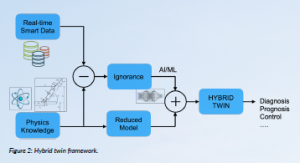
The platform is intended to accommodate real-time accuracy and robustness by promoting a so-called hybrid twinning (Chinesta et al., 2020), that is the combination of physics-based and data-driven approaches (Figure 2) to exploit at best all information available and optimise efficiency (e.g. resilience to overfitting and limited noisy data, or capability for interpretability and uncertainty propagation). It incorporates complementary functionalities embracing on-the-fly assimilation of large streams of noisy data, model updating and enrichment from data along the structure lifetime, as well as certified control law synthesis.
The overall technology relies on 2 key components: (i) in situ data collected from the structure and pre-processed; (ii) some physics-based models associated with dedicated simulation software. Their synergistic coupling and integration through the platform have the potential to go from smart materials to smart structures, able to perform online control of their health and take appropriate actions before downtime or failure occurs. This is recognised as one of the most challenging applications of simulation-based engineering sciences (Lake et al., 2017; Blasch et al., 2022; Moya et al., 2022).
Innovative scientific advances
The innovative methodology implemented in the proposed digital solution originates from the DREAM-ON project (2021–2026), whose objectives were to develop efficient numerical strategies for robust, real-time, and data-driven adaptive structural modelling for online control (Chamoin, 2021; Chamoin et al.,2025). Some key challenges were addressed from a scientific perspective, using cross-disciplinary and unconventional approaches embracing data science, advanced modelling and simulation techniques (such as model reduction or multiscale analysis (Bhattacharyya and Chamoin, 2025)), applied mathematics, computer science, and experimental mechanics.
In DREAM-ON, a radically new computational framework was introduced, leaning on information reliability, promoting the use of AI technologies augmented by physics fundamentals, and therefore yielding a hybrid twin with an optimised trade-off between the capabilities of data-based and physics-based tools. This way, focusing on composite specimens equipped with distributed optic fibre sensors (Chamoin, Farahbakhsh and Poncelet, 2022), a consistent and manageable digital strategy was designed by incorporating all ingredients from data acquisition up to state estimation, damage prediction, and safe command synthesis.
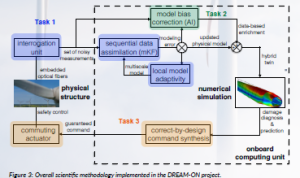
The key tasks of the DREAM-ON project were (see Figure 3): (i) the design of novel numerical approaches to perform real-time assimilation of noisy data in an uncertain environment (Farahbakhsh, Chamoin and Poncelet, 2026), together with strategies for model selection (Chamoin and Ladevèze, 2024; Nguyen and Chamoin, 2025) and optimal sensor placement (Pérez Orozco et al., 2025); (ii) reliable structural damage diagnosis and prognosis from a hybrid twin with data-based model enrichment, by learning model ignorance from physics-constrained AI tools (Benady, Baranger and Chamoin, 2024a, 2024b; Ladevèze and Chamoin, 2024, 2026); and (iii) on-the-fly certified command synthesis (Xavier, Chamoin and Fribourg, 2023, 2026). These approaches built on several unique computational strategies, encompassing cross-disciplinary tools and techniques such as bias-aware variational assimilation, Kalman filtering, model reduction, machine learning (e.g. neural networks), or model predictive control. The strategies were designed from the Constitutive Relation Error (CRE) concept, particularly suited to good prior physics knowledge and limited data.
First validation on a proof-of-concept
The resulting real-time feedback loop between a physical asset and its virtual representation, made possible through the DREAM-ON numerical developments, was successfully implemented and validated on a representative and original lab experiment, aiming to preserve the integrity of a specimen by monitoring its multi-axial mechanical loading. The idea was to make the structure remain in a safety region (operation at performance limits) for various instances of damage, e.g. by finding an optimal loading path encompassing damage conditions.
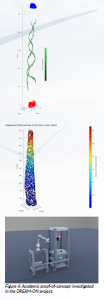
The experiment involved a reduced-size blade-shaped composite structure, subjected to multi-axial loading. We used a high-resolution optic-fibre measurement device based on Rayleigh backscattering (LUNA ODiSI 6108), sampled at a sensing rate of 250 Hz with 1.2 mm strain resolution, and a 6-actuator parallel-kinematic Stewart platform, both specifically purchased for DREAM-ON. We were able to show the feasibility of real-time monitoring and control of structural health, using separate numerical tools for data assimilation, mechanical state estimation and prediction, and control (Figure 4).
Exploring innovation potential towards industrial transfer
The scientific developments made in DREAM-ON, together with the gained scientific expertise, constitute the methodological core to be integrated in the computational platform.
Future work in an ERC-Proof-of-Concept (PoC) project called INCREASER will thus be dedicated to the full development of this platform, before its testing and validation on representative benchmarks and industrial use cases addressing OWT. The integration requires careful implementation and management of data, models, and algorithms to optimise performance when applied to complex industrial structures.
The aim is to progressively move from academic research to real-life application, testing feasibility in an industrial context with practical scenarios and increasing complexity, defining the path to make the ground-breaking research operational at scale, as well as exploring innovation potential and business opportunities.
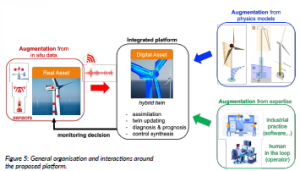
The platform architecture is to be designed in close collaboration with practical industrial constraints and requirements; in particular, the core of the platform will be made agnostic, interoperable, connectable to existing closed industrial software environments, and customisable to specific application needs (Figure 5). Integrating the platform into the industrial software chain will facilitate established internal certification procedures, practical use by operators, and the connection between research developments and commercial tools and applications. Access to the platform is expected to be made possible for commercial exploitation by licensing in the future, with expected end users for various engineering sectors.
In conclusion, the proposed solution is a unique technological asset, overcoming current limitations and answering challenges listed in (Nunes, Santos and Rocha, 2023). It does not follow purely data-driven trends, but instead proposes a principled framework where physical consistency, interpretability, robustness, and computational efficiency remain central objectives. This positioning significantly increases the long-term scientific value of the technology, which appears to be a key enabler for companies to implement reliable computer-based analysis and decision-making strategies, with direct socio-economic benefits.
The solution is also timely, supported by the emergence of connected cyber-physical systems equipped with integrated sensing technologies (e.g. wireless embedded sensor arrays), powerful communication solutions (IoT), as well as easily accessible (edge) computing facilities and AI tools. This is compatible with online monitoring and proactive maintenance.
The knowledge gained may also impact various engineering fields, from manufacturing to biomedicine (Figure 6), opening new opportunities for the design of modern smart-driven systems that adapt to evolving conditions (Lake et al., 2017), thus addressing challenges of operational efficiency, sustainability, and resilience in high-consequence decisions.
References
Azimi, M., Eslamlou, A.D. and Pekcan, G. (2020) ‘Data-driven structural health monitoring and damage detection through deep learning: state-of-the-art review’, Sensors, 20, 2778. Available at: https://doi.org/10.3390/s20102778.
Benady, A., Baranger, E. and Chamoin, L. (2024a) ‘NN-mCRE: a modified constitutive relation error framework for unsupervised learning of nonlinear state laws with physics-augmented neural networks’, International Journal for Numerical Methods in Engineering, 125(8), e7439. Available at: https://doi.org/10.1002/nme.7439.
Benady, A., Baranger, E. and Chamoin, L. (2024b) ‘Unsupervised learning of history-dependent constitutive material laws with thermodynamically-consistent neural networks in the modified Constitutive Relation Error framework’, Computer Methods in Applied Mechanics and Engineering, 425, 116967. Available at: https://doi.org/10.1016/j.cma.2024.116967.
Bhattacharyya, M. and Chamoin, L. (2026), ‘Effective reduced-order approximation for fast and robust mCRE-based parametric identification of nonlinear history-dependent material laws’, Computational Mechanics 78, 213-238. Available at: https://doi.org/10.1007/s00466-026-02754-1.
Blash, E.P et al. (eds) (2022) Handbook of Dynamic Data Driven Applications Systems, Springer
Chamoin, L. (2021) ‘DREAM-ON: Merging advanced sensing techniques and simulation tools for future SHM technologies’, The Project Repository Journal, 10, pp. 124–127.
Chamoin, L., Farahbakhsh, S. and Poncelet, M. (2022) ‘An educational review on distributed optic fiber sensing based on Rayleigh backscattering for damage tracking and structural health monitoring’, Measurement Science and Technology, 33, 124008. Available at: https://doi.org/10.1088/1361-6501/ac9152.
Chamoin, L. and Ladevèze, P. (2024) ‘Model verification, updating, and selection from the constitutive relation error concept’, Advances in Applied Mechanics, 59, pp. 311–362. Available at: https://doi.org/10.1016/bs.aams.2024.08.005.
Chamoin, L. et al. (2025) ‘A novel DDDAS architecture combining advanced sensing and simulation technologies for effective real-time structural health monitoring’, in E. Blasch, F. Darema and A. Aved (eds.) Handbook of Dynamic Data Driven Applications Aystems. Vol. 3. Springer, chap. 10. Available at: https://doi.org/10.1007/978-3-031-88574-7_10.
Chinesta, F. et al. (2020) ‘Virtual, digital and hybrid twins: a new paradigm in data-based engineering and engineered data’, Archives of Computational Methods in Engineering, 27(1), pp. 105–134. Available at: https://doi.org/10.1007/s11831-018-9301-4.
Farahbakhsh, S., Chamoin, L. and Poncelet, M. (2026) ‘Continuous structural health monitoring with a modified dual Kalman filter applied with optical fiber sensing data’, Computers & Structures, 329, 108284. Available at: https://doi.org/10.1016/j.compstruc.2026.108284.
Fox, H. et al. (2022), ‘A review of predictive and prescriptive offshore wind farm operation and maintenance’, Energies, 15(2), 504. Available at: https://doi.org/10.3390/en15020504.
Guemes, A. et al. (2020) ‘Structural health monitoring for advanced composite structures: a review’, Journal of Composites Science, 4(1), 13. Available at: https://doi.org/10.3390/jcs4010013.
Ladevèze, P. and Chamoin, L. (2024) ‘Data-driven material modeling based on the Constitutive Relation Error’, Advanced Modeling and Simulation in Engineering Sciences, 11(1), 23. Available at: https://doi.org/10.1186/s40323-02400279-x.
Ladevèze, P. and Chamoin, L. (2026) ‘From data to reality: criteria for the validation of data-driven models for history-dependent materials’, European Journal of Mechanics – A/Solids, 118, 106095. Available at: https://doi. org/10.1016/j.euromechsol.2026.106095.
Lake, B.M. et al. (2017) ‘Building machines that learn and think like people’, Behavioral and Brain Sciences, 40, e253. Available at: https://doi.org/10.1017/s0140525x16001837.
Moya, B. et al. (2022) ‘Digital twins that learn and correct themselves’, International Journal for Numerical Methods in Engineering, 123(13), pp. 3034–3044. Available at: https://doi.org/10.1002/nme.6535.
Nguyen, H.N. and Chamoin, L. (2025) ‘Model and mesh selection from a mCRE functional in the context of parameter identification with full-field measurements’, Computational Mechanics, 76, pp. 251–277. Available at: https://doi.org/10.1007/s00466-025-02598-1.
Nunes, P., Santos, J. and Rocha, E. (2023) ‘Challenges in predictive maintenance – a review’, CIRP Journal of Manufacturing Science and Technology, 40, pp. 53–67. Available at: https://doi.org/10.1016/j.cirpj.2022.11.004.
Pérez Orozco, J.A. et al. (2025) ‘Optimal placement of distributed optic fiber sensors with the modified Constitutive Relation Error’, Mechanical Systems and Signal Processing, 238, 113206. Available at: https://doi.org/10.1016/j.ymssp.2025.113206.
Ritto, T.G. and Rochinha, F.A. (2021) ‘Digital twin, physics-based model, and machine learning applied to damage detection in structures’, Mechanical Systems and Signal Processing, 155, 107614. Available at: https://doi.org/10.1016/j.ymssp.2021.107614.
Xavier, D.M, Chamoin, L. and Fribourg, L. (2023) ‘Training and generalization errors for underparameterized neural networks’, IEEE Control Systems Letters, 7, pp. 3926–3931. Available at: https://doi.org/10.1109/LCSYS.2023.3344139.
Xavier, D.M., Chamoin, L. and Fribourg, L. (2026) ‘MPC surrogates based on supervised or unsupervised learning for the real-time control of nonlinear systems’, IFAC Journal of Systems and Control, 36, p. 100409. Available at: https://doi.org/10.1016/j.ifacsc.2026.100409.
Project summary
Project DREAM-ON aims to design smart autonomous mechanical structures, able to perform online control of their health and take anticipated actions during service for increased reliability and performance. Its innovative concept is a synergistic, real-time, and robust dialogue between advanced sensing techniques and powerful simulation tools to make all knowledge on the physical system available and perform early damage detection, precise diagnosis, and safe decision-making.
Project lead
Ludovic Chamoin is a full professor in the mechanical engineering department at ENS Paris-Saclay. His research activities in computational mechanics are broad, with strong links with applied mathematics and industry. He is the head of a research team working on model certification and adaptivity, data assimilation, uncertainty quantification, and optimal control applied to engineering structures. Chamoin has published circa 120 papers in international journals and was invited to give plenary lectures in major international conferences. He received several awards including the John Argyris Award and the Robert J. Melosh medal. He was selected as a Junior member of the Institut Universitaire de France (IUF) in 2019, then Senior member in 2026.
Project contacts
Ludovic Chamoin
Université Paris-Saclay, ENS Paris-Saclay, LMPS, 4 avenue des Sciences, 91190 Gif-sur-Yvette (France).
Email: ludovic.chamoin@ens-paris-saclay.fr
Web: www.ens-paris-saclay.fr
Funding
This project has received funding from the European Research Council (ERC) under the European Union’s Horizon 2020 research and innovation programme (Grant agreement No. 101002857).
Views and opinions expressed are, however, those of the author(s) only and do not necessarily reflect those of the European Union or the ERC. Neither the European Union nor the granting authorities can be held responsible for them.
Figure legends
Figure 1: Illustration of computer-based SHM, acting as the human nervous system.
Figure 2: Hybrid twin framework.
Figure 3: Overall scientific methodology implemented in the DREAM-ON project.
Figure 4: Academic proof-of-concept investigated in the DREAM-ON project.
Figure 5: General organisation and interactions around the proposed platform.
Figure 6: Potential structural applications of the technology.