
What if researchers across Europe could combine genomic, imaging and clinical information to understand why 2 patients diagnosed with the same neurodegenerative disease can experience entirely different disease trajectories?
Neurodegenerative diseases remain among the most complex challenges for modern biomedical research. Conditions such as amyotrophic lateral sclerosis (ALS), multiple sclerosis (MS), frontotemporal dementia (FTD), and Parkinson’s disease (PD) differ in symptoms, progression, and prognosis, yet they also share important biological dimensions. Genetic susceptibility, brain network vulnerability, clinical progression, cognitive and behavioural changes, environmental exposures, and treatment response all contribute to how these diseases emerge and evolve.
The Horizon Europe project HEREDITARY addresses this complexity by developing a secure, interoperable, and privacy-preserving framework for integrating heterogeneous health data. Within the project, Work Package 2 coordinates the clinical use cases and the provision of harmonised clinical, research, and environmental data.
At the current stage of the project, ALS has been selected as the first model disease for multimodal stratification.1
This is not only because ALS is clinically severe and rapidly progressive, but also because it represents an ideal test case for data integration. ALS is genetically complex, clinically heterogeneous, variably associated with cognitive and behavioural impairment, and increasingly understood as a multisystem disorder rather than a purely motor neuron disease. The availability of clinical, genomic, neuroimaging, laboratory, cognitive and environmental information from HEREDITARY partners makes ALS a powerful demonstrator for the broader objective of integrating multimodal health data in a semantically interoperable and federated environment.2,3
From data to meaningful disease profiles
A central idea emerging from HEREDITARY is that the availability of multiple data types is not enough. Multimodal data only become clinically meaningful when they can be transformed into interpretable disease profiles. For this reason, the project distinguishes between multimodal datasets and multimodal endophenotypes.
Multimodal datasets may include whole-genome sequencing, FDG-PET, MRI, clinical scales, laboratory markers, cognitive assessments, and environmental exposure data. Multimodal endophenotypes, instead, are latent disease profiles that emerge from the integration of these modalities and that may correspond to biologically meaningful mechanisms. In ALS, such profiles could include a high genetic liability phenotype, a gene-specific brain-metabolic phenotype, a sex-modified penetrance phenotype, a frontotemporal vulnerability phenotype, or a progression-related respiratory phenotype.
This distinction is essential for clinical translation. If biologically coherent ALS subgroups can be identified, they may support more precise prognosis, better trial stratification, improved selection of therapeutic targets, and a more accurate interpretation of treatment response.
Preparing data for collaborative research
The intermediate work reported in Deliverable D2.17 Neurodegenerative use cases: Intermediate results shows that HEREDITARY has progressed from use-case definition towards the operational preparation of data for multimodal analysis. Before genomic, imaging, clinical, and laboratory data can be analysed together, they must first be discoverable, documented, governed, and semantically interpretable.
Semantic interoperability is becoming a strategic requirement for European health research. As health data are generated across different hospitals, countries, and disciplines, the ability to understand and combine information consistently is essential for unlocking their full value. HEREDITARY contributes to this vision by developing shared semantic resources and federated infrastructures that align closely with the principles of the European Health Data Space (EHDS), which aims to enable the secure and trustworthy reuse of health data across Europe.
This is why FAIRification, Beaconisation, and semantic harmonisation are key achievements at this stage of the project. FAIRification activities, aligned with European and international standards such as HealthDCAT-AP, 1+MG, GDI, and GA4GH, support dataset discoverability while respecting the sensitivity of health data. But the genomic component of ALS research requires additional safeguards. In collaboration with WP3, HEREDITARY has implemented a pilot Beacon v2 instance for the University of Turin (UNITO) ALS whole-genome sequencing cohort. The pilot includes 200 fully consented genomes and demonstrates that standardised variant-level discovery can be performed locally without moving raw genomic data outside the institutional environment. This is a crucial step towards privacy-preserving genomic discovery.
At the same time, semantic harmonisation activities have highlighted the limitations of simple dictionary matching. Initial work comparing PARALS, AnswerALS and the Beacon v2 data model showed that only a limited number of variables can be directly matched across independently developed ALS datasets. Rather than being a limitation, this finding confirms the need for ontology-mediated integration. The HEREDITARY ontology (HERO)4 provides the semantic layer required to connect local variables to shared clinical and biological concepts.
The first UNITO ALS datasets mapped into HERO cover complementary dimensions of ALS characterisation: demographics and baseline clinical information, longitudinal functional assessment through ALSFRS-R and staging systems, and blood biomarkers including neurodegeneration, inflammatory, metabolic, nutritional, hepatic, thyroid, and respiratory parameters. Together, these mappings provide the first semantic backbone for the HEREDITARY ALS use case.
Biological insights: sex, genetics, and brain vulnerability
A major contribution of D2.17 is that it does not present multimodal analysis as a purely computational exercise. Instead, it builds a biological interpretation layer to guide future modelling.
Recent work by HEREDITARY partners supports a multidimensional model of ALS heterogeneity. Grassano et al. (2026) showed that female ALS patients carry a higher burden of rare damaging variants than male patients, supporting the hypothesis of a female protective effect and a sex-specific genetic liability threshold. This result has direct implications for modelling: sex should not simply be treated as a covariate to adjust away, but as a biological modifier of disease expression.
Sex-specific differences are also visible at the level of brain metabolism and cognitive reserve. Canosa et al. (2024, 2025, 2026) reported sex-related differences in FDG-PET hypometabolism and metabolic connectivity in ALS. Further work on cognitive reserve suggests that males and females may rely on different compensatory mechanisms despite comparable clinical classification. These findings strengthen the rationale for sex-aware multimodal modelling in ALS.
Turning complex data into clinical insight
A key lesson is that direct clustering of raw variables is not appropriate for ALS multimodal stratification. Whole-genome sequencing produces highly sparse and high-dimensional data. FDG-PET and MRI produce spatially complex imaging features. Clinical scales, laboratory values, and cognitive measures differ in scale, timing, and biological meaning. If all these variables are simply concatenated, clustering may be driven by technical artefacts, missingness patterns, or one dominant data modality.
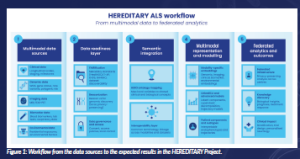
HEREDITARY therefore proposes a representation learning strategy that first transforms each modality into a compact and meaningful representation. Genomic data can capture genetic risk and molecular mechanisms; imaging data can summarise patterns of brain structure and function; and clinical and laboratory information can reflect disease progression, patient characteristics, and biological status. These complementary representations are then connected through the HERO ontology and analysed using advanced AI and multimodal modelling approaches. This framework allows researchers to identify hidden patterns across different data sources, revealing biologically relevant patient subgroups, allowing them to move from raw heterogeneous variables to clinically interpretable insights that can support a more precise understanding of neurodegenerative diseases.
Beyond ALS: expanding to other neurological diseases
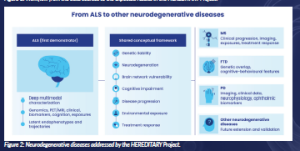
Use Case 25 extends the logic developed in ALS to other neurodegenerative diseases. The aim is not to force ALS, MS, FTD, and PD into a single rigid model. Rather, HEREDITARY will identify shared semantic concepts that allow comparison across diseases while preserving disease-specific features.
For example, ALS and FTD share genetic and cognitive-behavioural dimensions, particularly in relation to C9ORF72. MS provides a model for integrating clinical progression, imaging, and treatment response. PD contributes multimodal clinical, imaging, neurophysiological, and ophthalmic dimensions. Across these conditions, common concepts such as genetic liability, brain network vulnerability, neurodegeneration, cognitive impairment, disease progression, environmental exposure, and treatment response can support cross-disease interpretation.
This cross-disease strategy is particularly relevant for the future of personalised neurology. It may help identify whether different diseases share biological mechanisms, whether similar imaging or genetic signatures correspond to different clinical trajectories, and whether disease-specific classifications can be complemented by molecular and multimodal profiles.
From research foundations to future impact
D2.17 represents a complete intermediate milestone for the neurodegenerative use cases in the HEREDITARY project.6 It establishes the conceptual, semantic, technical, and biological foundations for ontology-driven multimodal ALS stratification and sets the basis for future multicentric implementation.
The next phase, leading to Deliverable 2.18 Neurodegenerative use cases: Outcomes, will focus on implementing and validating the multimodal and federated workflow. This includes expanding the semantic mapping of clinical, genomic, imaging, and biomarker data; refining derived features and embeddings; testing latent multimodal models; and preparing the transition from local analyses to federated multicentric analytics.
For patients, clinicians, and researchers, the long-term ambition is clear: to move beyond one-size-fits-all disease categories and towards biologically grounded, data-driven patient stratification. In ALS and related neurodegenerative diseases, this could improve prognosis, support clinical trial design, identify relevant biological mechanisms, and contribute to more precise therapeutic strategies.
HEREDITARY demonstrates that this transformation requires more than data collection. It requires trustworthy governance, semantic interoperability, privacy-preserving infrastructure, biological interpretation, and advanced multimodal analytics. By connecting these layers, the project is building a foundation for a future in which researchers can collaborate across Europe without compromising privacy, and where patients benefit from more precise and personalised approaches to neurological care.
References
Canosa, A. et al. (2022) ‘Brain 18fluorodeoxyglucose-positron emission tomography changes in amyotrophic lateral sclerosis with TARDBP mutations’, Journal of Neurology, Neurosurgery & Psychiatry, 93(9), pp. 1021–1023. Available at: https://doi.org/10.1136/jnnp-2021-328296.
Canosa, A. et al. (2024) ‘Sex-related differences in amyotrophic lateral sclerosis: A 2-[18F]FDG-PET study’, European Journal of Neurology, 32, e16588. Available at: https://doi.org/10.1111/ene.16588.
Canosa, A. et al. (2025) ‘Cognitive Reserve in Amyotrophic Lateral Sclerosis: A 2-[18F]FDG-PET Study on Sex-Related Differences’, European Journal of Neurology, 32, e70412. Available at: https://doi.org/10.1111/ene.70412.
Grassano, M. et al. (2026) ‘Sex-Specific Genetic Architecture of ALS: Evidence of a Female Protective Effect?’, Annals of Neurology, 99, pp. 1536–1544. Available at: https://doi.org/10.1002/ana.78172.
Footnotes
1 https://hereditary-project.eu/wp-content/uploads/2025/09/UC-1.pdf
4 https://youtu.be/bCfy-GyRS7c?si=UBqP65FeckFsfTdT
5 https://hereditary-project.eu/wp-content/uploads/2025/06/Use-Case-2_infographic.pdf
6 https://hereditary-project.eu/use-case/
Project summary
HEREDITARY develops privacy-preserving AI, semantic interoperability, and federated analytics technologies to study neurodegenerative diseases and the gut–brain axis across Europe. By integrating multimodal clinical, genomic, and imaging data without moving sensitive records, the project aims to enable collaborative research, improve disease understanding, and support future European health data infrastructures.
PROJECT PARTNERS
HEREDITARY brings together 17 partners from 9 countries, including universities, hospitals, research centres, technology organisations, patient engagement experts, and innovation specialists. The consortium combines expertise in artificial intelligence, data science, neuroscience, genomics, clinical research, ethics, citizen science, and science communication to advance privacy-preserving multimodal health data analysis.
PROJECT LEAD PROFILE
Prof. Gianmaria Silvello is Associate Professor at the University of Padua and Co-ordinator of HEREDITARY. His research focuses on information retrieval, data integration, knowledge graphs, semantic technologies, and artificial intelligence for health and biomedical applications. He has coordinated and contributed to numerous European research initiatives at the intersection of data science and healthcare.
PROJECT CONTACTS
Project Co-ordinator: Prof. Gianmaria Silvello
Email: gianmaria.silvello@unipd.it
WP2 Co-ordinator: Umberto Manera
Email: umberto.manera@unito.it
Communications Leader: Carlos Iglesias Losada
Email: ciglesias@feuga.es
FUNDING
This project has received funding from the European Research Council (ERC) under the European Union’s research and innovation programme (Grant agreement No. 101137074).
Views and opinions expressed are, however, those of the author(s) only and do not necessarily reflect those of the European Union or the ERC. Neither the European Union nor the granting authority can be held responsible for them.
Figure legends
Figure 1: Workflow from the data sources to the expected results in the HEREDITARY Project.
Figure 2: Neurodegenerative diseases addressed by the HEREDITARY Project.