
Europe’s battery strategy has, until recently, been told almost entirely through the lens of engineering and industrial policy: gigafactories, cathode chemistries, recycling yields. Within BATMASS, a project co-funded under the EU’s Interregional Innovation Investment (I3) instrument, 15 partners across 11 regions are laying the foundations for the first European Circular Battery Valley (CBV), spanning collection, dismantling, second-life use, and re-manufacturing at scale. The ambition is considerable: to transform end-of-life batteries from a looming waste problem into a strategic domestic resource, reducing Europe’s dependence on external suppliers of raw materials and finished cells alike.
Yet, a circular battery economy is not only a technical system; it is also a social one. Whether communities host recycling plants, whether consumers trust a second-life battery in their home, and whether institutions co-operate across borders are all questions of acceptance. A technology can be safe, efficient and cost-competitive on paper and still fail to scale if the people and institutions around it withhold their trust. AFIL, the Lombardy-based Advanced Manufacturing Cluster led the BATMASS Social Acceptance study to map where that trust currently stands—and what would need to change for it to hold.
The 3 dimensions of social acceptance
Social acceptance research distinguishes 3 different dimensions (Wüstenhagen, Wolsink and Bürer, 2007): socio-political acceptance, community acceptance, and market acceptance. Socio-political acceptance concerns policymakers, regulators, and public opinion at large, and depends on a supportive institutional context that holds steady over time. Community acceptance concerns the people directly affected by specific facilities or projects, and rests on their trust in the siting process, the safety record, and the fairness of how costs and benefits are distributed locally. Market acceptance concerns consumers, investors, and businesses and turns on whether they actually choose circular battery products and services over conventional alternatives and under what conditions.
The 3 dimensions are strictly interconnected. A government can legislate in favour of circularity, yet a single poorly handled local incident can undermine community trust faster than any policy can rebuild it. A market can be technically ready for second-life batteries, yet remain stalled if consumers doubt their safety or investors doubt the industrial base behind them. For a circular battery economy, none of these dimensions can be assumed. Second-life and recycled batteries are unfamiliar to most people, batteries themselves carry pre-existing safety associations from unrelated incidents in consumer electronics, and the industrial base building this economy is still young and financially fragile.
To highlight all the 3 dimensions, the evidence base drew on desk research, a consortium-wide survey, and 26 interviews with stakeholders spanning the battery value chain, from industry to regulators to civil society. Desk research established the wider policy and market context; the survey captured the views of the BATMASS consortium itself, with direct operational experience of collection, dismantling and re-manufacturing; and the interviews allowed individual stakeholders to explain, in their own words, where confidence in the circular battery economy is solid and where it is closer to a hope than a certainty. This mixed-methods approach allowed the analysis to triangulate stated attitudes with the practical barriers stakeholders actually encounter day to day.
At the socio-political level, Regulation (EU) 2023/1542 concerning batteries and waste batteries, together with the Critical Raw Materials Act and the Net Zero Industry Act, signals a clear EU intention to build a domestic, circular battery value chain and reduce dependence on non-EU suppliers (European Parliament and Council, 2023). Between them, these instruments touch almost every stage of the value chain: sustainability and safety requirements for batteries placed on the market, due diligence obligations for raw material sourcing, and targets for collection and recycled content. Interviewees broadly welcomed this direction and saw it as an enabler rather than a burden, describing regulatory clarity as one of the sector’s strongest foundations.
However, policy consensus has not yet translated into durable industrial confidence. Northvolt, once positioned as Europe’s flagship battery manufacturer, filed for bankruptcy after BMW cancelled a contract worth around 2 billion euros and production at its flagship Swedish gigafactory failed to scale as planned (Segal, 2025). Alongside this, European gigafactories continue to face a persistent cost disadvantage relative to their Chinese counterparts, who benefit from mature supply chains, lower energy costs, and years of manufacturing experience at scale.
At the community level, concerns centre on safety, fire risk, and the environmental impacts of storage, dismantling, and recycling facilities, particularly among residents and workers near proposed sites. Interviewees repeatedly identified a gap between the technical performance and safety claims made by industry and the perceived reliability experienced, or simply imagined, by host communities and end users. Interviewees pointed to a broader reputational challenge: isolated but widely reported battery-related incidents in consumer electronics have shaped public perceptions of battery safety more generally, and this association can transfer onto second-life and recycling facilities even where the underlying risk profile is different. This gap is compounded by fragmented and inconsistent communication: different actors along the value chain, from local operators to national regulators to project communicators, tell different stories about the same technology, with no single trusted voice for residents to turn to.
This gap narrows fastest where communities have direct, visible experience of the technology working safely, for example through demonstration projects and pilot facilities that residents can see and, where possible, visit, rather than through abstract reassurance issued from a distance. Transparency about operational incidents and how they are handled, rather than their absence from public discussion, appears to matter more for long-term trust than an unblemished record alone. Communities that are kept informed, even when something goes wrong, tend to extend more benefit of the doubt than those who learn of problems only through rumour or media coverage.
Market acceptance emerged as similarly conditional. Businesses and consumers showed genuine openness to reused and recycled batteries, but only where quality and performance could be reliably assured; enthusiasm in principle did not always survive contact with practical questions of warranty, resale value and long-term performance.
Barriers identified included unclear ownership and liability for second-life batteries as they change hands between applications, the absence of standardised testing and valuation methods that would let a buyer compare one second-life battery against another with confidence, and a shortage of business models, such as battery-as-a-service or leasing arrangements, capable of sharing risk between suppliers and users rather than concentrating it on whichever party happens to hold the asset when something goes wrong. Public procurement and targeted financial incentives were repeatedly mentioned as levers that could accelerate adoption without waiting for the market to solve these problems unaided, effectively giving early movers the confidence to invest ahead of full market maturity.
The BATMASS Circular Battery Valley
BATMASS Circular Battery Valley is the project’s proposal for closing the 3 gaps described previously. Conceived as the first attempt in Europe to build an interregional industrial ecosystem around circular batteries, the CBV connects 15 partners across 11 regions around a shared aim: reducing Europe’s dependence on critical raw materials sourced outside the EU and strengthening the continent’s competitive position against non-EU manufacturers.
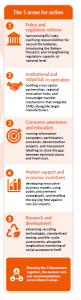
At the socio-political level, the CBV gives regulators a live, cross-border testing ground for frameworks that are still largely on paper. By bringing industry, research and technology organisations, universities, and regional authorities together around shared roadmaps, it generates the operational evidence on collection rates, recycled content, and cross-border material flows that can feed back into the implementation of the Battery Regulation, the Critical Raw Materials Act, and the Net Zero Industry Act, rather than leaving each partner to interpret those frameworks alone.
At the community level, the CBV’s demonstrators are a live test of the direct, visible experience that interviewees said mattered most for building local trust: residents and workers can see collection, dismantling, and processing in operation across 11 regions, rather than relying on reassurance issued from a distance. The initiative pairs socio-economic monitoring with its technical work packages and is also positioned to track how that trust develops over time as facilities move from pilot to operational scale, rather than assuming it once at the outset.
At the market level, the CBV is designed to produce the kind of comparable, standardised evidence on performance that businesses and consumers said was missing: shared testing protocols and consistent data on second-life battery quality across the participating regions, alongside a visible reference case for the leasing and battery-as-a-service models the report identifies as necessary to share risk along the value chain. In this sense, the CBV functions less as a single facility than as shared infrastructure for proof, from which individual partners and the wider sector can draw evidence rather than each having to build trust alone.
Integrating socio-economic analysis alongside technological development means the initiative can track social acceptance over time as the facilities move from pilot to operational scale, rather than assuming it once at the outset and moving on to purely technical concerns.
References
European Parliament and Council (2023) Regulation (EU) 2023/1542 of the European Parliament and of the Council of 12 July 2023 concerning batteries and waste batteries, amending Directive 2008/98/EC and Regulation (EU) 2019/1020 and repealing Directive 2006/66/EC. Official Journal of the European Union, L 191, pp. 1–117. Available at: https://eur-lex.europa.eu/eli/reg/2023/1542/2025-07-31/eng (Accessed: 31 July 2026).
Segal, M. (2025) ‘Northvolt files for bankruptcy’, ESG Today. Available at: https://www.esgtoday.com/northvolt-files-for-bankruptcy/ (Accessed: 31 July 2026).
Wüstenhagen, R., Wolsink, M. and Bürer, M.J. (2007) ‘Social acceptance of renewable energy innovation: an introduction to the concept’, Energy Policy, 35(5), pp. 2683–2691. Available at: https://doi.org/10.1016/j.enpol.2006.12.001.
Project summary
PROJECT NAME: BATMASS
BATTMASS: BATtery valley for second life, recycling, and re-manufacturing of materials and black MASS
PROJECT SUMMARY
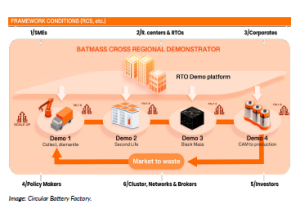
BATMASS aims to build the EU’s first Circular Battery Valley, offering cross-regional investment in TRL6+ circular battery material technologies. It mobilises an interregional ecosystem around 4 demonstrators to scale, commercialise, and deploy breakthrough GreenTech, leveraging RTOs and SMEs to speed market entry and replication across EU regions, while tech transfer between regions anchors this emerging value chain.
PROJECT PARTNERS
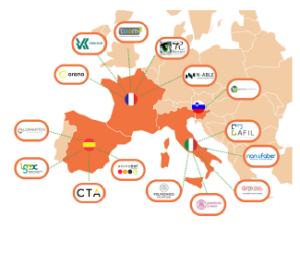
The BATMASS consortium, led by Politecnico di Milano, brings together 15 partners from 11 European regions, including Lombardy, Lazio, Andalucía, Castilla-La Mancha, Castilla-y-León, Valencia, Auvergne-Rhône-Alpes, Hauts-de-France, Île-de-France, Nouvelle-Aquitaine, and Slovenia. Partners include Università di Pavia, Kemijski Institut, Nanofaber, Lomartov, ERP Italia Servizi, Orano, Verkor, Green-Vision, Envirobat, CTA, AFIL, TEAM2, ISMC, and N-ABLE, spanning the battery value chain from research to deployment.
PROJECT LEAD PROFILE
Politecnico di Milano is a science and technology university that trains engineers, architects, and designers. Founded in 1863, it is among the world’s leading universities, ranked 1st in Italy and 98th globally in the QS World University Ranking 2026. The university emphasises quality and innovation in teaching and research, fostering strong ties with industry through experimental research and technology transfer.
PROJECT CONTACTS
Email: info@batmasscorporaciontecnologica.com
Web: batmass.corporaciontecnologica.com
For the topic of this article:
FUNDING
This project has received funding from the European Union’s Interregional Innovation Investment (I3) under Grant Agreement No.101115058.
Views and opinions expressed are, however, those of the author(s) only and do not necessarily reflect those of the European Union or European Innovation Council and SMEs Executive Agency (EISMEA). Neither the European Union nor the granting authority can be held responsible for them.
Figure legends
Image: Circular Battery Factory.