
Mapping the March is an innovative project aiming to create the first holistic cultural history of the medieval March of Wales, a vast patchwork of territories that stretched along what is today eastern Wales and the borderlands—from Denbigh and Flint in the north to Brecon and Monmouth in the south—as well as along the coast of South Wales, from Glamorgan to Pembroke. The project’s aim is to recover the medieval March as a distinctive multicultural and multilingual zone marked by not just military conflict, but also administrative complexity and literary activity.
To achieve this, the project has 2 main objectives. The first is to create, for the first time, a series of layered digital maps showing the shifting borders of the individual Marcher lordships on the basis of historical documents and administrative records. The second is to develop a relational database connecting the people, places, manuscripts, and texts of the medieval March. Through this database, users will be able to see who held offices in the lordships, which people or institutions owned books there, where books came from and where they travelled, who used them, what texts were contained in them and in what languages. This database, accessible through a bespoke web-interface, will enable users to visualise the connections between these entities as network diagrams and as integrated with the new historical maps, thereby opening up the medieval March as an object of study for students and researchers of multiple disciplines.
The manuscript data is, therefore, an important aspect of our holistic cultural history. The manuscript corpus is, in some ways, wider in scope than other sections of the database. The temporal parameters of the project (1272–1550) mean that we are primarily interested in the period between the Edwardian Conquest and the Laws in Wales Acts. However, the database must also take account of manuscripts produced prior to that period, but that came to circulate in the Marches during it. Collecting this data gives us useful insights into the far-reaching networks of Marcher people and institutions, many of whose books came from universities and religious houses in France, Italy, and beyond.
In terms of geographic parameters, too, the manuscript data collection takes a wider view of the Marches than one restricted to the borders of the Marcher lordships, since it also encompasses books from the English border counties, taking as its eastern edge the natural boundaries of the Rivers Severn and Dee. This wider view allows us to see the Marches as a broader, porous cultural zone that centred on, but also extended beyond, the Marcher lordships themselves. This approach enables us to resituate manuscripts, texts, and cultural centres usually considered ‘English’ or ‘Welsh’ (based on post-medieval national geographies) in this more complex and nuanced Marcher space.
Finally, the parameters for the types of manuscripts included in the database are deliberately broad, encompassing both institutional and private libraries, as well as books in Latin, Welsh, English, French, and combinations of all of these. Our holistic approach obviates any need to delimit the manuscript corpus on the basis of language or perceived disciplinary relevance.
How, then, is a manuscript selected for inclusion in the database? So far, our primary sources for identifying manuscripts are:
- Daniel Huws’ Repertory of Welsh Manuscripts and Scribes (2022)
- Neil Ker’s Medieval Libraries of Great Britain (1964), along with Andrew Watson’s Supplement (1987), and the online MLGB3.
- Catalogues of extant repositories, such as Mynors and Thomson’s catalogue of Hereford Cathedral (1993)
- Reconstructive catalogues of medieval holdings, such as Sarah Sheppard’s work on Buildwas Abbey (1997) and Kirsty Bennett’s study of Llanthony Priory (2006)
- The Catalogue of Vernacular Manuscript Books of the English West Midlands, 1300–c. 1475 compiled by the Manuscripts of the West Midlands research project (2006).
Drawing from these sources, manuscripts are selected on the basis of their place(s) of production and/ or provenance. In other words, we ask: was the manuscript produced in our area and period of interest? Or, if produced earlier or elsewhere, did it circulate there later? If the answer to either of these questions is yes, then the manuscript is included in our dataset, where it is associated with the relevant place(s), with all the main text entities it contains, and with any known person entities (owners, users, scribes, etc.). In this way, the database is able to document the movement of books between people and across space.
Using this methodology, we have identified approximately 1000 manuscripts so far, with room for expansion and further refinement. Of these, roughly 500 have now been entered into the database, accompanied by individual biographies, and with over 800 place connections, 900 person connections, and 1200 text connections. Upon completion, the database will provide an unprecedented resource for the study of literary culture in the medieval Marches by bringing together a vast and diverse array of manuscripts and texts rarely studied alongside each other.
That being said, our project’s aim to document all that survives from the medieval March also makes us increasingly aware of all that has been lost in the intervening centuries. One of the sources that illustrates the extent of such losses is the Registrum Anglie de libris doctorum et auctorum ueterum, a union catalogue of books in England, Wales, and Scotland which was compiled probably by the Oxford Franciscans, on the basis of on-site surveys conducted in the early fourteenth century (Rouse, Rouse, and Mynors 1991). The Registrum lists around 1400 works attributed to 99 classical, patristic, and early medieval authors; each title is followed by a series of numbers identifying the monastic and cathedral libraries that possessed a copy of it. In the Marches, the surveyors intended to conduct assessments of some 20 institutions, though only 16 were completed.
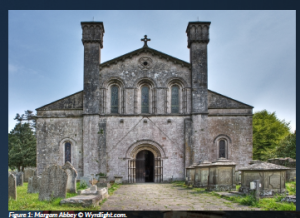
One of these visitations—conducted at Margam Abbey in Glamorgan (Figure 1)—lists 242 titles of interest to the surveyor. Today, only 3 or 4 manuscripts survive from Margam Abbey, and none of their texts corresponds to those listed in the Registrum entry. Taking the Marcher institutions as a whole, there is a rate of 100 % title-loss from 11 of the 16 surveyed institutions, with 666 titles missing out of the 715 recorded overall, a loss of some 93 %. To put the extent of these losses into perspective: for Canterbury Cathedral, the Registrum records 356 titles, of which some 211 correspond to extant manuscripts or are confirmable by other sources (a loss rate of only 38 %).
There are several caveats to bear in mind when considering the Registrum as a data source. Firstly, titles do not equate to books; multiple titles might be contained within a single volume, or a single title might be split across multiple volumes. A second point is that the surveyors did not intend to fully inventory the libraries they visited; rather, they seem to have been looking, in particular, for works of moral theology. Numerous fields are therefore neglected by the Registrum’s records, and we know that there were many more manuscripts in each of the institutions visited than those indicated by the number of titles recorded. Finally, it is also true that the surveyors sometimes missed titles that they were looking for in the libraries they visited.
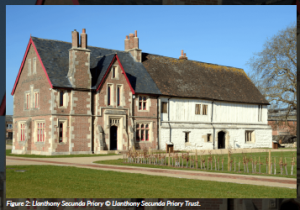
Even so, the rates of loss are impressive, and they are often corroborated by contemporary booklists, which also demonstrate considerable losses. At Llanthony Secunda Priory in Gloucester (see Figure 2), for example, a catalogue dated to c.1355–60 lists some 508 items (see Bennett 2006; Webber and Watson 1998, list A16). Again, this number is not exactly coextensive with the number of books at the Priory, but, of these 508, just 130 can be associated with extant manuscripts, 6 of which are also identifiable with entries in the Registrum. A further 3 correspond to Registrum entries, but do not survive.
A second document relating to Llanthony is the will of Dr John Lecche, a Gloucestershire man, canon of Hereford, and chancellor of the University of Oxford in 1338–9 (died by 6 August 1361). His will records his bequest of 57 books, mainly legal texts (Webber and Watson 1998, list A17): 7 are identifiable with extant manuscripts, 5—including one of the extant manuscripts—are identifiable in additions to the Llanthony catalogue. In Lecche’s bequest, 2 books listed as remaining in the custody of his executors likely never reached the Abbey at all. Finally, in c. 1536–40, John Leland reports having seen 5 titles at Llanthony, 4 of which correspond to catalogue entries and one to an extant manuscript (Webber and Watson 1998, list A18).
Llanthony is one of the more successful Marcher institutions in terms of its rates of manuscript survival: some 178 manuscripts survive from the holdings of the medieval Priory. Yet, even here, pulling all these sources together and allowing for duplicates across book lists, we can see that some 599 items are associable with Llanthony Secunda, which gives a rate of loss of approximately 70 %.
What survives from the medieval March gives us compelling insights into a vibrant, multilingual world of literary creation, book production, and manuscript circulation in and between gentry households and religious houses across the region. What does not survive from the March gives us an even fuller version of that picture. As work continues on Mapping the March, it will be interesting to consider how our project—or a future one—might take account of these non-extant materials. The cultural history of the March cannot be complete without them.
References
Bennett, K. (2006) The book collections of Llanthony Priory from foundation until dissolution (c.1100–1538). Unpublished PhD thesis. University of Kent.
Huws, D. (2022) A repertory of Welsh manuscripts and scribes, c. 800–1800. National Library of Wales.
Ker, N.R. (ed.) (1964) Medieval libraries of Great Britain: a list of surviving books. 2nd edn. Royal Historical Society.
MLGB3 (2009–) Medieval libraries of Great Britain. Available at: https://mlgb.bodleian.ox.ac.uk.
Mynors, R.A.B. and Thomson, R.M., with Gullick, M. (1993) Catalogue of the manuscripts of Hereford Cathedral Library. D.S. Brewer.
Rouse, R.H., Rouse, M.A., and Mynors, R.A.B. (eds) (1991) Registrum Anglie de libris doctorum et auctorum ueterum. British Library in association with the British Academy.
Sheppard, J.M. (1997) The Buildwas books: book production, acquisition and use at an English Cistercian monastery, 1165–c. 1400. Oxford Bibliographical Society, Bodleian Library.
Scase, W. et al. (2006) Manuscripts of the West Midlands: a catalogue of vernacular manuscript books of the English West Midlands, c. 1300–c. 1475. Available at: https://www.dhi.ac.uk/mwm/.
Watson, A.G. (ed.) (1987) Medieval libraries of Great Britain: a list of surviving books. Supplement to the second edition. Royal Historical Society.
Webber, T. and Watson, A.G. (eds) (1998) The libraries of the Augustinian canons. British Library in association with the British Academy, pp. 36–94.
Project summary
The project aims to create the first cultural history of the medieval March of Wales, the borderlands between Wales and England. The main aims are to catalogue the manuscripts produced and circulated in the medieval March from 1282 to 1550, to create an original series of digital maps of the Marcher lordships, and to explore cultural identities in a British border region.
Project partners
Project lead: Helen Fulton, University of Bristol
Postdoctoral researchers: Rachael Harkes and Matt Lampitt
Research administrator: Abi Freeman
Research IT Bristol: Mike Jones
Digital maps: Scott Lloyd and Jon Dollery, RCAHMW
Project partner: Royal Commission on Ancient and Historical Monuments of Wales
Project lead
Professor Helen Fulton holds the Chair in Medieval Literature Medieval Literature at the University of Bristol. She has previously held a number of research awards, including a Leverhulme Major Research Fellowship. Her research focuses on the literature and culture of medieval Wales and its relations with England, and she has published widely in this field. She is the co-editor of the Cambridge History of Welsh Literature.
Project contacts
Professor Helen Fulton
School of Humanities, University of Bristol, 11 Woodland Road, Bristol BS8 1TB, UK.
Email: mapping-the-march@bristol.ac.uk
Blog: blog.mowlit.ac.uk
X: @MappingtheMarch
Bluesky: @mappingthemarch.bsky.social
YouTube: @MappingtheMarch
Funding
The project was selected for funding by the European Research Council (ERC) and funded by the UKRI Horizon Guarantee programme, under grant agreement No. ERC 101054383/ UKRI EP/ X027880/1.