
Bryan R. Bzdek
Aerosols are central players in atmospheric chemistry, climate change, human health, and materials synthesis. In the atmosphere, aerosols are major contributors to air pollution and, through their contribution to atmospheric cloud droplets, represent the largest uncertainty in predictions of future climate.
As we saw during the COVID-19 pandemic and recent measles outbreaks, aerosols can serve as vehicles that efficiently spread diseases. Aerosols can also be used to deliver pharmaceuticals to the respiratory tract. Over the last decade, they have become increasingly recognised as highly efficient microscopic reactors that accelerate chemical reaction rates by up to 107 times relative to macroscopic solutions.
Elucidating how aerosols contribute to these very different processes requires robust approaches for characterising and disentangling their surface and bulk properties and processes. Because of their high surface area-to-volume ratios, the significance of surface processes in aerosols is greatly enhanced relative to macroscopic systems. One example where the importance of the particle-air interface is magnified is the activation of atmospheric aerosols to serve as cloud droplets, which influences cloud cover and precipitation patterns. A cloud droplet seed particle’s surface tension is key to predicting what fraction of atmospheric aerosol will ultimately activate into cloud droplets. However, this parameter is not directly measurable on atmospheric aerosols (owing to their small size). Instead, models typically assume atmospheric aerosol particles have surface tensions equivalent to that of pure water, despite aerosols being complex chemical mixtures containing a substantial fraction of surface-active compounds. Similarly, resolving how chemical reactions can be accelerated in aerosols requires detailed knowledge of the droplet’s surface and bulk composition and the dynamic coupling between these regions.
AeroSurf has tackled these challenges by developing completely novel approaches to characterise the surface and bulk properties of aerosol droplets. These new technologies were then used to address longstanding questions about how molecules partition to the interface of high surface area-to-volume ratio droplets and how chemical reactions proceed in microscopic systems, providing crucial insights into atmospheric and materials synthesis processes.
Surfactant partitioning in picolitre-volume droplets
Surfactants lower the surface tensions of macroscopic solutions by adsorbing to the liquid-air interface. However, this process also reduces the bulk surfactant concentration (referred to as bulk depletion). Although bulk depletion is usually negligible in macroscopic systems (except at extremely low surfactant concentrations), it can become significant in high surface area-to-volume ratio aerosol droplets. Models accounting for surface-bulk partitioning in aerosol droplets were not rigorously tested against experiments, mainly because direct measurement of the surface tension of aerosol droplets had not been possible. A quantitative understanding of bulk depletion effects in aerosol droplets is essential, as these effects alter the surface and bulk composition of a droplet, influencing surface tension and chemical reaction rates.
We developed a holographic optical tweezers platform to directly measure the surface tension of picolitre-volume droplets, providing quantitative constraints on the magnitude of bulk depletion effects in aerosol droplets and enabling assessment of how well models predict this phenomenon, which is crucial for understanding aerosol surface composition (Bain et al., 2023).
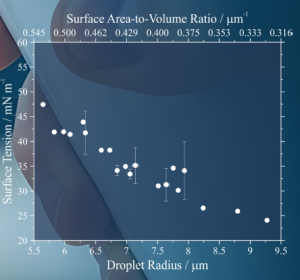
Figure 1 shows size-dependent surface tension measurements for aerosol droplets containing the surfactant C16E8. In these experiments, the solution from which aerosol droplets were generated was held constant and droplet size was varied. Smaller droplets have higher surface tensions than larger droplets, consistent with an understanding of depletion effects. Because they have higher surface area-to-volume ratios, a larger fraction of surfactant molecules is lost to the interface in smaller droplets, thereby reducing the bulk concentration and leading to surface tensions closer to those of the solvent (water) value. Larger droplets (with lower surface area-to-volume ratios) have lower surface tensions approaching bulk solution values, as a smaller fraction of surfactant molecules is partitioned to the interface.
Figure 1 highlights how the surface compositions of aerosol droplets can differ dramatically from that of the solution that produced them, demonstrating the unique environment available in aerosol droplets. By quantitatively reconciling the droplet measurements with a thermodynamic understanding of surfactant surface-bulk partitioning, we demonstrated that approaches to model surfactant partitioning in aerosol droplets provide largely accurate predictions (Bain et al., 2023, 2025; Bain, Prisle and Bzdek, 2024). Confidence in these models is necessary to accurately predict the evolution of surface tension as an atmospheric particle activates into a cloud droplet and to rationalise how chemistry may proceed differently in aerosols compared to macroscopic solutions.
Resolving the dynamics of interfacial composition is also important. Chemical reactions in aerosol droplets are much more sensitive to interfacial partitioning equilibria, and knowledge about the kinetics of mass transport to the droplet-air interface becomes essential. We developed an approach to characterise the dynamic surface tension of picolitre-volume droplets in the 500 µs after droplet generation, providing insight into the timescales for surfactant mass transport in aerosol droplets (Bain et al., 2024).
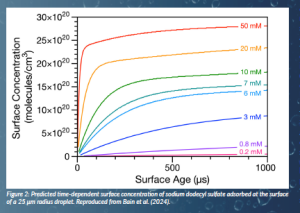
Figure 2 shows surface concentrations for the surfactant sodium dodecyl sulfate partitioning to the interface of a picolitre-volume droplet. The main takeaway from this figure is that equilibration timescales for surfactant-containing droplets can extend to several milliseconds. By applying kinetic models, we ascertained that diffusional transport is the main process governing mass transport in droplets of this size range. The outcomes are essential for rationalising observations of accelerated chemical reactivity in microdroplets, as these results demonstrate that, at least for systems containing surfactants, reaction and partitioning timescales may be very similar in magnitude, so chemistry at the droplet-air interface in freshly generated droplets may proceed under nonequilibrium conditions.
Elucidating accelerated reactivity in aerosol droplets
Chemical reactions can be accelerated by up to 107-fold in aerosol droplets relative to macroscopic solutions, but the underlying mechanisms for this enhanced reactivity are unclear. Potential explanations include droplets reaching solute concentrations far beyond those accessible in macroscopic solutions as well as reactant confinement, partial solvation, or electric fields at the droplet-air interface. A detailed understanding of why reactions are accelerated in aerosols is necessary to realise the potential of droplet-based synthesis in the commercial sector. Observations of accelerated reactivity in aerosol droplets also challenge our basic understanding of atmospheric chemistry.
Most approaches to investigating accelerated reactivity in aerosol droplets rely on electrospray-generated droplets that are then chemically analysed by mass spectrometry. In these approaches, droplet formation and chemical analysis are tightly coupled. Moreover, droplet charge is poorly constrained, and reagent concentrations may increase dramatically owing to solvent evaporation. We developed and applied approaches using levitated and flowing aerosol droplets that permit control over a wide range of parameters, including droplet size, relative humidity (influencing water content), and net charge (Harrison et al., 2025; Walker and Bzdek, 2025).
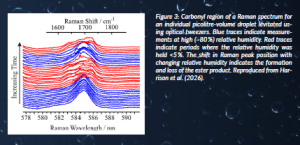
To explore accelerated reactivity, we investigated a reaction where an acid and alcohol were combined to form an ester product and water. In macroscopic solutions, this reaction requires a nonaqueous solvent, acid catalyst, high temperature, and long times to produce the ester product. However, we found we could generate the product in seconds to minutes in aqueous aerosol droplets without an acid catalyst and at room temperature (Harrison et al., 2026). By studying individual droplets levitated using optical tweezers, we could control droplet size and relative humidity, while minimising any effects from net charge. Figure 3 shows the carbonyl region of the Raman shift for a levitated picolitre-volume droplet. As relative humidity decreases from ~80 % to <5 %, a shift in the carbonyl peak to a longer wavelength is observed, indicating facile conversion to the ester product.
Intriguingly, by increasing the relative humidity, we could then reverse the reaction. By lowering relative humidity again, we could form the products. We also performed experiments on plumes of sub-femtolitre droplets and found similar behaviour. Overall, these experiments are elegant examples of Le Chatelier’s principle on the micro- and nano-scales, and they represent a clear route to exploit aerosol reactions for rapid, controlled chemical synthesis.
Conclusions
The goal of AeroSurf is to pioneer new approaches to characterise the surface and bulk properties of aerosol droplets. During the course of the project, we developed and applied new tools to infer the dynamic and equilibrium surface tensions of picolitre-volume droplets, providing important insights into how surfactant partitioning is modified by the high surface area-to-volume ratio environment of an aerosol droplet. Moreover, we developed novel tools for chemical analysis of aerosol droplets from picolitre to sub-femtolitre scales, demonstrating how aerosol droplets can serve as highly efficient reaction vessels. The outcomes of this project are now influencing our understanding of how cloud droplets form in the atmosphere and leading to a re-evaluation of how we consider chemical reactivity in aerosol droplets.
References
Bain, A. et al. (2023) ‘Surface-Area-to-Volume Ratio Determines Surface Tensions in Microscopic, Surfactant-Containing Droplets’, ACS Central Science, 9(11), pp. 2076–2083.
Bain, A. et al. (2024) ‘Surfactant Partitioning Dynamics in Freshly Generated Aerosol Droplets’, Journal of the American Chemical Society, 146(23), pp. 16028–16038.
Bain, A. et al. (2025) ‘Partitioning of Ionic Surfactants in Aerosol Droplets Containing Glutaric Acid, Sodium Chloride, or Sea Salts’, Atmospheric Chemistry and Physics, 25(11), pp. 5633–5645.
Bain, A., Prisle, N.L. and Bzdek, B.R. (2024) ‘Model-Measurement Comparisons for Surfactant-Containing Aerosol Droplets’, ACS Earth and Space Chemistry, 8(11), pp. 2244–2255.
Harrison, J. et al. (2025) ‘The Role of Aerosol Liquid Water in Droplet-Assisted Ionization Mass Spectrometry’, Analytical Chemistry, 97(36), pp. 19918–19925.
Harrison, J. et al. (2026) ‘Enhancement of Esterification Reaction Rates in Solvent-Free Aerosol Droplets’, Journal of the American Chemical Society, 148(12), pp. 12630–12640.
Walker, J.S. and Bzdek, B.R. (2025) ‘Rapid and Sensitive Chemical Analysis of Individual Picolitre Droplets by Mass Spectrometry’, Analytical Chemistry, 97(1), pp. 854–861.
Project name
AeroSurf
Project summary
AeroSurf explores composition and reactivity at the particle-air interface through development of new surface-selective analytical approaches. Project outputs have clarified how these interfaces influence climate (e.g. by altering cloud formation) and materials synthesis (through enhanced chemical reactivity). The developed technologies are broadly applicable to grand challenges in the chemical, physical, materials, and atmospheric sciences.
Project partners
AeroSurf is hosted by the School of Chemistry, University of Bristol. This project is supported through collaborations with leading kinetic and thermodynamic modellers at the University of Oulu (Finland) and Lawrence Berkeley National Laboratory (USA).
Project lead profile
Bryan R. Bzdek is an associate professor in the School of Chemistry, University of Bristol. He earned a BS in Chemistry from Bucknell University and a PhD in Analytical Chemistry from the University of Delaware. His expertise in aerosol science is internationally recognised through the Marlow and Faraday Horizon Prizes from the Royal Society of Chemistry, the Philip Leverhulme Prize, and the Kenneth T. Whitby Award from the American Association for Aerosol Research.
Project contacts
Principal Investigator: Bryan R. Bzdek
School of Chemistry, University of Bristol, Bristol, BS8 1TS, United Kingdom.
Funding
This project has received funding from the European Research Council (ERC) under the European Union’s Horizon 2020 research and innovation programme (Grant agreement No. 948498).
Views and opinions expressed are, however, those of the author(s) only and do not necessarily reflect those of the European Union or the ERC. Neither the European Union nor the granting authorities can be held responsible for them.
Figure legends
Figure 1: The surface tension of picolitre-volume droplets containing 0.8 mM of the surfactant C16E8 and 0.9 M glutaric acid as a function of droplet size. Modified from Bain et al. (2013).
Figure 2: Predicted time-dependent surface concentration of sodium dodecyl sulfate adsorbed at the surface of a 25 μm radius droplet. Reproduced from Bain et al. (2024).
Figure 3: Carbonyl region of a Raman spectrum for an individual picolitre-volume droplet levitated using optical tweezers. Blue traces indicate measurements at high (~80 %) relative humidity. Red traces indicate periods where the relative humidity was held <5 %. The shift in Raman peak position with changing relative humidity indicates the formation and loss of the ester product. Reproduced from Harrison et al. (2026).