
Created to test the gender mosaic hypothesis across cultures, this new dataset of approximately 43 000 participants from 29 countries is now available for collaborative research on a broad range of psychological and behavioural variables.
The gender binary framework and its costs
Women and men differ, on average, across many domains. These range from levels of sex-related hormones, such as testosterone, to personality traits, cognitive and emotional abilities, preferences, and behaviours (e.g. Archer, 2004; Cross and Madson, 1997; Eagly and Wood, 2011; Su, Rounds and Armstrong, 2009). Within the dominant binary view of sex and gender, these average differences are assumed to combine consistently within individuals, forming 2 kinds of humans. People are therefore treated as belonging to one of 2 gender categories, from which an entire set of traits, roles, and preferences can supposedly be inferred (Saguy, Reifen-Tagar and Joel, 2021). This binary thinking is socially costly. Gender stereotypes channel boys and girls, and women and men, into gender-congruent paths (e.g. Croft, Schmader, and Block, 2015; Ellemers, 2018; Halper, Cowgill, and Rios, 2019; Heilman, Caleo, and Manzi, 2024; Jewell and Brown, 2014; Master et al., 2025; Rudman and Fairchild, 2004; Verdugo-Castro et al., 2022; Xu, Feng, and Rahman, 2024).
Challenges to the gender binary and evidence for the gender mosaic
The binary framework persists even though many findings from neuroscience, psychology, and neuroendocrinology do not support the binary belief that human brains and ‘natures’ belong to 2 distinct kinds (Hyde et al., 2019; Joel, 2012, 2016).
The first modern study of masculinity and femininity reported low correlations among the subscales of the M-F test (Terman and Miles, 1936). Individuals could be masculine on some subscales and feminine on others. Spence (1993) later reported the same pattern, which is also manifested in low correlations between variables that show gender differences, such as interest in people versus things (Tay et al., 2011) and scores on empathising and systemising scales (Greenberg et al., 2018). Spence (1993, p. 633) concluded that “men and women do not exhibit all of the attributes, interests, attitudes, roles and behaviours expected of their sex according to their society’s descriptive and prescriptive stereotypes but only some of them. They may also display some of the characteristics and behaviours associated with the other sex.”
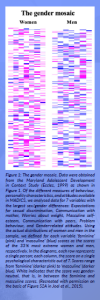
In 2015, we analysed gendered attitudes, preferences, and behaviours in 3 samples of young Americans. We found that most participants possess unique ‘mosaics’ (combinations) of both feminine (more common in women compared to men) and masculine characteristics. ‘Internally consistent’ individuals—those with only feminine or only masculine characteristics—were extremely rare (Joel et al., 2015; Figure 1).
The gender mosaic across 29 countries
Although these 3 studies span almost a century (Joel et al., 2015; Spence, 1993; Terman and Miles, 1936), all were conducted with American samples. The ERC-funded Beyond Gender Binary project therefore set out to test the binary and mosaic frameworks across additional Western and non-Western cultures.
To this end, we constructed the Gender Mosaic Questionnaire (GMQ) and the Gender Mosaic Cross-Cultural Dataset (GMCCD). The GMQ assesses psychological and behavioural variables reported to show large sex/gender differences in English-speaking samples. These include job and leisure-time preferences, empathising, systemising, aggression-related measures, gender identity as a woman and as a man, self-ascribed femininity and masculinity, sexual preferences and behaviours, and partner preferences. It also assesses sociodemographic characteristics, including age, country of residence, religiosity, sex registered at birth, the gender in which a person was raised, current gender, and sexual orientation.
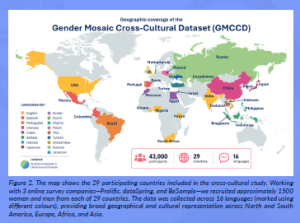
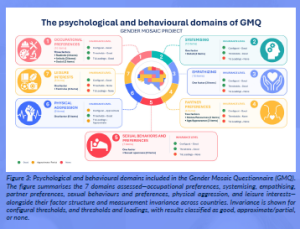
Working with 3 online survey companies—Prolific, dataSpring, and BeSample—we recruited approximately 1500 women and men from each of 29 countries to create the GMCCD (Figure 2). A detailed list of participating countries and available variables, including those demonstrating measurement invariance (Figure 3), is available at https://osf.io/h3emx/overview.
The GMQ is available in 16 languages on a dedicated website: https://gendermosaic.tau.ac.il/. The website allows participants to explore their gender mosaic and see how it changes when they select different comparison groups.
Get involved: invitation for research proposals
The dataset was created to test the mosaic hypothesis cross-culturally and to address other gender-related questions, but its scope is broader. It offers an excellent opportunity for researchers interested in studying these psychological and behavioural variables from a cross-cultural perspective, as well as for researchers with expertise in cross-cultural research who wish to investigate any of these variables.
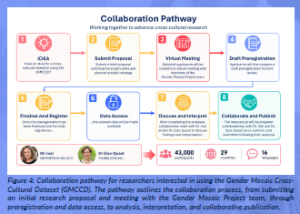
Researchers are invited to submit a brief proposal to Dr Joel (djoel@tauex.tau.ac.il) and Dr Else-Quest (neq@g.ucla.edu). The proposal should outline the study’s aims and planned analytic strategy. Selected applicants will be invited to a virtual meeting with members of the Gender Mosaic Project team and will then prepare a draft preregistration for joint review. Once the preregistration has been finalised and formally registered, the relevant data will be made available. After completing the analyses, collaborators will meet with Dr Joel and/or Dr Else-Quest to discuss the findings and their interpretation. The manuscript will be prepared collaboratively, with Dr Joel and Dr Else-Quest as co-authors, and submitted following their approval (Figure 4).
References
Archer, J. (2004) ‘Sex differences in aggression in real-world settings: A meta-analytic review’, Review of General Psychology, 8(4), pp. 291–322. Available at: https://doi.org/10.1037/1089-2680.8.4.291.
Croft, A., Schmader, T. and Block, K. (2015) ‘An underexamined inequality: Cultural and psychological barriers to men’s engagement with communal roles’, Personality and Social Psychology Review, 19(4), pp. 343–370. Available at: https://doi.org/10.1177/1088868314564789.
Cross, S.E. and Madson, L. (1997) ‘Models of the self: self-construals and gender’, Psychological Bulletin, 122(1), pp. 5–37. Available at: https://doi.org/10.1037/0033-2909.122.1.5.
Eagly, A. and Wood, W. (2012) ‘Social role theory’, in P.A. Van Lange, A.W. Kruglanski and E.T. Higgins (eds) Handbook of theories of social psychology (Vol., pp. 458–476). SAGE Publications.
Eccles J.S. (1999) MADICS Study of Adolescent Development in Multiple Contexts, 1991–1998. Murray Research Archive.
Ellemers, N. (2018) ‘Gender stereotypes’, Annual Review of Psychology, 69, pp. 275–298. Available at: https://doi.org/10.1146/annurev-psych-122216-011719.
Greenberg, D.M. et al. (2018) ‘Testing the Empathizing-Systemizing theory of sex differences and the Extreme Male Brain theory of autism in half a million people’, Proceedings of the National Academy of Sciences of the United States of America, 115(48), pp. 12152–12157. Available at: https://doi.org/10.1073/pnas.1811032115.
Halper, L.R., Cowgill, C.M. and Rios, K. (2019) ‘Gender bias in caregiving professions: The role of perceived warmth’, Journal of Applied Social Psychology, 49(9), pp. 549–562. Available at: https://doi.org/10.1111/jasp.12615.
Heilman, M.E., Caleo, S. and Manzi, F. (2024) ‘Women at work: Pathways from gender stereotypes to gender bias and discrimination’, Annual Review of Organizational Psychology and Organizational Behavior, 11, pp. 165–192. Available at: https://doi.org/10.1146/annurev-orgpsych-110721-034105.
Hyde, J.S. et al. (2019) ‘The future of sex and gender in psychology: Five challenges to the gender binary’, American Psychologist, 74(2), pp. 171–193.
Jewell, J.A. and Brown, C.S. (2014) ‘Relations among gender typicality, peer relations, and mental health during early adolescence’, Social Development, 23(1), pp. 137–156. Available at: https://doi.org/10.1111/sode.12042.
Joel, D. (2012) ‘Genetic-gonadal-genitals sex (3G-sex) and the misconception of brain and gender, or, why 3G-males and 3G-females have intersex brain and intersex gender’, Biology of Sex Differences, 3. Available at: https://doi.org/10.1186/2042-6410-3-27.
Joel, D. et al. (2015) ‘Sex beyond the genitalia: the human brain mosaic’, Proceedings of the National Academy of Sciences of the United States of America, 112(50), pp. 15468–15473. Available at: https://doi.org/10.1073/pnas.1509654112.
Joel, D. (2016) ‘Captured in terminology: sex, sex categories, and sex differences’, Feminism & Psychology, 26, pp. 335–345. Available at: https://doi.org/10.1177/0959353516645367.
Master, A. et al. (2025) ‘The role of stereotypes in gender development and disparities’, Annual Review of Developmental Psychology, 7, pp. 339–362. Available at: https://doi.org/10.1146/annurev-devpsych-111323-115554.
Rudman, L.A. and Fairchild, K. (2004) ‘Reactions to counterstereotypic behavior: the role of backlash in cultural stereotype maintenance’, Journal of Personality and Social Psychology, 87(2), pp. 157–176. Available at: https://doi.org/10.1037/0022-3514.87.2.157.
Saguy, T., Reifen-Tagar, M. and Joel, D. (2021) ‘The gender-binary cycle: the perpetual relations between a biological-essentialist view of gender, gender ideology, and gender-labelling and sorting’, Philosophical Transactions of the Royal Society B: Biological Sciences, 376(1822), 20200141. Available at: https://doi.org/10.1098/rstb.2020.0141.
Spence, J.T. (1993) ‘Gender-related traits and gender ideology: evidence for a multifactorial theory’, Journal of Personality and Social Psychology, 64(4), pp. 624–635. Available at: https://doi.org/10.1037/0022-3514.64.4.624.
Su, R., Rounds, J. and Armstrong, P.I. (2009) ‘Men and things, women and people: a meta-analysis of sex differences in interests’, Psychological Bulletin, 135(6), pp. 859–884. Available at: https://doi.org/10.1037/a0017364.
Tay, L., Su, R. and Rounds, J. (2011) ‘People-things and data-ideas: bipolar dimensions?’, Journal of Counseling Psychology, 58(4), pp. 424–440. Available at: https://doi.org/10.1037/a0023488.
Terman, L.M. and Miles, C.C. (1936) Sex and personality: studies in masculinity and femininity. McGraw-Hill.
Verdugo-Castro, S., García-Holgado, A. and Sánchez-Gómez, M.C. (2022) ‘The gender gap in higher STEM studies: a systematic literature review’, Heliyon, 8(8), e10300. Available at: https://doi.org/10.1016/j.heliyon.2022.e10300.
Xu, Y., Feng, J. and Rahman, Q. (2024) ‘Gender nonconformity and common mental health problems: a meta-analysis’, Clinical Psychology Review, 114, 102500. Available at: https://doi.org/10.1016/j.cpr.2024.102500.
Project name
BeyondGenderBinary
Project summary
As part of the ERC-funded BeyondGenderBinary project, we collected responses from approximately 43 000 people across 29 countries (about 1500 per country). Participants completed a set of self-reported behavioural and psychological measures that have been reported to show large sex/gender differences in English-speaking samples. The countries show wide variation on many national indices. This article describes the dataset and calls for collaborations.
Project partners
Dr Veronica Kostenko, PhD, is a researcher at the Gender Mosaic Lab at Tel Aviv University. Her interdisciplinary research focuses on gender and sexuality, intersectionality, and migration. Drawing on survey methods, advanced statistical techniques, and experience in cross-cultural studies, she examines how these dimensions shape experiences across diverse populations.
Prof. Nicole Else-Quest, PhD, is Professor of Education and Chair of the Social Sciences Interdepartmental Programme at the University of California, Los Angeles. Her interdisciplinary research on gendered patterns of development among diverse groups is focused on broadening participation across the sciences.
Project lead profile
Prof. Daphna Joel, PhD, is Professor of Neuroscience and Psychology at Tel Aviv University. She studies questions related to brain, sex and gender using various analytical methods to analyse diverse datasets, from large collections of brain scans to information obtained with self-report questionnaires. In a series of papers, she described and tested the ‘mosaic’ hypothesis.
Project contacts
Prof. Daphna Joel
School of Psychological Sciences and Sagol School of Neuroscience
Tel Aviv University, Israel
Email: djoel@tauex.tau.ac.il
Web: gendermosaic.tau.ac.il
Funding
This project has been funded by the European Research Council (ERC) under the European Union’s Horizon Europe research and innovation programme (Grant agreement No. 101054741 [BeyondGenderBinary]).
Views and opinions expressed are, however, those of the author(s) only and do not necessarily reflect those of the European Union or the ERC. Neither the European Union nor the granting authorities can be held responsible for them.
Figure legends
Figure 1: The gender mosaic. Data were obtained from the Maryland Adolescent Development in Context Study (Eccles, 1999) as shown in Figure 1. Of the different measures of behaviour, personality characteristics, and attitudes available in MADICS, we analysed data for 7 variables with the largest sex/gender differences: Expectations for sexual discrimination, Communication with mother, Worries about weight, Masculine self-esteem, Communication with peers, Problem behaviour, and Gender-related attitudes. Using the actual distributions of women and men in the sample, we defined for each variable ‘feminine’ (pink) and ‘masculine’ (blue) scores as the scores of the 33 % most extreme women and men, respectively. In the diagrams, each row represents a single person; each column, the score on a single psychological characteristic out of 7. Scores range from ‘feminine’ (darker pink) to ‘masculine’ (darker blue). White indicates that the score was gender-neutral, that is, in between the feminine and masculine scores. (Recreated with permission on the basis of Figure S2A in Joel et al., 2015).
Figure 2. The map shows the 29 participating countries included in the cross-cultural study. Working with 3 online survey companies—Prolific, dataSpring, and BeSample—we recruited approximately 1500 women and men from each of 29 countries. The data was collected across 16 languages (marked using different colours), providing broad geographical and cultural representation across North and South America, Europe, Africa, and Asia.
Figure 3: Psychological and behavioural domains included in the Gender Mosaic Questionnaire (GMQ). The figure summarises the 7 domains assessed—occupational preferences, systemising, empathising, partner preferences, sexual behaviours and preferences, physical aggression, and leisure interests—alongside their factor structure and measurement invariance across countries. Invariance is shown for configural thresholds, and thresholds and loadings, with results classified as good, approximate/partial, or none.
Figure 4: Collaboration pathway for researchers interested in using the Gender Mosaic Cross-Cultural Dataset (GMCCD). The pathway outlines the collaboration process, from submitting an initial research proposal and meeting with the Gender Mosaic Project team, through preregistration and data access, to analysis, interpretation, and collaborative publication.