
After a 3-year journey, the DRG4FOOD project comes to a close. The DRG4FOOD consortium faced the challenge of promoting trust, transparency, and responsibility in the food chain and of developing and demonstrating a collection of innovative solutions for a digital food system.
Throughout this journey, we witnessed firsthand how technology evolved to serve an increasingly extractive, advertising-driven business model that steadily eroded end users’ trust in digital services. Much of this technology was built for ‘Big Tech’ platforms.
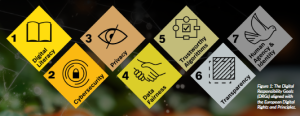
Part of our mission was to start shifting this paradigm by advocating for a more diverse, fair, and human-centred perspective, laying the foundations for new use cases and technology development that could contribute to a more sustainable food ecosystem that is trustworthy by default. At the core of our approach to designing a data-driven food system based on trust, responsibility, privacy, and user sovereignty—and aligned with the European Digital Rights and Principles—are the Digital Responsibility Goals (DRGs).
Another key element of the project was the involvement of researchers, SMEs, and entrepreneurs in a ‘development and demonstration’ process. Through a structured open funding programme, we supported ready-to-scale, data-driven solutions for the food system—with a strong scientific and/or technological background—in the areas of Targeted Nutrition, Food Traceability, and Consumers’ Food Choices. This collaborative approach ensured that ideas could be tested, validated, and strengthened in real-world contexts.
Main outcome
The guidelines for a more trustworthy digital food system: the DRG Playbook
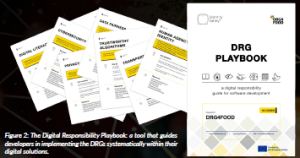
The Digital Responsibility Playbook is a tool that guides developers in implementing the DRGs systematically within their digital solutions. This manual translates the DRGs’ guiding criteria into practical questions and recommendations, instructing project participants on how to fulfil DRG4FOOD’s vision of a more trustworthy, data-driven food system.
The playbook is divided into sections, one per Digital Responsibility Goal. Each section contains key questions that guide the design and development of digital technologies, a checklist
of recommended implementations to support more responsible digital technology, resources to support implementation, and an exemplary scenario demonstrating optimal implementation.
The playbook is publicly available as an open-access publication via the DRG4FOOD website or the DRG4FOOD Toolbox.
The DRG Playbook in action: the DRG4FOOD Toolbox and the Trust Toolkit
Frameworks such as the DRGs provide guidance for developers and product owners on designing ethically and responsibly, but the true impact of those efforts depends on whether users actually experience the resulting technologies as trustworthy.
This is why the ability to measure trust matters. Trust is relational and contextual; it reflects how people feel when engaging with a system, while trustworthiness is demonstrable and designable. Understanding both is crucial to closing the gap between responsible design intentions and lived user experience.
The Trust Toolkit aims to help teams understand how their design and development choices influence user trust. Developed as a practical, research-based framework, it enables developers to assess how end users experience trust when interacting with their digital solutions. It combines methods to trace the dynamics of trust formation—from expectations to experience—giving developers practical insight into how trustworthy their solutions appear and how that perception evolves through use. By focusing on trust as a measurable outcome, organisations can make responsibility visible and actionable. Insights drawn from trust assessments can help product teams refine features and improve transparency, building technologies that not only meet ethical standards but also earn genuine user confidence.
How does it work? The evaluation begins before interaction, using guided reflection and survey instruments to capture users’ ‘images of trust’: their expectations, assumptions, and desired experience of a new digital service. This establishes a baseline of trust orientation—how optimistic or cautious users feel, what they consider essential for trust (e.g. transparency, accountability, security), and where they anticipate risks.
Participants then engage with the digital solution in a real or simulated scenario. Standardised surveys and behavioural observations record the actual trust experience across multiple dimensions—such as reliability, transparency, competence, integrity, benevolence, security, and usability—constructs grounded in scientific trust research but also well aligned with the DRGs.
The DRG Playbook and the Trust Toolkit are at the core of the DRG4FOOD Toolbox, along with the DRG Database, DRG Developer Guides, and the DRG4FOOD Pilot Projects. These consolidated contributions provide a reference catalogue of predominantly open-source tools, technologies, and solutions that have been guided by the Digital Responsibility Goals framework.
The digital responsibility toolbox was initially developed to support the DRG4FOOD pilot project participants in designing and developing more digitally responsible solutions, while ensuring that their Digital Responsibility Goals could be adequately maintained throughout the product lifecycle. As the DRG4FOOD Toolbox evolves, it is becoming a public reference aimed at a wider audience of potential users and contributors beyond the project.
To access the DRG4FOOD Toolbox, visit the page www.drg4foodtoolbox.eu or click on the link: drg4foodtoolbox.eu
DRG4FOOD applied: our DRG pilot projects
One of the pillars of DRG4FOOD was to involve European researchers, entrepreneurs, and SMEs in the creation and implementation of more trustworthy digital solutions in key areas that directly affect consumers’ lives: food data tracking and traceability from ‘farm-to-fork’, food nutrition, and consumer food choices.
Over the course of the project, we invited, selected, and mentored 8 consortia through a programme featuring 2 open calls. A total funding pool of €1 900 000 was made available on an equity-free basis, with each pilot project receiving a maximum budget of €300 000.
The 8 funded solutions are:
- ATTESTED (Food Tracking) developed a set of interoperable technologies to enhance efficiency in agriculture and food production. This toolbox enables transparent, efficient, and sustainable traceability and monitoring across the entire farm-to-fork journey, empowering both producers and consumers—developed by Commons Lab, FiBL, and Valdibella.
- CacaoTech (Food Tracking) built a circular, data-driven solution utilising whole cacao pods. Through NIR-based quality checks and traceability, cacao produce quality is linked directly to farmers, while the system further supports EU deforestation compliance. Tested in Ecuador, it reduced waste by 30 % and turns by-products into high-value ingredients and fertilisers—developed by Pacha de Cacao, Wageningen University, and the Czech University of Life Sciences Prague. It showcases how digital tools can drive sustainability in global supply chains.
- SafeNutriKids (Targeted Nutrition) brought together partners from Estonia, Bulgaria, and Turkey to create an AI-powered nutrition education app for children aged 6–12. Focusing on both healthy eating and digital literacy, it blends technology and interactive learning to promote better nutrition and responsible online behaviour—developed by Phase Growth, the Trakia University business incubator Go-up, and the Sabri Ulke Food Research Foundation.
- NutriWell (Targeted Nutrition) developed AI-based enablers, focusing on improving nutrition and well-being for older adults (65+) through personalised menus and social cooking. The project included a Nutrition Data Space, Personal Data Wallet, AI Nutrition Planner, Cuisine Allocator, and Social Cooking Tool, ensuring trusted, secure, and consent-based data sharing—developed by Innova Living, Institute of Technology and Development, Sofia Development Association.
- PINACLE (Targeted Nutrition) developed a smart tool that matches food donations with recipients’ dietary needs, promoting healthier and more sustainable diets. It digitises food redistribution networks, supports responsible nutrition, reduces food waste, and ensures trusted data exchange, validated through real-life pilot cases. developed by Konnecta Systems p.c., Cohesion Network 2gether, Sapienza University of Rome.
- GENIE (Targeted Nutrition) transformed grocery shopping through ultra-personalised nutrition advice based on genetic, microbiota, and biochemical data. Developed by GUNDO, ADN Institut, and i3S, the project integrated advanced biological insights into everyday food choices, helping users shop smarter and eat healthier. It assessed how such personalised diets improve gut microbiota and overall well-being, illustrating how such deep-personalisation can be aligned with responsible data practices—developed by Gundo, ADNinstitut, I3S.
- DISH (Targeted Nutrition) individualised the cooking experience. By providing recipes tailored to individual needs, it enables a healthier and more sustainable diet. DISH used advanced graph technologies and methods from artificial intelligence to create individual cooking recipes, based on the concept of ingredient replacement and automated nutritional scoring.
- NutriSight (Consumers’ Food Choices) developed a tool that automatically extracts nutritional information from photos of food packaging. Using deep learning, it combines a machine learning model and API that works across multiple languages and countries. The tool also presents this data in a user-friendly way, such as through the Nutri-Score system—developed by Open Food Facts and El Coco.
The DRG4FOOD legacy
Throughout its journey, DRG4FOOD met and collaborated with experts, entrepreneurs, policymakers, and fellow projects that share the same goal of building a trustworthy digital ecosystem with consumers at its centre. Together with the EU-funded project FOODITY, the DRG4FOOD consortium created the Data4Food Cluster, whose main objective was to bring these efforts together and communicate project outcomes with a unified voice.
Recently, the EU-funded projects SOS Food and FoodDataQuest joined the cluster, ensuring continuity and amplifying the collective impact of these initiatives, taking forward the legacy of DRG4FOOD and FOODITY to further explore and shape pathways toward a more sustainable food system.
EUFIC: food facts for healthy choices
This article is part of the collaboration between EUFIC and the PRj, as members of its editorial board. EUFIC – The European Food Information Council, is a non-profit organisation, established in 1995. EUFIC’s mission is to provide engaging science-based information to inspire and empower healthier and more sustainable food and lifestyle choices.
PROJECT SUMMARY
The EU-funded DRG4FOOD project aimed to create a data-driven food system that inspires trust throughout the food chain. To achieve this objective, the DRG4FOOD project developed and demonstrated, through a structured open funding programme, 8 pilot solutions in 3 use cases: Food Tracking, Targeted Nutrition and Consumers’ Food Choices. Moreover, DRG4FOOD developed a practical open-source toolbox to apply and replicate the Digital Responsibility Goals.
PROJECT LEAD PROFILES
Kai Hermsen, DRG4FOOD’s coordinator, is a ‘trust in tech’ activist. He is currently building the Twinds Foundation concerned with establishing open-source ‘disposable identities’ as a key technical enabler for building trust online. He coached different organisations on digital trust and cybersecurity. With Identity Valley, he actively drove the transition towards a more responsible digital space along the Digital Responsibility Goals.
PROJECT PARTNERS
DRG4FOOD gathers 7 European partners whose expertise and knowledge in the field of technology, trust and food will be crucial to achieve trust in a data-driven food system by implementing Digital Responsibility Goals for the food sector. “As a consortium, we believe that technology is not an end in itself but acts as an empowering enabler.”
CONTACT DETAILS
Kai Hermsen
Email: kai.hermsen@twinds.org
Email: info@drg4food.eu
Web: drg4food.eu
Web: SFSN (hashtag: #DRG4FOOD)
LinkedIn: /company/scifoodhealth
X: @SciFoodHealth
FUNDING
This project has received funding from the European Research Executive Agency (REA) under the Horizon Europe research and innovation programme (Grant agreement No. 101086523).
Funded by the European Union. Views and opinions expressed are, however, those of the author(s) only and do not necessarily reflect those of the European Union or the European Research Executive Agency (REA). Neither the European Union nor the granting authority can be held responsible for them.
Figure legends
Figure 1: The Digital Responsibility Goals (DRGs) aligned with the European Digital Rights and Principles.
Figure 2: The Digital Responsibility Playbook: a tool that guides developers in implementing the DRGs systematically within their digital solutions.