
Aluízio Marino and Moisés Kopper
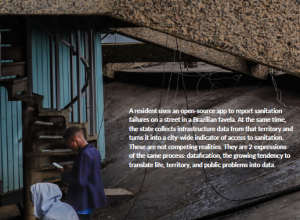
A resident uses an open-source app to report sanitation failures on a street in a Brazilian favela. At the same time, the state collects infrastructure data from that territory and turns it into a city-wide indicator of access to sanitation. These are not competing realities. They are 2 expressions of the same process: datafication, the growing tendency to translate life, territory, and public problems into data.
This essay invites readers to unsettle scales—an idea inspired by Doreen Massey and Jacques Revel. ‘Scale’ is how we usually organise reality: local, national, global. To unsettle scales is to stop treating these levels as separate boxes and to follow how power, categories, and evidence move across them. The central argument is simple: more democratic governance will not come from choosing either ‘bottom-up’ citizen data or ‘top-down’ state data. It will come from building a critical dialogue between them—and from confronting the power asymmetries that shape how data is produced and used.
Why data has become a political battleground
We are in a new era of data production. Phones, platforms, cameras, and sensors continuously generate data. The main issue is no longer a lack of information but overload—combined with concentration. Data has become a major commodity, dominated by large technology companies. Their business models depend on extraction (collecting), profiling (classifying), and monetisation (turning traces into value), including by selling ‘smart’ solutions to governments.
This is why digital technology cannot be treated as neutral or automatically ‘participatory’. The same infrastructures that allow reporting problems or organising communities can also amplify disinformation, intensify surveillance, and reinforce inequality. Datafication changes what counts as evidence, what gets measured, and what becomes visible to decision-makers. It also changes who has authority: a platform’s dashboard, a predictive model, or a government indicator can quickly become ‘the truth,’ even when the categories behind them are contested.
Against this background, we propose a horizon: treating data as a common good rather than a private commodity. Inspired by Elinor Ostrom and in dialogue with Morozov and Bria, this horizon is not a single recipe. It is a direction. Open-source tools, participatory methods, and open data can help—but only if accompanied by governance arrangements that protect communities, keep institutions accountable, and prevent extraction by powerful actors.
Crucially, initiatives of ‘data as a common’ already exist in 2 places often imagined as separate: civil society and the state. In popular territories, communities produce their own data to support claims for rights. Inside institutions, some public servants and technicians push for fairer categories and better representation. Unsettling scales means paying attention to the connections—sometimes cooperative, sometimes conflictual—between these sites.
Censuses: old tools, new disputes
One arena where these tensions are clear is the population census. In many contexts, there is a growing fascination with ‘big data’ and automated capture, as if sensors and administrative databases can replace traditional surveys. In some European countries, censuses are increasingly based on registers instead of door-to-door work. In more authoritarian settings, politicians may celebrate ‘technological modernity’ to justify weakening or discrediting statistics that could contradict official narratives.
But abandoning the census would be a mistake. Strong, independent, well-funded public statistical institutes are a democratic infrastructure. They provide a periodic portrait of society and territory that helps anchor policy in reality. When these institutes are precarised—through budget cuts, weakened field capacity, and overworked staff—societies lose a key instrument for public accountability.
At the same time, censuses have never been innocent. Historically, enumeration and classification have served domination, including colonial rule and racial hierarchy. That is why the democratic task is not to ‘trust’ census data blindly, but to contest and improve it: to make institutions more porous to public debate, and to treat categories as negotiable rather than fixed.
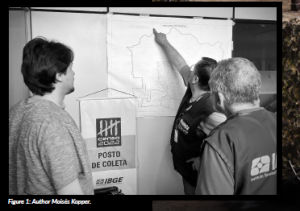
Brazil offers a clear example. At the Brazilian Institute of Geography and Statistics (IBGE), tenured technicians acted as internal advocates to ensure the most recent census was carried out. The institutional opening produced concrete changes: replacing the stigmatising term ‘subnormal agglomeration’ with ‘favelas and urban communities’, and including quilombola and indigenous communities for the first time. Here, social demands for visibility met internal institutional cracks, resulting in category changes with real political consequences.
Portugal and Germany highlight another sensitive area: ethnoracial categories. In Portugal, technicians at the National Statistics Institute (INE) have pushed to include ethnoracial dimensions in the census to better document inequality. In Germany, where the census does not ask about ethnicity, the Afrozensus initiative—led by activist collectives—built an autonomous survey to foreground structural racism experienced by Black populations. In both cases, historical abuses of racial classification create understandable hesitation. The shared challenge is difficult but unavoidable: how can societies document inequality without turning categories into tools of persecution again?
These cases show why we should not treat ‘official data’ and ‘community data’ as separate worlds. The most promising path is to strengthen public institutions while also opening them to dispute—transforming censuses and databases from instruments of one-way classification into arenas where the state’s power to name can be questioned and revised.
Situated science: when local evidence shifts the centre
A second arena is what is often called citizen-generated data. In some Global North debates, this is framed as a new type of civic engagement. In Latin America, it resonates with older traditions: Fals-Borda’s participatory action research and Paulo Freire’s pedagogy of the oppressed, where producing knowledge is part of political organisation.
We use the term situated science to emphasise that these practices are not simply ‘local data collection’. They are ways of producing evidence grounded in lived experience, aimed at territorial justice, and designed to travel across arenas.
A strong example is Redes da Maré in Rio de Janeiro. For years, the organisation has developed methods to document the impacts of police operations in favelas. The key move is to shift metrics: instead of focusing on ‘police productivity’, they measure everyday harms that are often erased from official accounts—missed school days, disrupted health services, cancelled medical procedures, and broader social impacts. This evidence supported the ADPF das Favelas, a case brought to Brazil’s Federal Supreme Court seeking rules to protect fundamental rights during police operations. Data produced at a neighbourhood scale moved upward into a national legal arena, helping contest security policy.
Other contexts show similar dynamics, including peacebuilding and territorial rights work where communities document memory, violence, and resistance—forms of knowledge often treated as ‘non-data’ by bureaucratic systems. The broader lesson is that connecting scales is not smooth cooperation. It is translation and struggle. Situated evidence can contradict official categories, forcing institutions to reconsider what counts.
The minefield: visibility, disinformation, and AI extraction
Because data is political, it is also risky: 3 tensions are central.
- Visibility vs control. Making marginalised realities visible can support rights and redistribution. But visibility can also enable surveillance and targeting. Data gathered for justice can be repurposed for policing or stigmatisation. This is why data projects need safeguards, governance, and constant reflexivity.
- Disinformation travels across scales. Disinformation is not only individual ‘error’. It is often strategic: designed to delegitimise knowledge (for example, climate science) or destabilise political disputes. A narrative can start locally and spread globally through platforms; global campaigns can be targeted at very local conflicts. This blurring of borders demands responses that combine literacy, verification networks, and accountability for platform infrastructures.
- AI and the capture of commons. Open data has long been promoted as a tool for transparency and participation. It remains important, but it now faces automated extraction. Bots and crawlers can scrape public repositories to train proprietary AI models. A telling case is WikiFavelas, a collaborative platform built to document the history, culture, and struggles of favelas. Its content—produced as a digital common—can be absorbed by corporate AI systems and turned into decontextualised outputs, while value and power concentrate elsewhere. This forces a rethink of openness: not to abandon it, but to design licences and governance that protect communities from predatory capture.
Conclusion: a compass, not a recipe
Datafication is not a technical trend. It is a battlefield over representation, evidence, and the power to name the world. Unsettling scales helps us see that there is no privileged level where democracy ‘naturally’ resides. What matters is the capacity to build bridges—sometimes cooperative, sometimes conflictual—between community knowledge, public institutions, and the global infrastructures that increasingly shape daily life.
Rather than offering a final map, this essay proposes a compass. Its direction is the horizon of data as a common: collective resources governed through dialogical arrangements and aimed at social justice. The practices that follow—strengthening independent statistical institutes, opening categories to negotiation, supporting situated science, building verification capacities, and protecting commons from algorithmic extraction—are not technical fixes. They are political work, always incomplete, and always contested. That unfinishedness is not a weakness; it is what democratic struggle looks like in a datafied world.
References
Bria, F. and Morozov, E. (2018) Ripensare la smart city. Codice Edizioni.
Fals-Borda, O. and Rahman, M.A. (1991) Action and knowledge: Breaking the monopoly with participatory action research. Apex Press.
Freire, P. (1970) Pedagogy of the oppressed (M. B. Ramos, Trans.). Herder & Herder. (Original work published 1968)
Giannella, L. de C. and Catalá, L.S. (2025) ‘Favelas e Comunidades Urbanas: a nova nomenclatura adotada pelo IBGE e o retrato da diversidade desses territórios’, Revista Brasileira De Estudos Urbanos E Regionais, 27(1). Available at: https://doi.org/10.22296/2317-1529.rbeur.202532
Massey, D. (1993) ‘Questions of Locality’, Geography, 78(2), pp. 142–149. Available at: http://www.jstor.org/stable/40572496
Massey, D. (2007) World city. Polity Press.
Moraes, C.B. and Rosendo, S. (2020) ‘“ADPF das favelas” e a garantia do direito à vida na Maré’, Redes da Maré. Available at: https://www.redesdamare.org.br/br/artigo/185/adpf-das-favelas-e-a-garantia-do-direito-a-vida-na-mare (Accessed: 13 February 2026).
Outras Palavras (2025) ‘Wikifavelas: O dilema de uma plataforma atacada por robôs’, Outras Palavras. Available at: https://outraspalavras.net/tecnologiaemdisputa/wikifavelas-o-dilema-de-uma-plataforma-atacada-por-robos/ (Accessed: 13 February 2026).
Revel, J. (Ed.). (1996). Jeux d’échelles: La micro-analyse à l’expérience. Gallimard; Le Seuil.
PROJECT SUMMARY
InfoCitizen explores how new forms of datafication change citizenship practices in the Global South by charting grassroots and institutional data efforts and their impact on identity, citizenship and policy in Brazil, Portugal, Germany, Tanzania and Kenya. Combining archival research, digital humanities, audiovisual techniques, and mixed methods, InfoCitizen examines how top-down and bottom-up data ecosystems come together to redefine the sociocultural and political-economic citizenship of marginalised populations. We connect practitioners, stakeholders, experts, and citizens by producing insights and tools to visualise data’s role in democratic transformation and citizenship dynamics today.
PROJECT PARTNERS
InfoCitizen engages in global partnerships to enhance local data representation and community voices. Collaborations include Africa’s Voices Foundation in Africa and Afrozensus in Germany; and the NGO Redes da Maré, GENI (the Group for the Study of New Illegalisms at Fluminense Federal University), and IESP-UERJ (Institute for Social and Political Studies of the State University of Rio de Janeiro) in Brazil. Each partner contributes to advancing inclusive, community-focused data initiatives and supporting InfoCitizen’s mission to empower diverse populations.
PROJECT LEAD PROFILE
Kopper is a Research Professor at the University of Antwerp and Associate Editor of the Journal of Latin American and Caribbean Anthropology. He is the author of Architectures of Hope and co-editor of Subjectivity at Latin America’s Urban Margins. He held postdoctoral appointments at the Free University of Brussels, the Max Planck Institute for the Study of Societies, and the University of São Paulo with grants from the ERC, the Alexander von Humboldt Foundation, and the São Paulo Research Foundation. He is interested in informal markets; class mobility; material hope; the politics of datafication, inequality, and expertise; statecraft, and societal resilience.
PROJECT CONTACTS
Moisés Kopper, Principle Investigator
Institute of Development Policy (IOB), University of Antwerp Lange Sint-Annastraat, 7, 2000, Antwerpen, Belgium
Email: moises.kopper@uantwerpen.be
Email: infocitizen@uantwerpen.be
Web: https://infocitizen.eu
LinkedIn: /infocitizen
X: /InfoCitizen8
YouTube: @InfoCitizen8
FUNDING
This project has received funding from the European Research Council (ERC) under the European Union’s Horizon Europe research and innovation programme under grant agreement No. 101076030.
Funded by the European Union. Views and opinions expressed are, however, those of the author(s) only and do not necessarily reflect those of the European Union or European Research Council. Neither the European Union nor the granting authority can be held responsible for them.
Figure legends
Figure 1: Author Moisés Kopper.
Figure 2: Author Alina Kiel.
Figure 3: Author Berta Fernandez.