
The European Commission promotes the circular economy to reduce the environmental footprint of food packaging, while the European Plastics Strategy sets ambitious targets for sustainable materials. Although circular packaging is increasingly supported at both policy and industry levels, implementation remains limited, largely due to the need for stronger cross-chain collaboration.
The Value4Pack project (I3 programme, GA No. 101132867), running until October 2025, directly addresses this challenge by fostering innovation, capacity-building and interregional cooperation under the EU Green Deal and the Packaging and Packaging Waste Regulation (PPWR). By connecting ten of the 14 European clusters from both advanced and less-developed regions, the project facilitates knowledge sharing, supports SMEs and scales best practices to strengthen a sustainable and competitive food packaging ecosystem. Originating from the S3 Partnership Food Packaging, which is a cooperation between clusters to accelerate the transition towards sustainable food packaging and support EU countries and regions in the development of research and innovation strategies. Value4Pack promotes structured collaboration across the full packaging value chain—including food and packaging companies, machinery suppliers, retailers, recyclers, research organisations, consumer groups and policymakers. This inclusive approach lowers barriers for the agri-food and packaging industries to access and implement innovative solutions, supporting the creation of new value chains and accelerating Europe’s transition towards smart and circular packaging.
A core ambition of Value4Pack is to help SMEs adopt the 4R principles—Refuse, Reduce, Reuse, Recycle—through eco-design, efficient resource use, reusable systems and high-quality recycling. A key feature of the project is linking advanced regions (GDP per capita > 100% of EU average, strong R&D and innovation ecosystems) with less-developed regions (GDP per capita < 75% of EU average, limited technology and investment access).
By linking these regions, Value4Pack facilitates the transfer of knowledge, technical expertise and best practices from more advanced areas to regions with untapped potential. This interregional collaboration not only strengthens the capacity of less-developed regions to implement innovative and sustainable packaging solutions but also creates opportunities for mutual learning, joint projects and cross-border partnerships, effectively narrowing innovation gaps and promoting a more balanced, resilient and competitive European food packaging ecosystem.
An interregional value chain analysis conducted at the start of the project revealed both progress and challenges: developed regions benefit from more advanced recycling infrastructures, but still face issues related to packaging that has a potential contact with food, recycling quality and collection harmonisation. Less-developed regions often lack infrastructure and R&D capacity but demonstrate strong potential if adequately supported. In response, five less-developed regional roadmaps (Poland, Lithuania, Hungary, Latvia, Slovenia) were created through interactive workshops. These propose actions such as scaling eco-design approaches, piloting deposit-return and packaging-as-a-service models and improving recycling quality. Already, these roadmaps have given rise to pilot projects, R&D collaborations and awareness campaigns, serving as strategic tools for SMEs, clusters and policymakers while reinforcing alignment with the Green Deal and PPWR.
The Value4Pack Consortium identified key barriers to a sustainable and circular
European food packaging sector:
- Regulatory fragmentation – differing standards, waste collection and labelling across EU countries hinder scalability; harmonised EU-wide standards and Digital Product Passports are recommended.
- Overpackaging and design issues – excessive materials and multi-layering reduce recyclability; innovation, R&D and co-creation can promote minimalistic and reusable designs.
- Material diversity and SME constraints – over 200 types of plastics complicate recycling, with SMEs facing technological and financial limits; targeted financing, grants and EU frameworks are needed.
- Knowledge gaps and limited collaboration – slow adoption of innovations; digital platforms and regular exchange events can foster knowledge sharing and value chain collaboration.
- Consumer awareness – misleading labels and limited education reduce recycling efficiency; standardised labelling and long-term educational campaigns are required.
- Lack of environmental assessment tools – difficulty prioritising initiatives; scalable tools for measuring environmental performance are recommended to guide decision-making.
Another defining aspect of Value4Pack is its focus on empowering SMEs. While the project does not provide direct funding, it creates value through tailored training, increased visibility and access to strategic networks and markets. SMEs benefit from activities such as pitch training, showcasing innovations at international trade fairs and structured matchmaking with potential partners and investors. For example, the French SME Gainosplast, a member of the Polymeris network, gained international exposure at an event in Austria and, through Value4Pack, collaborated with the Hungarian company Ugrinpack on material testing, opening opportunities for future cooperation.
Value4Pack helps SMEs adopt sustainable and circular practices by connecting less-developed and advanced regions and fostering joint initiatives through co-creation and design-thinking. The expert team (ET) consulted food packaging experts, while the advisory board provided industrial and academic guidance to ensure project relevance.
An online matchmaking platform linked SMEs with collaborators and investors, while the ET monitored 30 selected ideas from 60 proposals, using standardised templates to guide business cases beyond the project. Thematic webinars, networking events and the “Innovative SMEs all over EU” pitch event held in November 2024 strengthened skills, exposure and partnerships. Fifteen SMEs were selected as most promising and continue to receive support, demonstrating Value4Pack’s impact in advancing Europe’s sustainable packaging agenda.
Workshops have played an equally important role. The first regional workshop, held online in January 2024, mapped and analysed food packaging value chains, validated diversity of stakeholders, and identified bottlenecks, opportunities and competences. In March 2024, a workshop hosted by LITMEA in Kaunas deepened discussions on resilience and competitiveness, covering collaborative R&D, technology transfer and policy advocacy. The interregional workshop in Finland in May 2024 further benchmarked practices and generated over 50 innovation topics linked to the 4R framework, feeding into the upcoming pitching competition in Budapest.
Together, these activities demonstrate how Value4Pack has functioned as a true’ collaboration accelerator’, reinforcing interregional trust, facilitating project-based cooperation and showing how shared knowledge and networks can drive innovation, support SMEs and strengthen the European food packaging ecosystem.
By 2025, Value4Pack has achieved significant milestones, including:
- an action plan established to maintain an active and engaged food packaging ecosystem
- 40 interregional alliances created or in preparation to promote collaboration
- 20 clusters engaged in ecosystem-building activities
- 15 EU countries participating in the Value4Pack initiative
- 13 regional and national ecosystems (S3 sub-partnerships) established to support local and cross-border coordination.
Looking ahead, future events and outlooks of the Value4Pack project highlight the opportunities for sustained interregional collaboration, ensuring that the project’s achievements can be carried forward and expanded in the years to come.
Firstly, the Value4Pack project concluded with a two-day final event in Ghent, Belgium, on 2 October 2025, promoting the outcomes achieved and paving the way for future collaborations.
The first day was an internal meeting with S3 Food packaging partnership to discuss the 2026 work plan, after project objectives and conclusion of the project. The second day was the final event: The morning gathered 60 stakeholders to present results, business cases and collaborations with European actors. The session closed with B2B meetings to encourage collaborations. This also coincided with the 20th year of innovation of Pack4Food, and in the afternoon 100 people gathered to celebrate innovation.
The long-term vision of Value4Pack, through S3 Food packaging, is to ensure that the progress made during the project continues to generate impact well beyond its official conclusion on 31 October 2025. The project has laid the foundations for a sustainable, collaborative and innovation-driven European food packaging ecosystem, where SMEs remain at the heart of the transition. By equipping them with skills, networks and tools to thrive, Value4Pack aims to leave behind a self-sustaining legacy that strengthens Europe’s competitiveness while advancing circular and sustainable practices. As part of this vision, Value4Pack seeks to foster cross-regional innovation ecosystems, accelerate the transition to circular food packaging value chains across Europe, and ensure the competitiveness of EU SMEs in global markets.
A key part of this legacy lies in the ecosystems and collaborative structures built throughout the project. The action plan for liaison and the 13 regional and national ecosystems (S3 sub-partnerships) established during its implementation are designed to endure as long-term platforms for dialogue, exchange and co-creation. These structures will foster continued engagement between clusters, companies, research institutions and policymakers, while aligning with evolving EU policies such as the Packaging and Packaging Waste Regulation and the Green Deal Industrial Plan. The development of at least ten interregional multi-actor business cases further anchors this long-term impact, providing concrete collaboration models that can attract funding and remain viable beyond the project’s duration.
Policy influence and knowledge continuity are central to the project’s outlook. Value4Pack’s recommendations, best practice guides and business casebook will serve as practical tools for SMEs, clusters and policymakers, informing strategic decision-making and policy design. Thematic working groups established during the project are expected to continue as collaborative platforms for technical discussion and innovation exchange, addressing emerging topics such as biobased packaging, advanced recycling technologies and smart packaging systems. The International Funding Radar, created to identify and monitor relevant opportunities, will be transferred to the S3 Partnership Food Packaging, ensuring stakeholders retain access to financing intelligence long term.
Looking ahead, Value4Pack aspires to position the European food packaging ecosystem as a global leader in sustainable and circular solutions. By maintaining interregional networks, fostering collaboration between advanced and less-developed regions, and supporting SMEs in accessing international markets, the project’s outcomes are expected to extend influence beyond Europe. In this way, Value4Pack is set to evolve from a time-bound initiative into a long-lasting partnership that accelerates innovation, reinforces ecosystems and shapes a resilient and sustainable food packaging sector for the future.
As a conclusion, the project Value4Pack has shown the strength of collaboration between clusters, SMEs and regions in accelerating the shift to sustainable food packaging. By aligning with the EU Green Deal and the PPWR, it provides SMEs with concrete pathways to innovate, boost competitiveness and adopt circular practices. Beyond individual initiatives, the project has built lasting interregional partnerships, fostered knowledge exchange and offered targeted support such as pitch training, international exposure, and webinars. Its legacy is an empowered SME community and a stronger ecosystem for sustainable packaging, ensuring Europe’s regions are better equipped to meet regulatory challenges and seize new market opportunities.
Project summary
Value4Pack strengthens the food packaging ecosystem by connecting advanced and less-developed regions within the European Union. The project supports SMEs in adopting circular solutions, fosters interregional collaboration, and accelerates the transition towards sustainable packaging. Through training, matchmaking and innovation roadmaps, Value4Pack promotes eco-design, resource efficiency and new value chains, aligned with the EU Green Deal and Packaging Waste Regulation.
Project partners
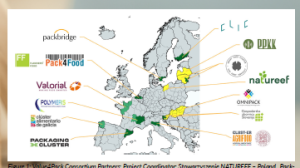
Project Coordinator: Stowarzyszenie NATUREEF, Poland Pack4Food, Belgium
Flanders’ FOOD, Belgium
Packaging Cluster Association, Spain
Lithuanian Food Exporters Association (LitMEA), Lithuania Valorial competitiveness cluster association, France
Clust-ER AgriFood, Italy
Nourishing Mother of Studies, University of Bologna, Italy DBH InnoHub KFT., Hungary
Chamber of Commerce and Industry of Slovenia, Slovenia CLIC Innovation, Finland
Packbridge AB (SVB), Sweden,
Galicia Food Cluster Association, Spain
Latvia Party Enterprises, Latvia
Polymeris, France
Project lead profile
Value4Pack is coordinated by Natureef, a Polish cluster specialising in innovations in food and cosmetic packaging. Under the leadership of Jasmina Solecka, Natureef promotes interregional cooperation, supports SMEs and fosters green innovation. The cluster engages companies, universities and R&D actors in building competitive, sustainable solutions for the agri-food and packaging industries in Poland and across Europe.
Project contacts
Natureef
Email: info@natureef.pl
LinkedIn: linkedin.com/company/value4pack/
Funding
Funded by the European Union. Views and opinions expressed are, however, those of the author(s) only and do not necessarily reflect those of the European Union or EISMEA. Neither the European Union nor the granting authority can be held responsible for them.
Grant agreement No. 101132867.