
The need: reducing the impact of fossil-based plastic waste in humanitarian contexts.
Plastic materials play an essential role in humanitarian operations. They are lightweight, versatile, affordable, and easy to transport. This makes them useful in emergency settings, where speed, hygiene, and logistics are critical. Medical products, flexible packaging and other single-use items are widely used in contexts such as natural disasters, armed conflicts, and refugee settings, where assistance must be delivered quickly and safely.
However, these same advantages become a challenge at the end of life. Humanitarian contexts often lack stable waste collection, sorting, and treatment systems, making waste management a practical and environmental challenge for humanitarian organisations (Groupe URD, 2020; WREC, 2023). As a result, plastic waste may remain unmanaged, be openly dumped, burned, or dispersed into the environment. Packaging is a particularly relevant stream. A baseline assessment cited in the Guidelines for Packaging Waste Management in Humanitarian Operations found that 32 % of packaging materials used to deliver food and non-food items in humanitarian operations are made of plastic (JI, 2023). More broadly, land-based sources account for 80 % of marine litter in Europe. Around 85 % of this litter is plastic, and packaging and small plastic items make up nearly 80 % of this plastic waste (European Environment Agency, 2023).
Medical products and their packaging are particularly relevant in this context. Wound dressings must support safe and hygienic wound care, while their packaging must protect the product before use, helping to preserve cleanliness, integrity, and barrier performance. For this reason, the priority is not always to eliminate single-use products, but to redesign them using safer, bio-based, and biodegradable materials suited to their real use and end-of-life conditions.
Bio-based and biodegradable plastic products offer a promising route, especially for applications where collection and recovery are difficult. Nevertheless, biodegradability must be treated carefully. A material should not be described as biodegradable in general terms without considering the environment where it ends up, the expected timeframe, its formulation, additives, thickness, and final product design. Scientific advice to the European Commission has highlighted that biodegradable plastics can be beneficial in specific applications, but only when their environmental fate is properly assessed and supported by evidence (European Commission, Directorate-General for Research and Innovation, 2020).
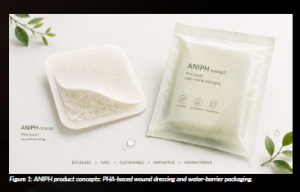
This is the context in which ANIPH operates. The project addresses the negative impacts produced by plastic materials in humanitarian contexts by developing a circular value chain based on polyhydroxyalkanoates (PHAs). These bio-based and biodegradable polymers are being explored as alternatives to fossil-based plastics for 2 target applications: modern wound dressings and recyclable water-barrier packaging. The objective is to develop products that combine technical performance, safety, traceability, and end-of-life design, while avoiding microplastic pollution and supporting clearer information for users, industry, and regulators.
The ANIPH solution: a circular PHA value chain
ANIPH builds on the potential of PHAs, a family of bio-based polymers that can be produced by microorganisms and tailored for different material applications. PHAs are widely discussed as promising biodegradable plastics, as they can be produced from different substrates, including waste feedstocks, and can support circular economy approaches (Zhou et al., 2023). In addition, PHAs are known for their strong biodegradation potential in relevant real-world environments, including soil, freshwater, and seawater. ANIPH goes beyond replacing fossil-based plastics with bio-based materials. It develops the full value chain needed to make these alternatives safe, functional, traceable, and suitable for real end-of-life conditions.
The project works with 2 main PHA-based material families. PHBV is being developed as a semi-crystalline polymer range suitable for processable and biodegradable materials, while PHN is explored as an elastomeric material with potential for adhesives and coatings. Together, these materials support the development of 2 target applications: modern wound dressings and recyclable water-barrier flexible packaging.
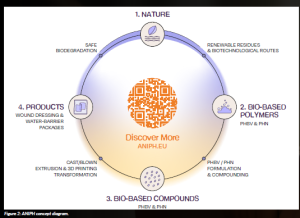
Circularity is introduced from the first stages of the value chain. ANIPH uses renewable residues and circular process streams as feedstocks for PHA production, aiming to reduce dependence on fossil resources while creating value from waste. The production stage is also used to influence key polymer properties, including composition and crystallinity, which are relevant for both processing behaviour and biodegradation performance.
After production, PHBV and PHN are formulated and compounded with safe additives, adhesives, and coatings. This stage is essential to balance technical performance with safe and sustainable design. For the wound dressing route, the project explores 3D printing and the use of probiotics@cellulose as an alternative to conventional antibiotics. For the packaging route, ANIPH combines film extrusion and spray coating to obtain flexible packaging with water-barrier functionality.
A central idea of the project is that biodegradation must be designed, not assumed. ANIPH therefore works on programmed biodegradation across the production, formulation, and manufacturing stages, while also considering recyclability where collection and waste management are possible. This approach links material design with realistic end-of-life scenarios and helps ensure that environmental claims are based on evidence.
Digital tools support the value chain throughout the project. An artificial intelligence (AI) predictive tool is being developed to model relevant properties such as biodegradation, ecotoxicity, and material performance, while the ANIPH information and communication technology (ICT) platform will bring together 3 complementary tools: the Traceability Tool, the Evaluation and Decision Tool, and the Public Tool. The Traceability Tool will help record and connect data across the different stages of the value chain. The Evaluation and Decision Tool is designed to support the safety, environmental, social, and economic sustainability assessment of the materials and products. The Public Tool will provide accessible and reliable information to users and stakeholders. This will help improve transparency, support informed decisions, and contribute to future information and labelling approaches. This digital approach is aligned with the European Commission’s Safe and Sustainable by Design (SSbD) framework, which promotes the design of chemicals and materials that are safer and more sustainable throughout their life cycle (Caldeira et al., 2022).
Together, these elements make ANIPH more than a material development project. It is a co-ordinated effort to connect biotechnology, materials engineering, product design, digital tools, and end-of-life validation into a safer and more transparent PHA-based value chain for humanitarian applications.
Expected impact: from safer materials to better end-of-life decisions
ANIPH aims to deliver impact at several levels: environmental, technological, regulatory, and societal. Its value chain is expected to reduce dependence on fossil resources and support the development of safer alternatives for applications where single-use products remain difficult to avoid.
In the longer term, adopting the ANIPH value chain could contribute to a lower-impact plastic system by reducing dependence on fossil resources, lowering CO2 emissions compared with conventional fossil-based alternatives, supporting biomass recirculation, and avoiding the use of hazardous substances.
At the technological level, the project will advance PHA-based materials, formulations, adhesives, coatings, manufacturing routes, and digital tools from early-stage concepts towards validation in relevant conditions. This includes progressing key developments from Technology Readiness Level (TRL) 2-3 to TRL 4-5, creating a strong basis for future scale-up and industrial uptake.
ANIPH also aims to contribute to better evidence for decision-making. The data generated through material development, biodegradation testing, safety assessment, and sustainability analysis will support more reliable claims and clearer communication on bio-based and biodegradable plastic products. This is particularly relevant for products whose end-of-life behaviour depends on the receiving environment, the material formulation, and the conditions under which they are used and disposed of.
Beyond the project itself, ANIPH seeks to support future standards, certification schemes, and information and labelling systems. By combining material innovation with traceability, safety, and sustainability assessment, the project aims to help users, industry, and regulators make more informed decisions about when and how bio-based and biodegradable plastics can offer real environmental benefits.
References
Caldeira, C. et al. (2022) Safe and sustainable by design chemicals and materials: Framework for the definition of criteria and evaluation procedure for chemicals and materials. Publications Office of the European Union. doi: https://doi.org/10.2760/487955.
European Commission, Directorate-General for Research and Innovation (2020) Biodegradability of plastics in the open environment. Publications Office of the European Union. doi: https://doi. org/10.2777/690248.
European Environment Agency (2023) From source to sea – The untold story of marine litter. Available at: https://www.eea.europa.eu/en/analysis/publications/from-source-to-sea-the-untold-story-of-marine-litter (Accessed: 27 May 2026).
Groupe URD (2020) Environmental footprint of humanitarian assistance: Scoping review for DG ECHO. Available at: https://www.urd.org/en/publication/report-on-environmental-footprint-of-humanitarian-assistance-for-dg-echo-2020/ (Accessed: 27 May 2026).
Joint Initiative for Sustainable Humanitarian Assistance Packaging Waste Management (JI) (2023) Guidelines for packaging waste management in humanitarian operations. Available at: https://logcluster.org/en/document/joint-initiative-guidelines-packaging-waste-management-humanitarian-operations (Accessed: 27 May 2026).
Waste Management and Measuring, Reverse Logistics, Environmentally Sustainable Procurement and Transport, and Circular Economy Coalition (WREC) (2023) Quick guide: waste management. Available at: https://logcluster.org/en/document/wrec-quick-guide-waste-management-august-2023 (Accessed: 27 May 2026).
Zhou, W. et al. (2023) ‘Polyhydroxyalkanoates (PHAs) synthesis and degradation by microbes and applications towards a circular economy’, Journal of Environmental Management, 341, 118033. doi: https://doi.org/10.1016/j.jenvman.2023.118033.
Project summary
ANIPH develops a circular PHA-based value chain for safer bio-based and biodegradable materials in humanitarian contexts. The project targets modern wound dressings and recyclable water-barrier packaging, integrating programmed biodegradation, SSbD assessment, digital traceability, and AI prediction to support technical performance, safer end-of-life options and clearer information for users, industry, and regulators.
Project partners
ANIPH brings together 8 partners from 6 countries: CETEC (Spain), CETBIO (Spain), AUA (Greece), TVB (Canada), UGR (Spain), GO!PHA (Netherlands), KVC (Belgium) and ICONS (Italy). The consortium combines expertise in bioplastic production, materials formulation, wound dressing, and packaging development, biodegradation and recyclability assessment, SSbD, information and labelling systems, communication, dissemination and exploitation.
Project lead profile
ANIPH is co-ordinated by CETEC, the Plastics and Footwear Technology Centre of the Region of Murcia, with Carmen Fernández Ayuso as Project Co-ordinator and Cristina Blaya as R&D Project Manager. Cristina holds a degree and master’s in industrial engineering, specialising in materials and biomaterials. Her work focuses on sustainable materials, bio-based solutions and multidisciplinary R&D project co-ordination.
Contact details
Project lead: Carmen Fernández and Cristina Blaya Almagro, CETEC
Email:coordinationaniph@ctcalzado.org
Web: aniph.eu
Web: ceteccentrotecnologico.org
Funding
This project has received funding from the European Union’s Horizon Europe research and innovation programme under grant agreement No. 101181943 (ANIPH).
Views and opinions expressed are, however, those of the author(s) only and do not necessarily reflect those of the European Union or the European Research Executive Agency (REA). Neither the European Union nor the granting authority can be held responsible for them.
Figure legends
Figure 1: ANIPH product concepts: PHA-based wound dressing and water-barrier packaging.
Figure 2: ANIPH concept diagram.