
After 4 years of collaborative research, the European project Bio-Uptake has demonstrated that biobased composites can meet demanding industrial requirements while supporting circular manufacturing.
Introduction
Funded by Horizon Europe, Bio-Uptake set out to remove the barriers that have limited the use of bioplastics in manufacturing. The project has now delivered concrete results across the full value chain, from advanced raw materials and intermediate formats to digital tools, demonstrators, and standardisation.
The project has shown that sustainable materials can be processed faster, monitored more accurately, and recycled more effectively than many conventional alternatives. This article will present in more detail what has been achieved by all the partners.
Stronger and more stable biobased materials
One of the project’s first achievements was improving the quality of biobased reinforcement materials.
CENTEXBEL developed high-strength, low-shrinkage PLA yarns for composite applications. Shrinkage was reduced from 20% to 8%, while yarn strength increased from 35 to 50 cN/tex. This breakthrough solved a major processing issue. Excessive shrinkage can distort tools and reduce product quality.
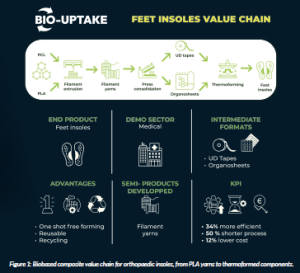
CENTEXBEL also wove 2 PLA fabrics, a 2×2 twill, and a satin weave, for use in the medical demonstrator. These fabrics were supplied to COMFIL for the manufacture of orthotic foot components.
A fully biobased foot orthosis manufactured in half the time
COMFIL successfully produced a fully biobased foot orthosis using its pilot press line.
Traditional foot orthoses are often manufactured using vacuum bagging. In Bio-Uptake, this has been replaced with a press-based process that reduced production time by approximately 50%.
The new approach also integrated pin holes for leg support directly into the part. Several mould redesigns were necessary to achieve the required dimensional accuracy and functionality.
The final result was a robust and fully functional component that demonstrated the viability of biobased composites for personalised medical devices.
New biobased pellets for high-volume applications
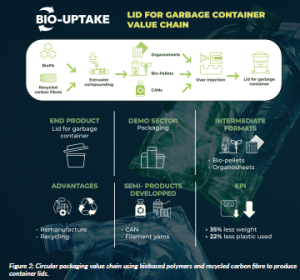
AITIIP developed and selected several bio pellet formulations for over-injection processes, made from PA1010 and different amounts of reinforcement (recycled carbon fibre or wood fibre).
These formulations were characterised mechanically at different temperatures to provide input data for process simulation.
AITIIP also introduced a hot-air drying conveyor that cools pellets without water. This innovation prevents moisture absorption and improves injection moulding performance.
A lightweight and circular packaging demonstrator
MOSES Products developed a new mould to over-inject PLA laminates with biobased polyamide.
This technology was used to manufacture a garbage container lid for tertiary packaging applications. The new design reduces weight while maintaining mechanical performance.
A reversible adhesive enables the lid to be dismantled at the end of its life, allowing materials to be reused or recycled.
MOSES has already demonstrated several packaging components and confirmed that the concept is compatible with different biobased thermoplastics.
Reversible adhesives and reprocessable epoxy resins
SPECIFIC POLYMERS developed 2 key material innovations.
The first was a debonding-on-demand adhesive based on reversible Diels-Alder chemistry. This adhesive provides durable bonding during use and heat-triggered separation at end of life. The concept was successfully demonstrated on the garbage lid developed with MOSES.
The second innovation was a biobased epoxy resin containing around 40% biocarbon. This resin was used to formulate a 3R epoxy system that is reprocessable, repairable, and recyclable. Future work aims to increase the biobased content to 100%.
Recyclable ceiling panels for construction
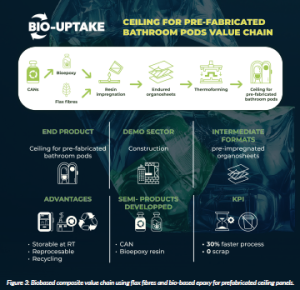
CIDETEC combined flax fibre reinforcement with the 3R epoxy resin to produce a prepreg material containing around 80% biobased content by weight.
Unlike conventional prepregs, this material can be stored at room temperature. The prepregs were used to manufacture a bathroom ceiling panel thanks to the expertise of PODCOM, through vacuum bag curing.
The demonstrator showed that biobased thermoset composites can achieve high performance while remaining recyclable.
Simulation reduces trial and error
SIMCON developed advanced injection moulding simulations to predict material behaviour during processing.
The models reduce the number of physical trials and accelerate process optimisation. They also improve predictability and support the adoption of new biobased materials.
By combining simulation with material characterisation, Bio-Uptake has shortened development cycles and reduced industrial risk.
Artificial intelligence for quality control
AIMEN developed a computer vision system to inspect garbage lids after over-injection. The system detects 2 critical defects: incomplete filling and excessive pressure. Using 2 dedicated neural networks, the system analyses the structural ribs and automatically identifies defects.
AIMEN also developed the project’s digital platform, digital thread, and decision support system. Together, these tools collect manufacturing data, ensure traceability, and recommend real-time process adjustments. The system transforms production data into actionable knowledge for operators and engineers.
Photonics-based monitoring for real-time quality assurance
IRIS Technology Solutions developed advanced monitoring systems based on near-infrared spectroscopy, hyperspectral imaging, and infrared thermography.
These systems measure key indicators such as polymer crystallinity, glass transition temperature, and degree of cure.
Predictive models were validated against laboratory measurements and achieved industrially acceptable accuracy. This approach allows manufacturers to move from offline testing to in-line and at-line quality control. As a result, deviations can be detected earlier and production consistency is improved.
Standards to support market adoption
UNE led the project’s standardisation activities. In March 2026, the consortium published CWA 18295:2026, which provides guidance for optimising filament extrusion of biobased materials.
Other standards are being finalised on technical and ecotoxicological analysis of biobased materials. These documents will help the industry adopt new materials with greater confidence.
Safety assessment under realistic conditions
The University of Aveiro evaluated the environmental and human safety of the materials and final products.
The garbage lid was tested under simulated indoor and outdoor light exposure, whereas leachates were assessed for ecotoxicity using terrestrial and aquatic organisms.
Orthotic and bathroom applications were tested using artificial sweat and real-life exposure conditions. These studies confirm that performance and sustainability can be achieved without compromising safety.
Closing the loop through recycling
In the final phase of the project, CENTEXBEL has investigated the recycling of PLA-based composite plates. Materials are being reprocessed either directly by injection moulding or reintroduced into yarn extrusion. Trials include recycled contents ranging from 10% to 50%.
This work also demonstrates how biobased composites can be integrated into circular manufacturing systems.
A European success story
Bio-Uptake has delivered much more than research results. The project has produced stronger materials, faster manufacturing processes, digital tools, safety assessments, and standardisation documents.
The concept has been validated across 3 industrial demonstrators in medical, construction, and packaging applications.
The project proves that biobased composites are no longer experimental materials. They are practical, competitive, and ready for industrial deployment.
By combining material innovation, digitalisation, and circular design, Bio-Uptake has laid the foundations for a smarter and more sustainable manufacturing industry in Europe.
Project summary
Bio-Uptake aims to boost the adoption of bioplastic composites in European manufacturing through innovative processes, digital tools and circular design. Demonstrated in construction, medical and packaging sectors, the project develops modular intermediate formats and promotes sustainability, training and standardisation.
Project partners
Bio-Uptake is coordinated by AITIIP, a Spanish technical institute with extensive expertise in advanced manufacturing and biocomposites. The project brings together a diverse consortium of 14 partners from seven EU countries, representing a balanced mix of research organisations, industrial players, SMEs and innovation hubs.
Project collaboration
Bio-Uptake thrives thanks to the dedication of scientists, engineers, researchers and innovators from across Europe. Their combined expertise in materials, manufacturing, digitalisation and sustainability drives the project’s success. Together, they co-develop solutions, validate technologies and promote circularity, making Bio-Uptake a true collaborative effort that is shaping the future of bio-based manufacturing in Europe.
Project contacts
Nicolas Longhitano – POLYMERIS
nicolas.longhitano@polymeris.fr
www.bio-uptake-project.eu
@BioUptake
/company/bio-uptake/
@biouptake
Funding
This project has received funding from the European Union’s Horizon Europe research and innovation programme (Grant agreement No. 101057049).
Views and opinions expressed are, however, those of the author(s) only and do not necessarily reflect those of the European Union. Neither the European Union nor the granting authorities can be held responsible for them.
Figure captions
Figure 1: Biobased composite value chain for orthopaedic insoles, from PLA yarns to thermoformed components.
Figure 2: Circular packaging value chain using biobased polymers and recycled carbon fibre to produce container lids.
Figure 3: Biobased composite value chain using flax fibres and bio-based epoxy for prefabricated ceiling panels.