
Europe’s buildings account for around 37 % of global energy-related CO₂ emissions from the building sector, nearly 50% of global material extraction, and 30 % of global energy demand. Tackling this requires more than operational efficiency. It demands a rethink of what buildings are made of and how they are built. GreeNest addresses this directly, targeting a 50 % reduction in embodied emissions relative to current Near-Zero Energy Building standards, a 60 % cut in life-cycle greenhouse gas emissions, more than a 30 % increase in construction productivity, and primary energy savings of 30–40 kWh/m². The policy context reinforces the urgency.
The updated Energy Performance of Buildings Directive (effective May 2024) requires the global warming potential of new buildings over 1000 m² to be calculated and disclosed from 2028, covering materials, energy, maintenance, and end-of-life impacts. Zero-emission buildings must address both operational energy and embodied carbon—and GreeNest is built around exactly that objective.
Standardised packages: innovation made repeatable
At the project’s core are the standardised packages (SPs) designed as tested, documented, and replicable building blocks ready for the construction value chain. The testing programme generates evidence for future manufacturing routes and standardisation.
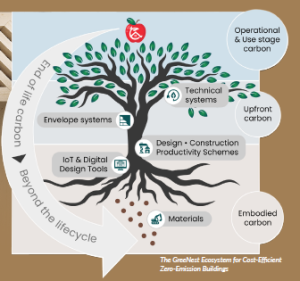
Standardised packages are organised into 5 pillars:
- Technical Systems optimise energy and efficiency through Eco-BIPV/PV, CASCADE heating/cooling, and NestControl sensor networks.
- Envelope Systems improve thermal performance via modular SmartWall, EcoTechWall, and GreenWall systems, alongside Heat-Harvest and Rotating Windows.
- Construction Schemes use circular frameworks like DeltaSmart and Design By Inventory (reclaiming timber).
- IoT & Digital Design Tools like GreeNPLUGIN, ZeBIM, and ASSESS-DST streamline digital integration and life-cycle assessments.
- Materials deliver low-carbon alternatives including KARZ, Waste-Wood Processing, WDLT-Slab & Earth Screed, Light Clay.
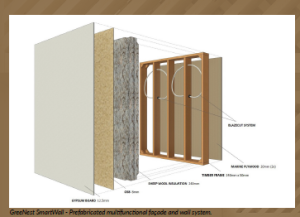
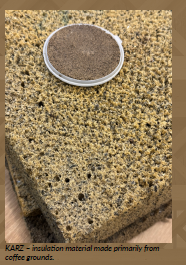
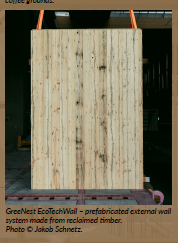
Among the standout innovations is KARZ, an insulation panel combining 50–60 % coffee bean waste with biogenic polyurethane. It achieves 20–40 % lower U-values than conventional alternatives, and GreeNest is working to increase coffee content further, targeting a 50 % rise in carbon storage. KARZ sits within the EcoTechWall system, which pairs it with waste wood, natural fibres, cellulose, and light clay to deliver a full envelope solution in circular, biogenic, and recycled materials. SmartWall offers a complementary prefabricated approach, reaching U-values as low as 0.16 W/m²K while integrating envelope, fire protection, and indoor environmental quality control in a single unit.
Athens Sandbox: real conditions, comparative science
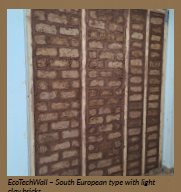
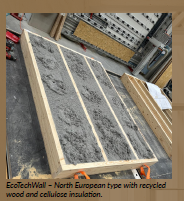
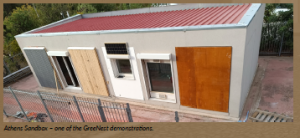
The Athens Sandbox, on the campus of the National Technical University of Athens, puts these solutions to the test. It acts as a real-scale, participatory innovation environment where new approaches for construction products can be tested and validated under realistic operating conditions. Built on a steel ‘cargotecture’ from reused shipping containers, its detachable façade elements and reversible connections allow systems to be swapped within less than an hour. In October 2025, 3 EcoTechWall variants (NEU1, NEU2, SEU) were installed alongside SmartWall and GreeNest’s IoT monitoring system, NestControl. NEU1 (EcoTechWall designed for northern climates with recycled wood and cellulose insulation), NEU2 (EcoTechWall designed for northern climates with KARZ insulation), and SEU (designed for a Mediterranean climate with light clay and straw—demonstrated here for the first time) are the variants tested simultaneously under the same outdoor conditions, allowing a direct comparison of their performance.
A BIM-based decision-support platform exploits the NestControl features that monitor thermal insulation, operational energy, indoor air quality, photovoltaic production, and HVAC performance. This evaluation framework captures technical, environmental, economic, social, and cultural data. The monitoring campaign, running since January 2026, will turn performance claims into verified evidence—feeding GreeNest’s digital tools, replication guidelines, and standardisation work. The sandbox also functions as an open learning environment for students, researchers and industry stakeholders, promoting creativity, innovation, and local identity regeneration, reflecting that the transition to zero-emission buildings is as much a cultural challenge as a technical one.
Scaling across Europe
GreeNest is already active across 4 construction sites in Germany, Italy, and Greece, working with local supply chains and targeting benefits for SMEs. SPs are the mechanism that makes scaling possible: they translate research into comparable, replicable components, and link innovation with manufacturing quality and digital verification. In a regulatory environment demanding life-cycle carbon disclosure, they offer a path from bespoke pilots to systemic decarbonisation, and the Athens Sandbox is the proof of concept.
- 50 % reduction in embodied emissions
- 60 % reduction in life-cycle GHG emissions
- 30 % productivity improvement
- 4 real demonstration sites
Bibliography
International Energy Agency (2025) Energy Efficiency 2025: Buildings. Available at: https://www.iea.org/reports/energy-efficiency-2025/buildings
European Commission (n.d.) Energy Performance of Buildings Directive. Directorate-General for Energy. Available at: https://energy.ec.europa.eu/topics/energy-efficiency/energy-performance-buildings/energy-performance-buildings-directive_en.
European Commission (n.d.) Global warming potential of buildings. Directorate-General for Energy. Available at: https://energy.ec.europa.eu/topics/energy-efficiency/energy-performance-buildings/energy-performance-buildings-directive/global-warming-potential-buildings_en.
European Commission (2026) Calculation framework for new building life-cycle Global Warming Potential. Directorate-General for Energy. Available at: https://energy.ec.europa.eu/news/calculation-framework-new-building-life-cycle-global-warming-potential-2026-05-04_en.
Le, D.L., Salomone, R. and Nguyen, Q.T. (2024) ‘Sustainability assessment methods for circular bio-based building materials: a literature review’, Journal of Environmental Management, 352, 120137. Available at: https://doi.org/10.1016/j.jenvman.2024.120137.
Li, C. et al. (2025) ‘Carbon footprint of the construction sector is projected to double by 2050 globally’, Communications Earth & Environment, 6, p. 831. Available at: https://doi.org/10.1038/s43247-025-02840-x.
Morganti, L. et al. (2024) ‘A1-A5 embodied carbon assessment to evaluate bio-based components in facade system modules’, Sustainability, 16(3), p. 1190. Available at: https://doi.org/10.3390/su16031190.
UNEP and GlobalABC (2026) Global Status Report for Buildings and Construction 2025/2026. United Nations Environment Programme. Available at: https://www.unep.org/resources/report/global-status-report-buildings-and-construction-2025-2026.
GreeNest: Nest Ingrained Ecosystem for Zero Emission Building
Project summary
GreeNest is a Horizon Europe project, running from January 2024 to December 2027. It brings together 20 partners across Europe to demonstrate resource-efficient, carbon-neutral construction through nature-based envelope systems, renewable energy, and circular materials at 4 real demonstration sites and 2 virtual buildings in Germany, Greece, Italy, and Denmark.
Project lead profile
Maria Founti is Emeritus Professor at the National Technical University of Athens (NTUA) and founder of its Laboratory of Heterogeneous Mixtures and Combustion Systems. With over 37 years of experimental and computational research in energy and building research, her expertise covers energy-efficient buildings, renovation technologies, thermal energy storage, advanced building materials, fire safety, heating, and cooling systems, life-cycle assessment, techno-economic evaluation, circular construction solutions, and building performance assessment. Holding a PhD in Mechanical Engineering from Imperial College London, she has built her career from early-stage laser diagnostics research at the UK Atomic Energy Research Establishment and fluid mechanics at the University of Erlangen-Nürnberg through to leading EU-funded projects at the frontier of near-zero and zero-emission buildings, life-cycle assessment, and sustainable construction—work she continues today as co-ordinator of GreeNest.
Project contacts
Project Lead: Maria Founti
LinkedIn: /in/maria-founti-01929650
Dissemination Lead: Ivana Kolackova
Email: ivana.kolackova@fenixtnt.cz
Web: www.greenest-ecosystem.eu
YouTube: @greenest-ecosystem
LinkedIn: company/greenest-ecosystem
Zenodo: communities/greenest-ecosystem
CORDIS: project/id/101138242
LinkedIn newsletter: /build-relation/newsletter-follow?entityUrn=7279795473614290944
Funding
GreeNest is co-funded by the European Union under Grant Agreement No. 101138242 and the State Secretariat for Education, Research and Innovation (SERI).
Views and opinions expressed are, however, those of the author(s) only and do not necessarily reflect those of the European Union or CINEA. Neither the European Union nor the granting authority can be held responsible for them.
Figures
The GreeNest Ecosystem for Cost-Efficient Zero-Emission Buildings.
KARZ – insulation material made primarily from coffee grounds.
GreeNest SmartWall – Prefabricated multifunctional façade and wall system.
EcoTechWall – South European type with light clay bricks.
EcoTechWall – North European type with recycled wood and cellulose insulation.
GreeNest EcoTechWall – prefabricated external wall system made from reclaimed timber. Photo © Jakob Schnetz.
Athens Sandbox – one of the GreeNest demonstrations.