
Concrete is everywhere, but so is its carbon footprint. Cement production accounts for roughly 7–8 % of global anthropogenic CO₂ emissions, much of it released directly by the chemical conversion of limestone into clinker. Research shows that reducing clinker use and replacing virgin raw materials with secondary resources could substantially cut emissions; one analysis estimated that clinker substitution with available supplementary materials could avoid up to 1.3 Gt CO₂-equivalent per year (Shat et al., 2022; Sabău, Bompa and Silva, 2021).
CO₂ mineralisation adds another pathway: captured CO₂ reacts with calcium-rich wastes to form stable carbonates, locking carbon into useful construction materials (Winnefeld et al., 2022). Recycled concrete can be carbonated rapidly and reused as a reactive cement component (Zając et al., 2021), while global estimates suggest concrete-based mineralisation could reduce emissions by around 0.39 Gt CO₂-equivalent (Driver et al., 2024).
Europe’s construction sector must reduce its climate impact while continuing to deliver essential building materials and infrastructure. Cement, bricks, and other mineral-based products remain indispensable, yet their production is energy-intensive, involves process-related CO₂ emissions and relies on primary raw materials.
The Carbon4Minerals project demonstrates how CO₂ from industrial flue gases can be used to produce low-carbon building material intermediates and construction products. Its approach combines CO₂ mineralisation with the circular use of construction and demolition waste and steelmaking by-products. Testing this concept under real industrial conditions are 2 pilots: Pilot 3c at the Górażdże cement plant in Poland and Pilot 4a at Vandersanden’s Lanklaar site in Belgium.
Górażdże Pilot—using cement plant flue gases for enforced carbonation
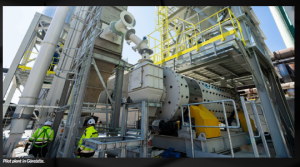
Górażdże Pilot is located at the Górażdże integrated cement plant in Poland, the EU’s largest cement plant
in terms of clinker and cement capacity. The plant operates 2 kiln lines, with the Carbon4Minerals pilot directly connected to Kiln Line #2. This enables testing with raw cement kiln flue gases as the CO₂ source, without pre-treatment.
Commissioned in May 2025, the pilot is the first continuous industrial demonstrator for enforced carbonation using raw kiln flue gases and recycled concrete powder from construction and demolition waste as the carbonation substrate. In practice, recycled concrete powder (RCP) is fed into the reactor and mixed with water to adjust its moisture content. It is then brought into continuous contact with kiln flue gases for approximately 5 minutes. During this time, CO₂ reacts with mineral phases in the RCP and becomes permanently bound through carbonation.
After carbonation, the resulting material is carbonated recycled concrete powder (cRCP). This pozzolanic material is being developed as a novel supplementary cementitious material that can replace part of the Portland clinker in cement formulations. Early operations have shown stable performance at 1.5 tonnes per hour, a carbonation degree of 77 % and CO₂ uptake of approximately 100–150 kg per tonne of RCP.
Lanklaar Pilot—producing CO₂-negative facing bricks
The Lanklaar Pilot demonstrates how CO₂ mineralisation can be integrated directly into finished construction products. Located at Vandersanden’s Lanklaar site in Belgium, the pilot focuses on Pirrouet®, the company’s CO₂-negative facing brick technology. Installed within an operational brick factory, it integrates a semi-dry pressing and carbonation-curing line.
The process enables the production of façade bricks using up to 80 % steelmaking by-products. Instead of the traditional clay-fired route, it uses a low-temperature, fossil-fuel-free method. Dried and milled slag is blended with sand and additives, compacted into bricks, and placed into carbonation chambers. During curing, reactive phases in the slag bind CO₂ into stable carbonates, storing carbon while contributing to the brick’s strength.
From pilot evidence to future value chains
Together, the Górażdże Pilot and Lanklaar Pilot demonstrate complementary routes towards the same objective. Górażdże Pilot uses cement plant flue gases to produce a low-carbon cement component from recycled concrete powder. Lanklaar Pilot uses steelmaking by-products and CO₂ curing to manufacture CO₂-negative facing bricks.
Both examples reflect the wider ambition of Carbon4Minerals: to transform industrial CO₂ and mineral residues into useful construction materials. By operating in real industrial environments, these pilots provide evidence for replication, upscaling, and market uptake, while supporting circular and low-carbon value chains for Europe’s construction industry.
- 5 tonnes per hour stable Górażdże Pilot operation achieved with recycled concrete powder.
- 77% carbonation degree reached during early operations under standard conditions.
- 100–150 kg CO₂ per tonne of RCP validated CO₂ uptake in the enforced carbonation process.
- Up to 80% steelmaking by-products used as raw materials in Lanklaar Pilot for CO₂-negative facing bricks.
References
Driver, J.G. et al. (2024) ‘Global decarbonization potential of CO2 mineralization in concrete materials’, Proceedings of the National Academy of Sciences, 121(29), e2313475121. Available at: https://doi.org/10.1073/pnas.2313475121.
Sabău, M., Bompa, D.V. and Silva, L.F.O. (2021) ‘Comparative carbon emission assessments of recycled and natural aggregate concrete: environmental influence of cement content’, Geoscience Frontiers, 12(6), 101235. Available at: https://doi.org/10.1016/j.gsf.2021.101235.
Shah, I.H. et al. (2022) ‘Cement substitution with secondary materials can reduce annual global CO2 emissions by up to 1.3 gigatons’, Nature Communications, 13(1), 5758. Available at: https://doi.org/10.1038/s41467-022-33289-7.
Winnefeld, F. et al. (2022) ‘CO2 storage in cement and concrete by mineral carbonation’, Current Opinion in Green and Sustainable Chemistry, 38, 100672. Available at: https://doi.org/10.1016/j.cogsc.2022.100672.
Zajac, M. et al. (2021) ‘CO2 mineralization of demolished concrete wastes into a supplementary cementitious material – a new CCU approach for the cement industry’, RILEM Technical Letters, 6, pp. 53–60. Available at: https://doi.org/10.21809/rilemtechlett.2021.141.
PROJECT SUMMARY
Carbon4Minerals: Transforming CO2 into added-value construction products Carbon4Minerals is a Horizon Europe project, running from January 2023 to June 2027. It brings together 14 partners across Europe to demonstrate how CO₂ from industrial flue gases and secondary mineral resources can be transformed into low-carbon binders and construction materials through 8 industrial pilots covering CO₂ capture, cement innovation, and finished construction products.
Project lead profile
Liesbeth Horckmans is Project Manager at VITO, the Flemish Institute for Technological Research, and co-ordinator of the Carbon4Minerals project. With a professional background linking applied research, sustainable materials, and circular innovation, she works at the interface between scientific development and industrial implementation. In Carbon4Minerals, she leads a European consortium demonstrating how industrial CO₂ and secondary mineral resources can be used to develop low-carbon construction materials.
Project contacts
Ivana Kolackova
Email: ivana.kolackova@fenixtnt.cz
Website: www.carbon4minerals.eu
CORDIS: /project/id/101091870
LinkedIn: /company/carbon4minerals
Instagram: @carbon4minerals
YouTube: @carbon4minerals
Zenodo: communities/carbon4minerals-project
Funding
Co-funded by the European Union under Grant Agreement No. 101091870 and the State Secretariat for Education, Research, and Innovation (SERI).
Views and opinions expressed are, however, those of the author(s) only and do not necessarily reflect those of the European Union or HaDEA. Neither the European Union nor the granting authority can be held responsible for them.
Images
Pilot plant in Górażdże.
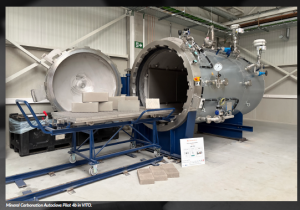
Mineral Carbonation Autoclave Pilot 4b in VITO.
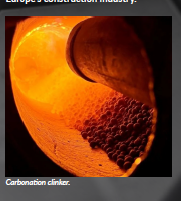
Carbonation clinker.