
Daniel Vasiliev, Seraj Shhadey, Dr Valeria Yarmiayev, Dr Shay Tirosh, and Dr Assaf Ben-Moshe, Department of Chemistry at Bar-Ilan University
In 1848, Louis Pasteur made an observation that helped establish the foundations of modern stereochemistry (Pasteur, 1848). While studying crystals of a tartrate salt under a microscope, he noticed that some crystals appeared as mirror images of others. This seemingly simple observation revealed a profound connection between molecular structure and crystal morphology—it introduced scientists to the concept we now call chirality.
Chirality describes objects that cannot be superimposed on their mirror image. Our hands provide the most familiar example: a left hand can never be perfectly aligned with a right hand, but one can ‘interconvert’ between their images when reflected in the mirror. Chirality is now known to be a fundamental feature of nature. DNA is chiral, proteins are chiral, and many pharmaceuticals exist in left- and right-handed forms that can exhibit dramatically different biological activity.
Pasteur’s discovery sparked a fascination with the relationship between chirality and crystallisation that continues today. Yet it also exposed a puzzle that remains surprisingly difficult to answer.
Why do some crystals develop chiral shapes while others do not?
At first glance, the answer might seem obvious. One might expect crystals with chiral atomic arrangements to naturally develop chiral external morphologies, while crystals with achiral structures should remain symmetric. Reality is considerably more complicated. Many materials with chiral crystal structures never develop chiral shapes. Conversely, certain materials with achiral crystal structures can nevertheless form left- and right-handed morphologies.
Nearly 2 centuries after Pasteur’s work, the mechanisms responsible for chiral shape formation remain unclear in many systems (Shtukenberg et al., 2014).
Nanocrystals as model systems
One reason this problem has proven so difficult is that crystal growth is inherently dynamic. By the time a crystal becomes large enough to observe easily, much of the information about how it formed has already been lost.
Nanocrystals provide a unique opportunity to overcome this challenge. These tiny crystals, often only tens to hundreds of nanometres in size, can be viewed as embryonic stages of crystal growth. Modern electron microscopy techniques allow scientists to examine their structures, shapes, and defects with extraordinary precision. As a result, nanocrystals have emerged as valuable model systems for studying fundamental questions about crystallisation.
A major motivation for the ERC project EnaDisNan lies exactly in these properties of nanocrystals. This project adopts the perspective that nanocrystals are very useful for investigating how chirality emerges during crystal growth and how handedness propagates from atomic-scale structures to the overall morphology of a crystal.
Looking beyond crystal structure
For many years, explanations of chiral crystal growth focused primarily on crystal structure and on the influence of chiral molecules that bind to growing crystal surfaces. These mechanisms are undoubtedly important and explain many observations.
However, they do not explain everything.
A growing body of evidence suggests that crystal defects may also play a critical role. Defects are often viewed as imperfections, but they frequently determine how materials behave and evolve. Among the most important defects in crystallography are screw dislocations (Meng et al., 2013).
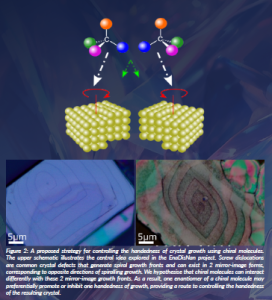
A screw dislocation can be imagined as a microscopic spiral staircase embedded within a crystal. Unlike a perfect crystal surface, which periodically requires the formation of new growth layers, a screw dislocation provides a continuous growth front that allows the crystal to keep growing. Because this spiral can be either left-handed or right-handed, screw dislocations are themselves chiral objects (Sung, de la Cotte and Grelet, 2018).
This observation raises an intriguing possibility: could some chiral crystal shapes originate not directly from the crystal structure itself, but from chiral defects that guide growth?
Insights from tellurium nanocrystals
A starting point for the ERC project EnaDisNan came from earlier studies of tellurium nanocrystals.
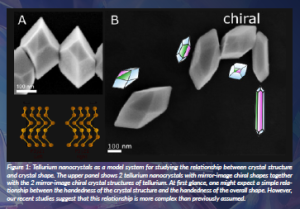
Tellurium is particularly interesting because its crystal structure is already chiral. For this reason, it would be natural to assume that its chiral morphology is simply inherited from its crystal structure.
Earlier work revealed a more complex picture (Ben-Moshe et al., 2021).
Using advanced electron microscopy and crystallographic analysis, it was found that tellurium nanocrystals developed chiral shapes only under specific growth conditions. These conditions were associated with growth mediated by screw dislocations. The results suggested that crystal defects, rather than crystal structure alone, were essential for the emergence of chiral morphology.
More recently, these studies were extended and systematically mapped the conditions under which tellurium nanocrystals develop chiral or achiral shapes (Vasiliev, Tirosh and Ben-Moshe, 2024). By varying parameters such as supersaturation, ligand concentration, and temperature, it was found that transitions between chiral and achiral morphologies follow a common underlying logic. Chiral shapes emerge under conditions that favour the growth of highly reactive nuclei, while changes in growth conditions can systematically shift the population toward achiral forms. These studies also revealed previously unknown crystal morphologies that appear only within narrow windows of experimental conditions.
Together, these findings suggest that the appearance of chiral crystal shapes is governed by crystal-growth mechanisms in ways that are more subtle than previously appreciated.
The larger panel presents several different shapes that can form in tellurium nanocrystals. Although all of these crystals share the same underlying chiral crystal structure, only one of the shapes is itself chiral. This is most easily observed by examining the pair of facets highlighted in the colour inset models. In the chiral shape, these facets break mirror symmetry, whereas in the other shapes the corresponding facets are arranged symmetrically. The observation that crystals with the same chiral crystal structure can develop either chiral or achiral shapes highlights an important unresolved question: what determines whether chirality at the atomic scale is expressed in the overall morphology of a crystal?
The EnaDisNan project
The goal of the ERC-funded project EnaDisNan is to uncover the role of screw dislocations in chiral crystal growth and to determine whether they provide a general mechanism for generating chirality in nanocrystals.
The project addresses 3 central questions.
- Can crystal growth be directed so that it proceeds preferentially through screw dislocations?
- Can chiral molecules selectively influence the handedness of these dislocations, allowing us to control whether left- or right-handed crystals are formed?
- How do screw dislocations arise during crystal growth in the first place?
To answer these questions, we combine nanocrystal synthesis, advanced spectroscopy, and state-of-the-art electron microscopy. By studying both materials with chiral crystal structures and materials with completely achiral crystal structures, we hope to identify general principles that govern the emergence of chirality during crystallisation.
The lower panel in Figure 2 shows optical micrographs of large crystals exhibiting spiral growth fronts of opposite handedness. In these systems, the direction of spiralling growth can be observed directly, making them an attractive model for investigating the interaction between chiral molecules and screw dislocations. Insights gained from such model systems may help establish general principles for controlling handedness in much smaller systems, including tellurium nanocrystals and other chiral nanomaterials.
Why it matters
Understanding how chirality emerges is important not only for fundamental science but also for future technologies. Chiral nanomaterials are being explored for applications in optics, sensing, catalysis, spintronics, and biomedicine.
The ability to control chirality reliably would open new possibilities for designing functional materials with tailored properties.
At the same time, the project addresses a much older scientific question. Since Pasteur’s pioneering experiments, scientists have sought to understand how handedness propagates across different length scales of matter. While tremendous progress has been made, important pieces of the puzzle remain missing.
By studying nanocrystals and the hidden defects that guide their growth, EnaDisNan seeks to uncover some of those missing pieces. The answers may not only improve our ability to design chiral materials but also deepen our understanding of one of the most fascinating symmetry-breaking phenomena in nature.
References
Ben-Moshe, A. et al. (2021) ‘The chain of chirality transfer in tellurium nanocrystals’, Science, 372(6543), pp. 729–733. Available at: https://doi.org/10.1126/science.abf9645.
Meng, F. et al. (2013) ‘Screw dislocation-driven growth of nanomaterials’, Accounts of Chemical Research, 46(7), pp. 1616–1626. Available at: https://doi.org/10.1021/ar400003q.
Pasteur, L. (1848) ‘Recherches sur les relations qui peuvent exister entre la forme cristalline, la composition chimique et le sens de la polarisation rotatoire’, Annales de Chimie et de Physique, 24, pp. 442–459.
Shtukenberg, A.G. et al. (2014) ‘Growth actuated bending and twisting of single crystals’, Angewandte Chemie International Edition, 53(3), pp. 672–699. Available at: https://doi.org/10.1002/anie.201301223.
Sung, B., de la Cotte, A. and Grelet, E. (2018) ‘Chirality-controlled crystallization via screw dislocations’, Nature Communications, 9, 1405. Available at: https://doi.org/10.1038/s41467-018-03745-4.
Vasiliev, D., Tirosh, S. and Ben-Moshe, A. (2024) ‘Experimental determination of the chiral and achiral shape diagrams of tellurium nanocrystals’, Chirality, 36(10), article e23716. Available at: https://doi.org/10.1002/chir.23716.
Project name
EnaDisNan
Project summary
This project investigates how crystals develop chiral (handed) shapes during growth, challenging the long-held belief that chiral building blocks alone determine crystal chirality. Using nanocrystals as model systems, researchers will explore how structural defects called screw dislocations influence crystal formation and shape. The findings could transform our understanding of crystal growth, reveal previously overlooked mechanisms, and provide new ways to design chiral nanomaterials for advanced technologies.
Project lead profile
This project investigates how crystals develop chiral (handed) shapes during growth, challenging the long-held belief that chiral building blocks alone determine crystal chirality. Using nanocrystals as model systems, researchers will explore how structural defects called screw dislocations influence crystal formation and shape. The findings could transform our understanding of crystal growth, reveal previously overlooked mechanisms, and provide new ways to design chiral nanomaterials for advanced technologies.
Project contacts
Dr Assaf Ben Moshe
Department of Chemistry at Bar-Ilan University
Email: assaf.ben-moshe@biu.ac.il
CORDIS: cordis.europa.eu/project/id/101116532.
Funding
This project has been funded by the European Research Council (ERC) under the European Union’s Horizon Europe research and innovation programme (Grant agreement No. 101116532 [EnaDisNan]).
Views and opinions expressed are, however, those of the author(s) only and do not necessarily reflect those of the European Union or the ERC. Neither the European Union nor the granting authorities can be held responsible for them.
Figure legends
Figure 1: Tellurium nanocrystals as a model system for studying the relationship between crystal structure and crystal shape. The upper panel shows 2 tellurium nanocrystals with mirror-image chiral shapes together with the 2 mirror-image chiral crystal structures of tellurium. At first glance, one might expect a simple relationship between the handedness of the crystal structure and the handedness of the overall shape. However, our recent studies suggest that this relationship is more complex than previously assumed.
Figure 2: A proposed strategy for controlling the handedness of crystal growth using chiral molecules. The upper schematic illustrates the central idea explored in the EnaDisNan project. Screw dislocations are common crystal defects that generate spiral growth fronts and can exist in 2 mirror-image forms, corresponding to opposite directions of spiralling growth. We hypothesise that chiral molecules can interact differently with these 2 mirror-image growth fronts. As a result, one enantiomer of a chiral molecule may preferentially promote or inhibit one handedness of growth, providing a route to controlling the handedness of the resulting crystal.