
NANOGROWDIRECT is an ERC Starting Grant that develops a transformative approach for the fabrication of nanostructured (meta)materials, called chemical contrast in situ growth.
Here, chemically patterned surfaces are engineered to express orthogonal surface chemistries in preordered geometrical arrangement. The resulting surface chemical contrast promotes the nucleation and growth of complex nanostructures at specific, predetermined locations directly on the substrate of choice. The project addresses a fundamental challenge in nanotechnology: how to build precise architectures on the surface of functional devices with nanometric precision, without relying on laborious hard lithography or colloidal self-assemblies.
The chemistry of metamaterials
Plasmonic metamaterials are artificial structures consisting of nanometric elements that are rationally designed and arranged periodically to generate a unique electromagnetic response. This design freedom has led to the engineering of exotic macroscopic properties not found in nature. The field of metamaterials has witnessed a sustained exponential growth, and we are now at the doorstep of a new development phase, the so-called ‘chemistry of metamaterials’, where the engineered artificial properties could dynamically interact with the surrounding chemical environment (Qiu and Odom, 2022).
The underpinned fabrication challenge
These goals require precise manipulation of composition, crystallinity, elemental distribution, and surface chemistry of the designed metamaterials and their constituent units. On one hand, these aspects remain extremely difficult to define and engineer using standard hard-lithography fabrication approaches. On the other hand, while chemistry-based colloidal bottom-up construction of metal nanoparticles has evolved enormously in the last 3 decades, their translation to an industrial setup remains hindered by scalability and reliability issues. The main bottleneck can be identified in the assembly step, where billions of nanometric-scale objects must be organised precisely on a surface or within a material, maintaining their orientation, morphology, and surface chemistry, while controlling, at the same time, spatial distribution and surface density (Vinnacombe-Willson et al., 2023).
The NanoOddLAB at the University of Cantabria attempts to circumvent these obstacles by developing synthetic protocols where particle nucleation location can be precisely engineered directly on the substrate of choice, effectively achieving patterned in situ growth. Here the challenge is bigger, as on top of size, crystallography, composition, and surface chemistry, we also aim to control the orientation and spatial position of each grown structure.
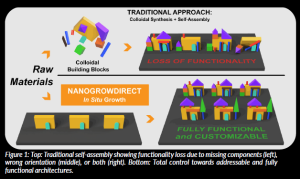
An easy way to visualise the proposed approach and its advantages is to draw a parallel with macro-scale construction (Figure 1): building each structure starting from its foundation and adding components step-by-step (in situ growth) is more intuitive, direct, and energetically favoured than creating millions of copies of each building block and subsequently assembling them simultaneously (traditional approach combining colloidal synthesis and self-assembly). Moreover, complex architectures can be targeted, as additional features and functionalities can be added sequentially. Overall, patterned in situ growth has the potential to establish facile, customisable, rapid, and scalable fabrication routes towards scalable functional nanomaterials (Vinnacombe-Willson et al., 2022).
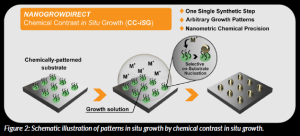
A major scientific motivation for the project is the current lack of mechanistic understanding of patterned in situ growth. Existing methods often struggle to control where nucleation occurs, leading to unwanted particle formation and poor reproducibility. By confining growth to chemically defined regions using chemical contrast, our team seeks to overcome these limitations and establish a robust framework for the rational design of nanosurfaces (Figure 2).
Chemical contrast by catecholamine-based biopolymers
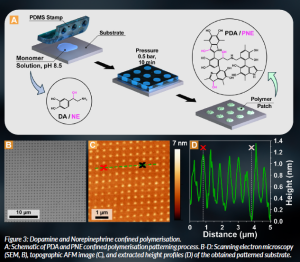
In our recent publication, we successfully engineered a surface chemical contrast in a single fabrication step (Schiavi et al., 2026). The process relies on the confined polymerisation of dopamine or norepinephrine beneath a patterned polydimethylsiloxane (PDMS) stamp, generating ultrathin polymer patches (0.8 nm) on the target surface (Figure 3).
The developed protocol presents several key advantages. First, the entire procedure can be completed in 10 minutes, requiring only room temperature and 0.5 bars of pressure to ensure conformal contact between the stamp and the surface. These mild conditions make it fully compatible with different materials and fabrication processes. Another key feature is the scalability and versatility of the procedure. The same protocol can be applied for features as small as 70 nm and as big as 8 microns. Moreover, we demonstrated the simultaneous fabrication of 9 different patterns over a 25 cm² area.
Finally, catecholamine-based biopolymers are biomimetic materials that can be processed in water-based conditions, ensuring a totally biocompatible and environmentally sustainable protocol. Other key advantages of these biopolymers include the ability to adhere to most organic and inorganic surfaces, and the rich chemistry stemming from a variety of functional groups (including catechols, amines, and imine groups) enabling covalent modifications, ionic co-ordination, and redox chemistry (Lee et al., 2007).
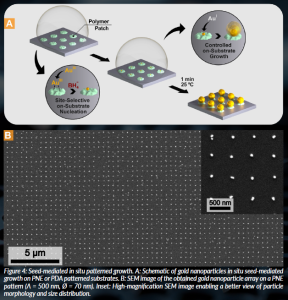
This last feature was exploited to maximise the chemical contrast, implementing a seed-mediated growth strategy. In the first step, small gold nuclei (1–5 nm) were generated selectively on the polymer patches, which were subsequently enlarged under carefully controlled conditions (Figure 4). This approach effectively separated nucleation from growth, suppressing unwanted particle formation out of pattern and enabling better control over nanoparticle size, density, and distribution.
This higher degree of control enabled us to induce the growth of a single gold nanoparticle per polymer patch, with an average of 1.0 ± 0.6 particles over a 1 cm² area with an average dimension of 60 ± 10 nm.
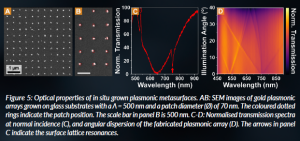
When combined with reactive polymer patches of 70 nm, the optimised growth conditions yield a significant improvement in nanoparticle alignment. This enhanced structural order translated directly into a stronger optical response of the fabricated metasurfaces. Specifically, the obtained nanoparticle array exhibited ultranarrow surface lattice resonances (SLRs)—collective plasmonic modes arising from long-range coupling between nanoparticles—with quality factors exceeding 130. These values rank among the highest reported for visible-light plasmonic metasurfaces fabricated through bottom-up approaches (Figure 5).
Beyond chemical growth
The NANOGROWDIRECT goal is to establish a new paradigm for nanoscale fabrication by developing simple, scalable, sustainable, and versatile protocols. Combining chemical contrast with fluidic, electromagnetic, and electrochemical control, the project could enable the production of sophisticated nanomaterials with unprecedented precision and functionalities. In the long run, patterned in situ growth could become a foundational technology for constructing next-generation nanostructured materials and metamaterials directly on surfaces, opening new opportunities for both scientific discovery and technological innovation.
References
Lee, H. et al. (2007) ‘Mussel-inspired surface chemistry for multifunctional coatings’, Science, 318(5849), pp. 426–430. Available at: https://doi.org/10.1126/science.1147241.
Qiu, C.W. and Odom, T.W. (2022) ‘Introduction: chemistry of metamaterials’, Chemical Reviews, 122(19), pp. 14987–14989. Available at: https://doi.org/10.1021/acs.chemrev.2c00541.
Schiavi, S. et al. (2026) ‘One-step confined polymerization of catecholamine biopolymers for the patterned in situ growth of plasmonic metasurfaces with single-particle resolution’, ACS Applied Materials & Interfaces, 18(24), pp. 34013–34023. Available at: https://doi.org/10.1021/acsami.6c05739.
Vinnacombe-Willson, G.A. et al. (2022) ‘Surface lattice plasmon resonances by direct in situ substrate growth of gold nanoparticles in ordered arrays’, Advanced Materials, 34(37), e2205330. Available at: https://doi.org/10.1002/adma.202205330.
Vinnacombe-Willson, G.A. et al. (2023) ‘Direct bottom-up in situ growth: a paradigm shift for studies in wet-chemical synthesis of gold nanoparticles’, Chemical Reviews, 123(13), pp. 8488–8529. Available at: https://doi.org/10.1021/acs.chemrev.2c00914.
Project name
NANOGROWDIRECT
Project summary
NANOGROWDIRECT targets the rational design of addressable nanostructures in a time-efficient and scalable manner, fostering the creation of new architectures and functionalities for catalysis, energy production, biosensing, and optoelectronics. By unlocking the possibility of engineering bottom-up nucleation and growth of nanostructures directly on the substrate of choice, the project addresses an urgent need in the field, limiting the practical application of nanotechnology in everyday life. This will ultimately enable direct nanocrystal synthesis in organised patterns with nanometric resolution, while offering full control over their chemical environment and surface chemistry.
Project lead
Leonardo Scarabelli is the founder and principal investigator of the NanoOddLAB, a vibrant multidisciplinary research team at the University of Cantabria. After completing his studies at the University of Pavia, he received his PhD in 2016 from the University of Vigo under the direction of Prof. L. M. Liz-Marzán. After training as a postdoctoral scholar at UCLA, he began his independent career at the Institute of Materials Science of Barcelona as a ‘La Caixa’ Junior Leader, before relocating to the north of Spain in 2024. His research activity combines colloidal and materials chemistry, self-assembly, soft lithography, and spectroscopy to develop unconventional strategies for the direct surface synthesis of nanostructured materials.
Project contacts
Dr Leonardo Scarabelli
NanoOddLAB Principal Investigator: Ramón y Cajal Researcher
Dpt. of Chemistry and Processes and Resources Engineering, University of Cantabria, Avenida de los Castros, 39005, Santander, Cantabria, Spain
Email: leonardo.scarabelli@unican.es
Web: nanooddlab.unican.es
Funding
This project has been funded by the European Research Council (ERC) under the European Union’s Horizon Europe research and innovation programme (Grant agreement No. 101115164 [NANOGROWDIRECT]).
Views and opinions expressed are, however, those of the author(s) only and do not necessarily reflect those of the European Union or the ERC. Neither the European Union nor the granting authorities can be held responsible for them.
Figure legends
Figure 1: Top: Traditional self-assembly showing functionality loss due to missing components (left), wrong orientation (middle), or both (right). Bottom: Total control towards addressable and fully functional architectures.
Figure 2: Schematic illustration of patterns in situ growth by chemical contrast in situ growth.
Figure 3: Dopamine and Norepinephrine confined polymerisation. A: Schematic of PDA and PNE confined polymerisation patterning process. B-D: Scanning electron microscopy (SEM, B), topographic AFM image (C), and extracted height profiles (D) of the obtained patterned substrate.
Figure 4: Seed-mediated in situ patterned growth. A: Schematic of gold nanoparticles in situ seed-mediated growth on PNE or PDA patterned substrates. B: SEM image of the obtained gold nanoparticle array on a PNE pattern (Ʌ = 500 nm, Ø = 70 nm). Inset: High-magnification SEM image enabling a better view of particle morphology and size distribution.
Figure 5: Optical properties of in situ grown plasmonic metasurfaces. AB: SEM images of gold plasmonic arrays grown on glass substrates with a Ʌ = 500 nm and a patch diameter (Ø) of 70 nm. The coloured dotted rings indicate the patch position. The scale bar in panel B is 500 nm. C-D: Normalised transmission spectra at normal incidence (C), and angular dispersion of the fabricated plasmonic array (D). The arrows in panel C indicate the surface lattice resonances.