
Linking linguistic and neural alignment in interacting brains
Kristof Strijkers, Aix-Marseille Univ, CNRS, LPL (UMR 7309), Aix-en-Provence, France
Within linguistics, psychology, and neuroscience, language research has predominantly focussed on the individual, rather than the dyad or the group. This is understandable: the individualistic focus of the dominant intellectual tradition runs deep, and one person is simply easier to study than 2. But the approach is limiting. Dialogue is undeniably the primary form of language use (e.g. Clark, 1996; Kuhlen and Abdel Rahman, 2023), and models of language processing built around the single speaker are at best incomplete. With LaDy (Language in the Dyad), funded by an ERC Consolidator Grant, we aim to bring the study of language and the brain into its most relevant context, namely the dyad. To do so, the project’s main focus is alignment, since this phenomenon occurs both at the level of behaviour (linguistic alignment, where people copy each other’s language use) and at the level of the brain (neural alignment, where the brain activity between listeners and speakers correlates). We will test this alignment in the dyad by recording the electrical activity of 2 interacting brains in real time (EEG hyperscanning), while they talk to each other.
LaDy revolves around 2 key questions:
- Is neural alignment between interlocutors the brain’s signature of linguistic alignment in behaviour?
- Is prediction the driving force behind both forms of alignment?
Two phenomena, one missing link
Linguistic alignment is the tendency of interlocutors to converge, over the course of a conversation, on similar words, syntactic structures, and even phonetic patterns (e.g. Clark, 1996; Pickering and Garrod, 2021). The dominant theoretical account, Pickering and Garrod’s interactive alignment model (2004), proposes that this convergence is precisely what makes dialogue efficient: by aligning, interlocutors gradually come to share their representations of what is being talked about, thereby enhancing communication.
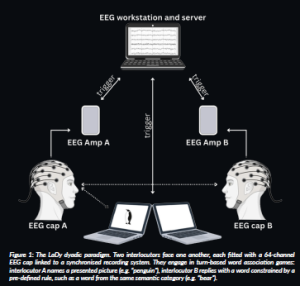
Independently, social neuroscience has uncovered a parallel phenomenon, namely neural alignment (e.g. Dumas et al., 2010; Hasson et al., 2012). When a speaker narrates a story and a listener follows it, their cortical activity becomes correlated, especially in classical language areas (e.g. Stephens et al., 2010; Silbert et al., 2014). This neural alignment (or brain-to-brain coupling) during communication can also be tracked in real time between 2 people whose brains are recorded simultaneously using EEG hyperscanning (e.g. Dikker et al., 2017; Pérez et al., 2017). This is the main technique used in the LaDy project. In short, when we process information, our brain emits electrical signals from neurons that are activated in synchrony, and we can capture those electrical signals with electrodes placed on participants’ scalp. When recording these electrical signals from (at least) 2 people simultaneously, we call this EEG hyperscanning (see Figure 1).
Tempting as it is to assume that linguistic and neural alignment are 2 sides of the same coin, the empirical bridge between them is missing. Neural alignment studies have approached language from a global communicative perspective, not measuring alignment of language representations between interlocutors, while studies of linguistic alignment have mostly focussed on specific representations (e.g. semantics, syntax, phonology) from individuals in isolation. LaDy is designed to close that gap by measuring both forms of alignment under the very same conditions to identify whether there is indeed a relationship between linguistic and neural alignment. Moreover, since it has been proposed that prediction seems to be crucial both in dialogue (e.g. Levinson, 2016; Pickering and Strijkers, 2025) and for coupling speakers and listeners’ brains (e.g. Friston and Frith, 2015), it may constitute the mechanism underlying both alignment phenomena. Put simply, since we are continuously trying to predict what our interlocutor will say, when prediction is successful, the same mental representations will be active in the speaker’s and listener’s brains (neural alignment). Consequently, interlocutors will start using the same language (linguistic alignment). LaDy will thus try to uncover whether neural alignment is the brain’s signature of linguistic alignment, and whether prediction is the driving force behind both forms of alignment.
A new paradigm: dyadic language games
To compare both forms of alignment on equal footing, my team and I have developed a paradigm that combines EEG hyperscanning with controlled, yet interactive, dyadic language games (see Figure 1), in which 2 interlocutors sit facing one another, each fitted with a 64-channel EEG cap. In its simplest form, interlocutor A names a presented picture (e.g. “dog“) and interlocutor B replies with a semantically related word (e.g. “cat”). The trick is that, even though we cannot know what exactly interlocutor B will reply, we do control what interlocutor A is presented with, and which association rule applies to the reply (e.g. reply with a word from the same semantic category). This allows us to target specific linguistic components, such as word meaning, while leaving interlocutors free to produce their own utterances.
First proofs of concept
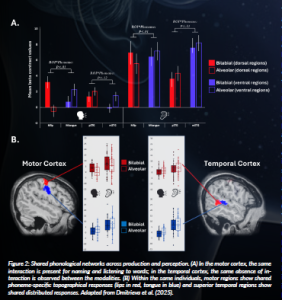
At the very threshold of LaDy, 2 studies demonstrated that the approach was feasible and rested on solid foundations. A first study (Dmitrieva et al., 2025) addressed a fundamental prerequisite of the project: For neural alignment to emerge at the level of words, the brain regions activated when speaking a word must overlap (to a large extent) with those activated when hearing the same word. We tested this with fMRI in 37 participants performing both an object naming and a passive listening task on minimal pairs; words differing only in their initial speech sound, either bilabial speech sounds produced with the lips (e.g. “monkey”) or alveolar speech sounds produced with the tongue (e.g. “donkey”). The same fronto-temporal network was recruited in both modalities (see Figure 2). The motor cortex, more specifically, displayed a topographical pattern in both production and perception: the lip region responded more to bilabial words, and the tongue region to alveolar words, regardless of whether the participant was speaking or listening. The temporal cortex displayed more distributed activation patterns, particularly for alveolar words, but crucially, these distributed patterns again overlapped between production and perception. Given the shared cortical infrastructure for words across language modalities, neural alignment between speakers and listeners at the level of specific word components is plausible.
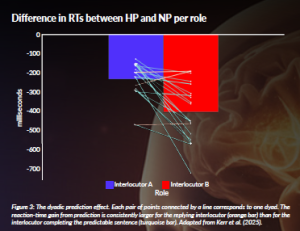
The second study (Kerr et al., 2025; see also Goriachun et al., 2026) showed the viability of the “Dyadic Language Game” paradigm and provided behavioural evidence for the importance of studying language in the dyad. A total of 20 dyads played the semantic association game explained previously while manipulating the predictability of the interaction: Both participants in the dyad either heard a highly predictable sentence preceding the picture interlocutor A must name (e.g. “Man’s best friend is a…” before the picture of “dog” appeared) or a non-predictable one (e.g. “Outside my window I saw a…” before the picture of “dog” appeared). As expected, the interlocutor completing the predictable sentence was faster to name. Strikingly, however, the partner formulating the associative reply was faster too, and even more so, by around 400 ms on average (see Figure 3). A control experiment in which participants did exactly the same task on their own, replying to a pre-recorded voice, showed that this dyadic prediction effect vanished. This result highlights fundamental differences between processing language in isolation and when using language in interaction, thereby highlighting the importance of studying the nature of language in the dyad.
The road ahead
Building on these foundations, LaDy unfolds across 3 work packages over 5 years. WP1 (Words in the dyad) tests whether neural alignment emerges for the basic linguistic components of words—meaning (animals vs tools), grammar (nouns vs verbs) and sounds (bilabial vs alveolar onsets). WP2 (Prediction in the dyad) will test the above designs in predictive versus non-predictive sentence contexts to assess whether prediction is the mechanism that drives linguistic and neural alignment. WP3 (Alignment in the dyad) finally embeds the EEG hyperscanning setup using a more complex, ecological task (the maze game of Garrod and Anderson, 1987) to test whether spontaneous behavioural alignment is mirrored in real time by neural alignment between the 2 brains.
Ground-breaking potential
If LaDy succeeds, it will deliver the first empirical bridge between 2 phenomena that, until now, have been pursued largely in parallel: linguistic alignment as observed in behaviour, and neural alignment as observed between brains. Beyond that specific aim, the broader move from individual to dyadic language science promises to reshape how we think about the human mind. Conversational artificial agents, language education, and the diagnosis and rehabilitation of language disorders all stand to benefit from frameworks that take the inherently social nature of language seriously. LaDy is one step on that path.
References
Clark, H.H. (1996) Using Language. Cambridge University Press.
Dikker, S. et al. (2017) ‘Brain-to-brain synchrony tracks real-world dynamic group interactions in the classroom’, Current Biology, 27(9), pp. 1375–1380. Available at: https://doi.org/10.1016/j.cub.2017.04.002.
Dmitrieva, X. et al. (2025) ‘Shared phonological networks in frontal and temporal cortex for language production and comprehension’, Cerebral Cortex, 35(10), bhaf275. Available at: https://doi.org/10.1093/cercor/bhaf275.
Dumas, G. et al. (2010) ‘Inter-brain synchronization during social interaction’, PLoS ONE, 5(8), e12166. Available at: https://doi.org/10.1371/journal.pone.0012166.
Friston, K. and Frith, C. (2015) ‘A duet for one’, Consciousness and Cognition, 36, pp. 390–405. Available at: https://doi.org/10.1016/j.concog.2014.12.003.
Garrod, S. and Anderson, A. (1987) ‘Saying what you mean in dialogue: A study in conceptual and semantic co-ordination’, Cognition, 27(2), pp. 181–218. Available at: https://doi.org/10.1016/0010-0277(87)90018-7.
Goriachun, D. et al. (2026) ‘The impact of social interaction on abstract concepts’, Psychonomic Bulletin and Review, 33, 178. Available at: https://doi.org/10.3758/s13423-026-02941-4.
Hasson, U. et al. (2012) ‘Brain-to-brain coupling: a mechanism for creating and sharing a social world’, Trends in Cognitive Sciences, 16(2), pp. 114–121. Available at: https://doi.org/10.1016/j.tics.2011.12.007.
Kerr, E., Morillon, B. and Strijkers, K. (2025) ‘Predicting meaning in the dyad’, Journal of Experimental Psychology: General, 154(12), pp. 3405–3416. Available at: https://doi.org/10.1037/xge0001828.
Kuhlen, A.K. and Abdel Rahman, R. (2023) ‘Beyond speaking: neurocognitive perspectives on language production in social interaction’, Philosophical Transactions of the Royal Society B, 378(1875), 20210483. Available at: https://doi.org/10.1098/rstb.2021.0483.
Levinson, S.C. (2016) ‘Turn-taking in human communication – origins and implications for language processing’, Trends in Cognitive Sciences, 20(1), pp. 6–14. Available at: https://doi.org/10.1016/j.tics.2015.10.010.
Pérez, A., Carreiras, M. and Duñabeitia, J.A. (2017) ‘Brain-to-brain entrainment: EEG interbrain synchronization while speaking and listening’, Scientific Reports, 7, 4190. Available at: https://doi.org/10.1038/s41598-017-04464-4.
Pickering, M.J. and Garrod, S. (2004) ‘Toward a mechanistic psychology of dialogue’, Behavioral and Brain Sciences, 27(2), pp. 169–190. Available at: https://doi.org/10.1017/S0140525X04000056.
Pickering, M.J. and Garrod, S. (2021) Understanding Dialogue: Language Use and Social Interaction. Cambridge University Press.
Pickering, M.J. and Strijkers, K. (2025) ‘Language production and prediction in a parallel activation model’, Topics in Cognitive Science, 17, pp. 936-947. Available at: https://doi.org/10.1111/tops.12775.
Silbert, L.J. et al. (2014) ‘Coupled neural systems underlie the production and comprehension of naturalistic narrative speech’, Proceedings of the National Academy of Sciences, 111(43), pp. E4687–E4696. Available at: https://doi.org/10.1073/pnas.1323812111.
Stephens, G.J., Silbert, L.J. and Hasson, U. (2010) ‘Speaker–listener neural coupling underlies successful communication’, Proceedings of the National Academy of Sciences, 107(32), pp. 14425–14430. Available at: https://doi.org/10.1073/pnas.1008662107.
Project name
LaDy (LANGUAGE IN THE DYAD)
Project summary
Most research on language and the brain has studied the individual, yet dialogue is the primary form of language use. LaDy aims to link 2 phenomena that capture this joint nature: linguistic alignment in behaviour and neural alignment between brains. Combining EEG hyperscanning with a novel dyadic paradigm, the project tests whether prediction is the mechanism that drives both.
Project partners
Prof. Dr Martin Pickering (University of Edinburgh, UK); Dr Cristina Baus (University of Barcelona, Spain); Dr Benjamin Morillon (Aix-Marseille Universite, Inserm, France) and; Dr Elin Runnqvist (Aix-Marseille Universite, CNRS, France).
Project lead profile
Kristof Strijkers is a tenured CNRS Director of Research (DR) at the Laboratoire Parole et Langage (LPL) and Aix-Marseille Universite, and a board member of the Institute of Language, Communication and the Brain (ILCB). His ANR- and ERC-funded research focuses on the cognitive and neural dynamics of language production, perception, and their integration. He is co-editor of the Handbook of Language Production (Routledge, 2023).
Project contacts
Kristof Strijkers
Laboratoire Parole et Langage (LPL), CNRS & Aix-Marseille Universite,
5 Avenue Pasteur, 13001 Aix-en-Provence, France.
Email: kristof.strijkers@univ-amu.fr
Web: lpl-aix.fr
Funding
This project has been funded by the European Research Council (ERC) under the European Union’s Horizon Europe research and innovation programme (Grant agreement No. 101115182).
Views and opinions expressed are, however, those of the author(s) only and do not necessarily reflect those of the European Union or the ERC. Neither the European Union nor the granting authorities can be held responsible for them.
Figure legends
Figure 1: The LaDy dyadic paradigm. Two interlocutors face one another, each fitted with a 64-channel EEG cap linked to a synchronised recording system. They engage in turn-based word association games: interlocutor A names a presented picture (e.g. “penguin”), interlocutor B replies with a word constrained by a pre-defined rule, such as a word from the same semantic category (e.g. “bear”).
Figure 2: Shared phonological networks across production and perception. (A) In the motor cortex, the same interaction is present for naming and listening to words; in the temporal cortex, the same absence of interaction is observed between the modalities. (B) Within the same individuals, motor regions show shared phoneme-specific topographical responses (lips in red, tongue in blue) and superior temporal regions show shared distributed responses. Adapted from Dmitrieva et al. (2025).
Figure 3: The dyadic prediction effect. Each pair of points connected by a line corresponds to one dyad. The reaction-time gain from prediction is consistently larger for the replying interlocutor (orange bar) than for the interlocutor completing the predictable sentence (turquoise bar). Adapted from Kerr et al. (2025).