
Developing child-friendly EEG neurofeedback for phonological processing in developmental dyslexia
Irtisha Chakraborty and Marie Lallier
Understanding how the brain co-ordinates phonological processing across its 2 hemispheres may open new routes for dyslexia intervention. Using EEG neurofeedback, this research takes a careful step towards a personalised therapeutic pathway.
Reading is often assumed to be a skill that only begins on the page, with children learning to recognise letters, words, and sentences. In reality, reading builds on systems that develop much earlier, especially the brain’s ability to organise the sounds of language. This ability is called phonological processing: the way the brain recognises, stores and uses the sound structure of language, including speech sounds, syllables, and word forms. When children learn to read, they steadily learn that written symbols are linked to these speech sounds. This supports decoding, meaning the ability to use letter-sound connections to read unfamiliar words. Over time, stronger phonological processing helps children read familiar words more fluently and build reading comprehension.
When this sound-based system is less efficient, learning to read can become much harder. This is one of the core difficulties in developmental dyslexia, a neurodevelopmental learning difficulty that affects accurate and fluent word reading and spelling, despite adequate intelligence, education, and sensory abilities. Dyslexia is more than a problem of letters on a page. Many children with dyslexia struggle to build stable links between written symbols and speech sounds. As a result, reading may remain slow, effortful, or inaccurate, even when the child understands language well and has access to appropriate instruction.
Dyslexia and the 2 hemispheres
At the neural level, reading relies on complementary networks across both hemispheres, although skilled reading and phonological processing are usually strongly left-lateralised in right-handed individuals. Left temporoparietal regions, together with inferior frontal areas, support the mapping between written symbols and speech sounds, helping children recognise words fluently. In children with dyslexia, this typical pattern of left-hemisphere dominance is often reduced or disrupted. Instead of a clear left-hemisphere dominance for phonological processing, neuroimaging studies often report weaker activation in left-hemisphere reading regions and more atypical or bilateral patterns of brain activity.
Evidence suggests that this reduced left-hemisphere dominance for phonological processing can be observed even before formal reading instruction. To compensate for this, children with dyslexia may recruit relatively preserved right-hemisphere control systems. However, we hypothesise that this right-hemisphere support can only be useful if it can effectively communicate with the left-hemisphere system. This communication between the 2 sides of the brain is called interhemispheric connectivity, and it is largely supported by the corpus callosum. If this connectivity is inefficient, the preserved right hemisphere may not be able to properly support the weaker left-hemisphere phonological network.
Why interhemispheric connectivity matters
This makes interhemispheric connectivity a key mechanism for understanding ‘hemispheric rebalance in dyslexia, i.e. the increase of activation in both hemispheres (including the impaired left hemisphere), to help individuals with dyslexia to compensate for the complexity of reading or speech-sound processing tasks.
Here, we are moving beyond viewing dyslexia solely as a left-hemisphere phonological difficulty and asking whether strengthening co-ordination between the 2 hemispheres and promoting an ‘hemispheric rebalance’ could support weak left-hemisphere functioning and, potentially, restore stronger activation in this hemisphere. With this system, we aim to take one step towards future neurofeedback-based interventions that could add to existing dyslexia support, especially for children who do not benefit enough from current approaches.
Using dichotic listening to study and improve hemispheric rebalance
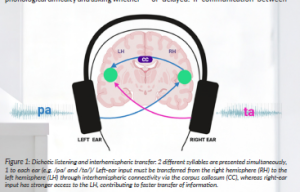
To study this hemispheric rebalance, we use dichotic listening. In this task, 2 competing syllables are presented simultaneously, 1 to each ear. It has been reported that in most right-handed listeners, speech sounds presented to the right ear are reported more easily because they have a more direct route to left-hemisphere phonological regions compared to sounds presented to the left ear. These are first processed by the right hemisphere and then need to cross through the corpus callosum to the left hemisphere to be reported by the listener (Figure 1).
This makes left-ear report a useful behavioural window into interhemispheric transfer. If transfer from the right to the left hemisphere is inefficient, left-ear stimuli are more likely to be missed or delayed. If communication between hemispheres becomes more efficient, left-ear report may improve, and the usual right-ear advantage may be reduced. For the project, this behavioural pattern is treated as one possible marker of hemispheric rebalance during phonological processing; therefore, dichotic listening provides a simple but very powerful tool to study hemispheric rebalance and connectivity during phonological processing.
Measuring timing with EEG
To view the corresponding neural mechanism and move from behaviour to the brain, we use electroencephalography, or EEG, a non-invasive method that records the brain’s electrical activity via electrodes placed on the scalp. EEG provides real-time insight into brain activity, allowing us to track how the brain responds to sounds across different scalp regions. This temporal aspect is critical, as reading and speech perception depend on the rapid co-ordination of information, and small latency differences in neural responses between hemispheres may reveal how efficiently phonological information is transferred.
To understand these neural response latency differences across hemispheres during dichotic listening, we focus on an early auditory neural response which occurs around 100 milliseconds after a sound or in this case, when the syllable is heard, known as the N100/N1 event-related response. In EEG, such responses are known as event-related potentials (ERPs), which are brain responses that are time-locked to a specific event, such as hearing a sound.
During dichotic listening, we could measure this N100 over both the left and right hemisphere electrodes and measure their latency difference: usually, left hemisphere responses will show faster and stronger responses than those of the right hemisphere in this context. Here, our key measure that we will try to improve is ΔLatency (or ΔLat), defined as the supposedly longer latency of the N100 response recorded in the right hemisphere minus the supposedly shorter latency of the N100 response recorded in the left hemisphere. So ΔLat could help us understand how strong the hemispheric connectivity is and how efficiently (i.e. how fast) the left and right hemispheres are working. With this rationale, we predict that a smaller and more stable ΔLat, together with faster response latencies in both the left and the right hemispheres, reflects stronger interhemispheric transfer and hemispheric rebalance.
From brain signal to neurofeedback
Our goal is not only to use these neural signals for measurement but also for training. This is where neurofeedback becomes relevant. Neurofeedback is a training technique in which, during a task, a predefined neural signal (e.g. EEG power, connectivity, or an ERP latency) is measured in real time and converted into a simple visual or auditory cue. Participants learn to self-modulate that signal because the feedback gets better when the signal moves in the desired direction, reinforcing the target brain pattern.
The purpose is to create a learning environment for the child in which the brain receives immediate feedback on its own activity, and in this case, connectivity across hemispheres and their activation.
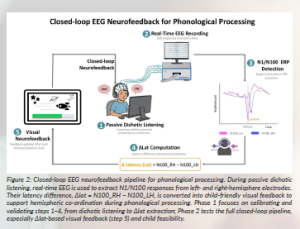
The long-term aim is to use EEG-based neurofeedback to help the brain achieve a more efficient hemispheric rebalance during phonological processing and show that this leads to improved phonological and reading skills in individuals with dyslexia. We are building the neurofeedback pipeline so that ΔLat in response to single dichotic syllables can be detected reliably and extracted to send a real-time derivative feedback target on the screen. This will help us develop a child-friendly visual display in the form of a video game. The feedback will use this video game as a medium to guide the child in self-regulating their brain signals and thus achieve a more balanced hemispheric pattern that can support a more efficient compensation of phonological and reading difficulties (Figure 2).
From concept to feasibility
The most important question that remains is whether our neurofeedback system is feasible and whether it could be adequate for children with developmental disabilities. Could we use this intervention for the benefit of children with dyslexia? To understand and answer these questions, we are implementing a study split into 2 phases. Each phase tests the efficiency of our system on neurotypical developing individuals before it is applied to children with developmental dyslexia later.
Phase 1 tests the EEG and feedback components individually and the pipeline using healthy adults and children as subjects. Before using the system for closed-loop neurofeedback training, we need to ensure that each component works reliably. This means checking whether the EEG captures clear neural responses, whether the system can detect the N1/N100 response and calculate ΔLat accurately and the temporal accuracy of the feedback loop. The conceptual idea behind this neurofeedback approach is to provide feedback after each stimulus presentation, which is why we are developing a single-trial EEG-neurofeedback system.
Our Phase 2 tests the complete closed-loop neurofeedback performance on children. This is a critical stage that will help us understand the children’s experience with our system. We want our feedback system not only to be scientifically valid, but also practical, comfortable, and understandable for a child user. This means testing whether children can tolerate the EEG setup, remain engaged during the task, and receive feedback in a simple form without being distracted or stressed. Building the method in this way is more essential before any future therapeutic claims can be made.
Building a pathway towards personalised dyslexia intervention
A major challenge in dyslexia research is that children with reading difficulties do not all have the same underlying profile. Some may struggle mainly with phonological awareness, while others with auditory attention, timing, fluency, or other cognitive difficulties. This variability may somewhat explain why some children respond well to standard interventions, while others continue to struggle despite receiving appropriate support.
The long-term value of our work lies in its potential to make intervention more targeted and personalised. By linking behavioural measures with real-time EEG markers of hemispheric co-ordination, this approach could help identify which neural processes are most relevant for each child and whether they can be targeted through carefully designed neurofeedback training. The current stage is therefore not an endpoint, but a necessary step towards future studies that can test whether repeated training improves phonological processing and reading-related outcomes in children with dyslexia.
Bibliography
Eichele, T. et al. (2005) ‘Asymmetry of evoked potential latency to speech sounds predicts the ear advantage in dichotic listening’, Cognitive Brain Research, 24(3), pp. 405–412.
Enriquez-Geppert, S., Huster, R.J. and Herrmann, C.S. (2017) ‘EEG-neurofeedback as a tool to modulate cognition and behavior: a review tutorial’, Frontiers in Human Neuroscience, 11, 51.
Friedrich, P. et al. (2017) ‘Callosal microstructure affects the timing of electrophysiological left-right differences’, NeuroImage, 163, pp. 310–318.
Lallier, M., Perez-Navarro, J. and Ordin, M. (2024) ‘Enhanced reading skills are associated with auditory spatial attentional rebalance induced by exposure to dual-language contexts’, Scientific Studies of Reading, 28(4), pp. 371–390.
Sitaram, R. et al. (2017) ‘Closed-loop brain training: the science of neurofeedback’, Nature Reviews Neuroscience, 18, pp. 86–100.
Snowling, M.J. and Hulme, C. (2020) ‘Annual research review: reading disorders revisited – the critical importance of oral language’, Journal of Child Psychology and Psychiatry, 62(5), pp. 635–653.
Project summary
The BILREADy project explores whether early bilingualism enhances resilience to dyslexia by promoting hemispheric rebalance. One objective is to develop a child-friendly EEG-neurofeedback system to investigate whether hemispheric rebalance can support language processing in children with difficulties, with the final aim of helping children with developmental dyslexia respond more effectively to speech therapy.
Project partners
This work is conducted at Basque Center on Cognition, Brain, and Language (BCBL) within the Educational Neuroscience and Developmental Disorders (ENDD) group, led by Dr Marie Lallier. It forms part of the AEI BILREADy research project.
Project lead profile
Marie Lallier, is an Ikerbasque Research Professor and leader of the Educational Neuroscience and Developmental Disorders group at the Basque Center on Cognition Brain and Language. Dr Lallier specialises in cognitive neuroscience, with a particular emphasis on reading development and reading disorders. Irtisha Chakraborty is a PhD researcher working on the BILREADy project funded by the Agencia Estatal de Investigación at Basque Center on Cognition, Brain, and Language, under the supervision of Marie Lallier.
Project contacts
Dr Marie Lallier
Ikerbasque Research Professor
Leader of the Educational Neuroscience and Developmental Disorders group
Basque Center on Cognition, Brain, and Language (BCBL)
Email: m.lallier@bcbl.eu
Irtisha Chakraborty
PhD Researcher
Email: i.chakraborty@bcbl.eu
Web: www.bcbl.eu
Funding
The authors acknowledge financial support by the Spanish State Research Agency (AEI/10.13039/501100011033) through project PID2022-136989OB-I00, co-funded by the European Regional Development Fund (ERDF/FEDER, UE).
Figure legends
Figure 1: Dichotic listening and interhemispheric transfer: 2 different syllables are presented simultaneously, 1 to each ear (e.g. /pa/ and /ta/)/ Left-ear input must be transferred from the right hemisphere (RH) to the left hemisphere (LH) through interhemispheric connectivity via the corpus callosum (CC), whereas right-ear input has stronger access to the LH, contributing to faster transfer of information.
Figure 2: Closed-loop EEG neurofeedback pipeline for phonological processing. During passive dichotic listening, real-time EEG is used to extract N1/N100 responses from left- and right-hemisphere electrodes. Their latency difference, Δlat = N100_RH – N100_LH, is converted into child-friendly visual feedback to support hemispheric co-ordination during phonological processing. Phase 1 focuses on calibrating and validating steps 1–4, from dichotic listening to Δlat extraction; Phase 2 tests the full closed-loop pipeline, especially Δlat-based visual feedback (step 5) and child feasibility.