
Cristina Rius, Amaia Carrión Castillo, and Marie Lallier
“I am really struggling to learn to read.”
“I can speak and understand 2 languages.”
These 2 statements, produced respectively by a child with dyslexia and a bilingual child, seem unrelated, or even contradictory. However, dyslexia and early bilingualism may share more similarities than we think. Critically, they share specific features of brain organisation.
Both populations do not show classical phonological and attentional control spatial asymmetries. This is indexed by reduced processing advantages for stimuli presented to the contralateral side of the dominant hemisphere: the left hemisphere (LH) for phonological operations, and the right hemisphere (RH) for attentional control processes. This is classically interpreted as ‘reduced hemispheric dominance’. This striking neurobiological similarity, however, is not reflected in outcome measures of reading.
What could explain these similarities and divergences? Could they be supported by the same mechanism? Does this mechanism determine the neural architecture supporting reading trajectories? If so, why would the end-state reading performance of early bilinguals and individuals with reading difficulties be so different?
Amongst the cognitive functions that a child must develop during their first years of schooling, reading is by far one of the most complex. Because a child’s brain is highly plastic and adaptable to environmental influences, childhood experiences have a profound impact on shaping the configurations of neural networks, including those supporting reading.
Reading strongly depends on the adequate development of phonological abilities, which have been a cornerstone theoretical construct in the study of dyslexia. Substantial evidence shows that phonological (dis)abilities mediate the link between the complex dyslexia phenotype and its genetic bases; for this reason, they are also susceptible to influence by environmental linguistic factors. Therefore, the early acquisition of 2 phonological systems in early bilingualism might significantly change the trajectory of reading acquisition and determine the extent of its success.
BIBALANCE and BILREADy examine a fundamental mechanism, namely ‘hemispheric rebalance’, that could explain variability in performance of phonological and reading skills, as well as the differences between early bilingualism and dyslexia. Our research aims to demonstrate how early exposure to bilingual environments rebalances neural resources across the brain hemispheres, through more connection and co-operation between them. Our research will also explore how this rebalanced reconfiguration interacts with high genetic predispositions for dyslexia, which are associated with poorly connected systems.
Filling the gap
With the BIBALANCE and the BILREADy projects, we investigate for the first time whether early bilingualism can be an environmental factor that spontaneously promotes an optimally rebalanced brain to support phonological and reading acquisition and overcome challenges encountered along the way. If validated, our model will achieve a major breakthrough in revealing the developmental dynamics of the bilingual brain’s resilience to (risks of) dyslexia, which will have far-reaching implications.
The 2 projects will offer an understanding of how early bilingualism may sharpen phonological processing and, in turn, increase the brain’s resilience to a higher genetic predisposition for dyslexia. With this approach, we will ultimately make a substantial leap in understanding the organisation of the phonological and reading networks, and how the brain leverages the environment to overcome challenges.
Our hypothesis was motivated by 3 previous pieces of evidence in the literature:
- Early language learning in bilingual environments is complex.
Children in bilingual contexts must frequently switch between languages, creating variability, uncertainty, and conflict. This increases cognitive load and engages more strongly LH regions (in addition to more classical RH regions) involved in language and attention. Bilingual children—especially those exposed to frequent language switching—show stronger activation and connectivity in these LH regions, suggesting adaptive responses to linguistic complexity. - Complex tasks trigger hemispheric rebalance.
As task demands and complexity levels increase, the brain shifts from lateralised processing to greater co-operation between hemispheres. More specifically, interhemispheric connectivity between anterior and posterior parts of the brain is critical in supporting complex task processing, as well as connectivity within each hemisphere. - Hemispheric rebalance may support resilience to dyslexia.
Dyslexia is associated with an overactivation of RH networks, reflecting signs of attempts to compensate for a hypoactivation in weakened LH language networks. Importantly, RH overactivation has been linked to a favourable prognosis in children with dyslexia and pre-readers at risk of developing dyslexia, but only when it was accompanied by increased interhemispheric connectivity. This suggests that communication between the preserved (RH) and the impaired (LH) hemispheres is critical to support efficient compensatory mechanisms that support resilience to genetic vulnerability to developing reading difficulties.
First steps
We recently conducted a first test of this hypothesis through analysing the Adolescent Brain Cognitive Development (ABCD®) database—a US sample of over 11 000 children (recruited at 9–10 and currently 17–18 y.o). We tested the hypothesis that structural changes in the corpus callosum (CC), the major white matter pathway connecting the 2 hemispheres, might explain the differences in reading trajectories of bilingual individuals.
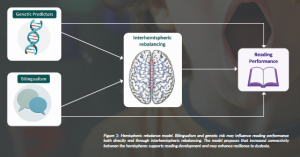
Previous studies showed that both bilingualism and reading difficulties affect CC structure. Specifically, the genu (the anterior section of the CC, connecting regions involved in cognitive and attentional control) seems to be influenced by bilingualism experience. Meanwhile, the splenium (the posterior section of the CC, playing a particular role in language) seems to predict variations in reading and language development. Leveraging the neuroimaging, behavioural, demographic, and genetic data of the ABCD database, we perform the first test of our hemispheric rebalance model (Figure 1) to confirm that CC structure might mitigate genetic risks of developing dyslexia.
Critically, our results showed a robust positive and direct association between bilingualism and reading—if children were bilingual, they were better readers. Importantly, and in line with our hemispheric rebalance model, we found that structural interhemispheric connectivity in the anterior part of the CC partly mediated this effect. However, this mediating effect was not as robust as the direct beneficial effect of bilingualism on reading skills. Importantly, this was found independently of the global brain size of children, an important measure that generally explains most of the effects between brain and behaviour. This suggests that the anterior CC has a specific role to play in the effects of bilingualism on reading.
We also found a significant direct negative effect of genetic risks on reading, which was mostly explained by the global brain size of children.
These results could indicate that the CC might reflect compensatory strategies developed through exposure to bilingual environments. Moreover, these effects could potentially benefit both children with high and low risks of developing reading difficulties.
Refining the test of our model: the BIBALANCE and BILREADy projects
If research from the ABCD database has provided an initial validation of our hemispheric rebalance model, our current research programmes aim to investigate it in greater detail using more controlled and customised paradigms to address our research questions. We are now testing our hypothesis in a local bilingual sample from the Basque Country (Spain), where thousands of children learn to speak and read in at least 2 of the country’s official
languages—Basque and Spanish. These participants are currently coming to the Basque Center on Cognition, Brain and Language (BCBL) in San Sebastián to help us answer these questions.
The BILREADy project has already provided important preliminary results of our model in the Basque-Spanish population, in both children and adults, by conceptualising bilingualism as a continuum rather than a dichotomous variable. Through this project, we have collected data showing that the more frequently individuals are exposed to balanced Spanish-Basque bilingual environments, the more bilateral their hemispheric processing of language, and the better their reading skills.
The project is now being taken further through BIBALANCE, which pushes the frontiers of science by capitalising on cutting-edge genetic and neuroimaging tools. Specifically, we are using structural magnetic resonance imaging (MRI) as well as functional electroencephalography (EEG) and magnetoencephalography (MEG) to measure structural and functional hemispheric rebalance in more than 500 Spanish-Basque bilingual children with and without a family risk of developmental dyslexia.
In the long term, if our hypothesis is validated, BILREADy and BIBALANCE will contribute to fostering an inclusive and equitable literate society by identifying strategies that enhance the brain’s resilience to the risk of developing dyslexia. Their ground-breaking scientific outcomes could translate into multiple levels of clinical practice through the validation of simple behavioural indices of hemispheric rebalance, which could become central to the development of cost-efficient and accessible tools beneficial to linguistic communities worldwide. In addition, our projects’ impact may extend to bilingual educational practices by helping redesign learning environments and supporting the implementation of dual-language contexts in the classroom.
By forging new neural pathways that compensate for and support cognitive weaknesses, (bilingual) hemispheric rebalance could benefit a range of disorders beyond dyslexia. This could include (i) disorders affecting the development of attentional control functions (e.g. ADHD), (ii) disorders acquired after birth (e.g., stroke or brain tumours), and (iii) disorders associated with ageing and neurodegeneration. Our model therefore has broad explanatory power that may facilitate knowledge sharing across fields and contribute to the development of a healthier, wealthier, happier, and multilingual society.
Project name
BIBALANCE
Project summary
Phonological development plays a key role in learning to read, but this process can be influenced by the environment—particularly in bilinguals who acquire 2 phonological systems. This project investigates how early bilingualism shapes the brain networks supporting reading development. We hypothesise that bilingualism modifies whole-brain connectivity dynamics, helping to mitigate the impact of genetic risks for dyslexia, a condition associated with poorly connected neural systems. By studying 500 Basque-Spanish bilingual children, BIBALANCE aims to uncover how bilingualism interacts with genetic risk to improve reading outcomes, providing new insights for education and dyslexia interventions.
Project lead profile
Marie Lallier is an Ikerbasque Research Professor leading the Educational Neuroscience and Developmental Disorders group at BCBL, Spain. Her research focuses on reading development, bilingualism, and the neurocognitive variability of language-related developmental disorders, employing behavioural and neuroimaging methods. She actively mentors graduate students and promotes interdisciplinary collaboration with educators, clinicians, and stakeholders. Her work bridges fundamental and translational research, investigating factors that support prevention and compensation to promote positive outcomes in language and reading, and developing tools to improve early detection, diagnosis, and intervention.
Project contacts
Dr Marie Lallier
Basque Center on Cognition Brain and Language, Paseo Mikeletegi 69, planta 2, 20009 Donostia-San Sebastián, Spain.
Email: m.lallier@bcbl.eu
Web: www.bcbl.eu/en/conocenos/equipo/marie-lallier
Funding
This project has received funding from the European Research Council (ERC) under the European Union’s research and innovation programme (Grant agreement No. 101170337).
Views and opinions expressed are, however, those of the author(s) only and do not necessarily reflect those of the European Union or the ERC. Neither the European Union nor the granting authority can be held responsible for them.
Project name
BILREADy
Project summary
The BILREADy project explores whether early bilingualism enhances resilience to dyslexia by promoting hemispheric rebalance. One objective is to develop a child-friendly EEG-neurofeedback system to investigate whether hemispheric rebalance can support language processing in children with difficulties, with the final aim of helping children with developmental dyslexia respond more effectively to speech therapy.
Project partners
This work is conducted at Basque Center on Cognition, Brain, and Language (BCBL) within the Educational Neuroscience and Developmental Disorders (ENDD) group, led by Dr Marie Lallier. It forms part of the AEI BILREADy research project.
Project lead profile
Marie Lallier is an Ikerbasque Research Professor and leader of the Educational Neuroscience and Developmental Disorders group at the Basque Center on Cognition Brain and Language. Dr Lallier specialises in cognitive neuroscience, with a particular emphasis on reading development and reading disorders.
Project contacts
Dr Marie Lallier
Ikerbasque Research Professor
Leader of the Educational Neuroscience and Developmental Disorders group Basque Center on Cognition, Brain, and Language (BCBL)
Email: m.lallier@bcbl.eu
Irtisha Chakraborty
PhD Researcher
Email: i.chakraborty@bcbl.eu
Web: www.bcbl.eu
Funding
The authors acknowledge financial support by the Spanish State Research Agency (AEI/10.13039/501100011033) through project PID2022-136989OB-I00, co-funded by the European Regional Development Fund (ERDF/FEDER, UE).
Figure legends
Figure 1: Hemispheric rebalance model. Bilingualism and genetic risk may influence reading performance both directly and through interhemispheric rebalancing. The model proposes that increased connectivity between the hemispheres supports reading development and may enhance resilience to dyslexia.