
Problem statement and strategic challenges
The management of urban wastewater systems (UWS) has reached a critical juncture where traditional hydraulic-only control—focusing solely on managing water volumes to prevent pollution of receiving bodies and flooding—is nolonger sufficient to meet modern environmental mandates. The classical method for mitigating pollution in receiving bodies mostly relies on the construction of new storage infrastructure, the so-called grey-based solutions. This type of solution is increasingly costly as urban spaces become denser. As this urban density increases and rainfall patterns become more erratic, the environmental compliance gap has widened. The rise of advanced digital tools and sensor technologies enables us to add additional control layers on top of existing storage capacities to optimise their use and thus avoid building new, heavy, and costly infrastructure to mitigate receiving bodies’ pollution from urban drainage systems.
LIFE RUBIES addresses this topic by implementing an advanced digital tool in parallel with pollution-based real-time control (PBRTC), shifting the operational focus from simple volumetric management to the active minimisation of the pollutant mass discharged during storm events.
The core environmental challenge lies in the significant pressure placed on surface waters by combined sewer overflows (CSOs). In Madrid, the Manzanares River—classified as a ‘heavily modified’ water body—remains under extreme stress due to low natural flow and high urban pressure. Similarly, the canalised Marque River in Lille faces strict quality mandates.
Strategic impulses for project initiation
- Water Framework Directive (WFD) compliance: There was an urgent requirement to achieve ‘Good Ecological Potential’ in heavily modified bodies like the Manzanares and the Marque.
- The 1:17 dilution benchmark: Engineering compliance with the Tajo River Management plan, which dictates that all flows with a dilution factor less than 17 times the peak dry weather flow (DWF) must be intercepted and treated.
- Regulatory evolution: Preparation was required for the revised Urban Wastewater Treatment Directive (2025) and Spanish RD665/2023, which enforces higher hydraulic efficiency and stricter discharge monitoring.
- Receiving body sensitivity: Mitigation of toxic impacts from ammonium and organic matter was required in rivers where natural dilution is insufficient to prevent anoxia.
- Infrastructure optimisation: A transition was required from ‘autonomous’ detention tank operations to a centralised, integrated strategy that maximises existing investment.
Project consortium and objectives
The LIFE RUBIES project is a continuation of the LIFE EFFIDRAIN project and aims to protect receiving environments by optimising the management of sewerage networks during rainy weather. Here are the details concerning its context, partners, duration, budget, and ambitions.
Partners
The project is led by a consortium of 8 European beneficiaries, coordinated by SUEZ Digital Solutions. Partners include water managers, research centres, and technology experts. The pilot site managers are the Métropole Européenne de Lille (MEL) in France and Canal de Isabel II (CYII) in Madrid, Spain. The technical and scientific partners are Cetaqua, Aquatec, CSIC (Spanish National Research Council), the University of Lille (LASIRE), the University of A Coruña and the LYRE research centre.
The project began on 1 October 2021. Its initial end date of March 2025 was extended to 31 December 2025 to allow for the completion of operational tests based on water quality. The total investment for this project is € 3 337 607. The European Union is contributing €1 835 681, or 55% of eligible costs, through the LIFE programme.
Ambition and objectives
The central ambition of the project is to move from conventional hydraulic management (based on volumes) to dynamic management based on actual pollution.
Specific objectives include:
- Reduction of pollutant discharges: The ambition is to reduce the annual volume of CSOs by 15% to 50% and the mass of suspended solids (TSS) discharged into the Manzanares (Madrid) and Deûle (Lille) rivers by 25% to 45%.
- Digital optimisation of existing infrastructure: The use of real-time control (RTC) and model predictive control (MPC) tools maximises the ‘digital’ storage capacity of the current network, thereby avoiding the construction of new, very costly concrete retention basins (approximately €1000/m³).
- Regulatory compliance: Help local authorities comply with the new European directive on urban wastewater treatment (DERU 2) and the WFD.
- Technological innovation: Deploy an operational solution integrated into the AQUADVANCED Urban Drainage (AQDV UD) platform, capable of processing weather forecasts, real-time quality sensor data, and complex algorithms to recommend the best control actions to operators.
- Replication: Assess the feasibility of transferring this solution to other European cities, such as Porto or Alicante.
Project overview
The LIFE RUBIES project ran from October 2021 to December 2025. Its implementation followed a rigorous structure, divided into several key actions, ranging from technical planning to real-world demonstrations at pilot sites in Madrid and Lille.
From 2021 to 2022, the projects focused on planning and adaptation, with an initial phase that served to validate the scope of the study, the need for new instrumentation and the IT architecture for both sites, then experts adapted pollution-based control concepts (from the previous LIFE EFFIDRAIN project) to make them robust to weather forecast uncertainties and modelling errors.
From 2022 to 2024, the projects mainly concentrated on software integration and deployment of AQDV UD. The control algorithms (MPC for Madrid, MV Curve for Lille) have been integrated into SUEZ’s AQDV software platform.
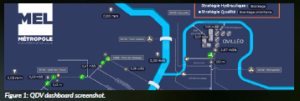
Then, the site instrumentation began with the network and the installation of turbidity and conductivity sensors and automatic samplers to characterise pollution in real time. The rivers were monitored through the deployment of monitoring stations to measure the direct impact of discharges on receiving environments (Manzanares and Deûle). Finally, the commissioning of AQDV with the configuration of synoptic views, connection to weather radar data and implementation of digital twins of the networks.
From 2023 to 2025, the test and demonstration cycle was conducted. The project followed a gradual ramp-up approach on the 2 pilots using 3 stages:
- Virtual tests used simulation of control strategies on a computer model (‘virtual reality’) to validate algorithms without risk to the real network.
- Operational hydraulic tests implemented dynamic management, initially based on volumes, to optimise the filling of existing basins.
- Operational quality tests enabled the final activation of control based on pollutant load, allowing prioritised storage of the dirtiest water.
In 2025, the evaluation and capitalisation activities enabled the analysis of benefits, whether they be technical (reductions in volumes discharged), environmental (impact on eutrophication), economic (cost–benefit), or social.
Pilot sites and perimeters
The LIFE RUBIES project utilises 2 distinct pilot sites to demonstrate its real-time pollution-based control solution.
Madrid pilot (Spain)
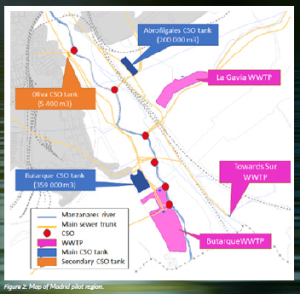
Located in the southern, most complex downstream part of the Manzanares drainage system, this site receives flow from the entire city network. The perimeter includes 2 major detention tanks, Butarque (359 000 m³) and Abroñigales (200 000 m³), along with the secondary Oliva tank (5400 m³), and coordinates with the Butarque and La Gavia WWTPs. The system monitors 5 to 6 primary CSO discharge points (CSO_D2 to CSO_I2). Instrumentation comprises a pre-existing network of 39 sensors and 20 actuators, enhanced by 2 new rain gauges and 3 sewer quality stations (turbidity/conductivity) equipped with automatic samplers for pollutant correlation. Environmental impact is tracked via 2 river monitoring stations (upstream near Oliva tank and downstream near the Butarque effluent) using multiparameter probes for ammonia, dissolved oxygen, and other indicators.
The Manzanares River is considered one of the most polluted rivers in Spain due to constant pressure from urban waste in the metropolitan area. It has alarming physical and chemical qualities: the river has very low dissolved oxygen (DO) concentrations, frequently reaching anoxic conditions, and acute toxicity, as ammonium (NH4+) levels often exceed 20 mg/L, which is extremely toxic to all forms of aquatic life. These concentrations are incompatible with the ‘good status’ of the water body. In parallel, the Mazanares River experiments with hydrological imbalance. The river’s natural flow is reduced, while treated water discharges are 10 times higher. This means the river’s quality is essentially that of slightly diluted sewage treatment plant effluent, eliminating its self-purification capacity. From a regulatory perspective, the river is classified as a ‘heavily modified’ water body. It must achieve good ecological potential by 2027 under the WFD. However, the risk of not achieving this is considered ‘very high’.
Lille pilot (France)
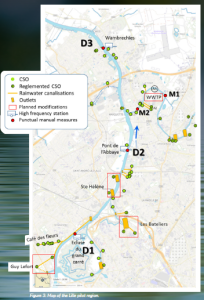
This site focuses on the Lille sewerage agglomeration, specifically the Marquette WWTP and its associated Bateliers and Left Bank branches. Main storage infrastructures include the Guy Lefort basin (28 000 m³), which features a dual-mode system for flood and pollution control, and the Bateliers basin (20 000 m³), supported by several high-capacity pumping stations. The perimeter targets 5 strategic weirs (Bateliers, Maracci, Guy Lefort, Café des Fleurs, and Pasteur) responsible for 40% of the area’s wet-weather discharges. The pilot integrates 56 pre-existing measurement points and 10 real-time rain gauges. New deployments include 5 sewer quality monitoring stations (turbidity/ conductivity) and 3 high-frequency river stations (D1, D2, D3) on the Deûle canal, plus 2 additional stations (M1, M2) on the Marque River using passive samplers and specialised filtering prototypes.
The Lille network manages a highly urbanised area where discharges during rainy weather have a direct impact on the Deûle and Marque rivers. The legal compliance criteria stipulate that no more than 5% of the total annual volume of wastewater may be discharged. However, the metropolitan area initially had a discharge rate of around 7.5%, requiring optimisation measures to meet the legal threshold. The water quality has long been poor to mediocre in terms of ammonium and total phosphorus. Although new wastewater treatment plants have improved the situation, the environment remains fragile in the face of acute pollution peaks during storms. The ecological objective is that the water bodies concerned (FRAR32 for the Deûle and FRAR34 for the Marque) aim to achieve good chemical status and good ecological potential by 2027.
Overall, the 2 pilot sites shared 3 common objectives:
- Optimisation of existing infrastructure aimed to avoid the construction of new, costly concrete retention basins by better utilising the network’s current storage capacity through real-time management.
- Protection of biodiversity aimed to reduce toxic shocks (ammonium, oxygen depletion), enabling the return and survival of aquatic fauna and flora in these urban environments.
- Adaptation to climate change responded to increasing rainfall intensity by shifting from static to dynamic management to prevent flooding while protecting the environment.
The effectiveness of these perimeters relies on the synergy between the digital architecture and the physical sensing tools deployed within them.
Technical architecture: sensors, models, and digital environments
High-quality data and predictive modelling form the backbone of PBRTC, enabling real-time decisions that protect the environment.
Hardware deployment and digital intelligence
Hardware deployment
- Precipitation monitoring: rain gauges and X-Band radar real-time monitoring and forecast provide the necessary inputs for anticipatory control.
- Hydraulic sensing: water level and flow sensors are established at key interceptors to monitor system states.
- Quality proxies: turbidity and conductivity sensors correlate with particulate pollutants, organic matter and nutrients.
- Advanced probes for river quality assessment: multiparameter probes (O2, pH, T, turbidity and conductivity), ammonium analyser.
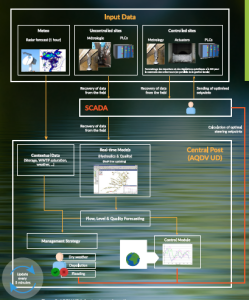
Digital intelligence relies on various components, starting with the strong foundation provided by AQDV UD, a central software platform that integrates SCADA, weather forecasts, hydraulics, and quality models to compute optimal setpoints. The optimal decisions obtained by AQDV UD are provided for 2 different types of technologies, depending on the pilot site. For Madrid, MPC is deployed in GAMS for high-level optimisation to minimise CSO mass while respecting WWTP limits. The optimiser implemented in Lille is based on the MV Curve Approach, an expert system developed in a French research institute (INSA Lyon).
To ensure reliability, the architecture utilises a closed-loop simulation algorithm (CLSA). This facilitates ‘virtual testing’ where strategies run against a simulated network model before progressing to ‘real testing’ with physical actuators, ensuring no risk of flooding or WWTP process degradation.
Operational results and site-specific gains
Operational results confirm that PBRTC balances environmental protection with hydraulic efficiency more effectively than standard hydraulic rules.
- Madrid (Manzanares impact): The PBRTC strategy explicitly protects the Aliviadero Sur from premature discharges while the Abroñigales tank is not yet full—a common error in previous autonomous systems. This results in significant reductions of ammonium and BOD5 impacts on the river.
- Lille (MEL site): The ‘volume substitution’ logic in the MV Curve algorithm allows the system to discharge less-polluted water already in the tank to make room for higher-concentration incoming flow, effectively ‘trading’ volume for a lower total pollution load on the Marque.
- CSO reduction: The target is a 50% reduction in storm overflow volumes and pollution mass.
- Reporting efficiency: Regulatory reporting and compliance analysis time is reduced by 50%.
- Regulatory readiness: Immediate alignment with RD665/2023 and the Urban Wastewater Treatment Directive.
These gains support the economic feasibility of the RUBIES solution as a standard European utility tool.
LIFE RUBIES environmental benefits
The LIFE RUBIES project has had a significant impact on the water quality of receiving rivers, thanks to a direct reduction in the volumes and pollutant load discharged by CSOs during rainfall events.
Manzanares River (Madrid, Spain)
The dynamic management system has improved the health of the Manzanares River by limiting massive urban discharges:
- Reduction in volumes: an average decrease of 28.5% to 30% in the total volume of storm overflows was recorded compared to traditional static management.
- Pollution reduction: the annual load of suspended solids (TSS) discharged decreased by 25.4%, while biochemical oxygen demand (BOD5) fell by 35.6%.
- Ecological indicator: these results translate into a 16.1% reduction in eutrophication of the river’s fresh water, thereby limiting the proliferation of harmful algae.
Deûle River (Lille, France)
In Lille, the impact focused on reducing acute pollution peaks that occur during storms:
- Volume reduction: Overflows were reduced by 8% to 17%, depending on weather and operational conditions.
- Pollution reduction: Pollutant loads discharged were reduced by 23% for suspended solids and 25% for BOD5.
- Chemical impact: A 9.2% decrease in ammonium peaks was measured in the Deûle during major events, which is crucial for the survival of aquatic fauna, as ammonium is toxic to fish.
Overall environmental benefits
The project demonstrated that integrating real-time water-quality sensors enables prioritising the storage of the most polluted water (often the first runoff, which is heavily laden with sediment and metals). By allowing only the most diluted water to overflow, the project minimises the toxic shock suffered by river ecosystems.
Finally, these results help local authorities comply with the requirements of the WFD and the new directive on urban wastewater treatment (DERU 2), which impose strict monitoring and reductions in discharges during rainy weather.
Techno-economic analysis and replicability
Technology transferability is a core mandate of the LIFE programme. Feasibility studies were performed in other cities in Europe.
LIFE RUBIES techno-economic benefits
The LIFE RUBIES solution provides a cost-effective alternative to traditional ‘grey’ infrastructure, such as concrete storage tanks, by utilising ‘digital storage’ to optimise existing assets.
The project evaluated the economic performance of LIFE RUBIES’ implementation and operational costs using equivalent annual cost (EAC), which combines annualised capital (CAPEX) and recurring operational (OPEX) costs over 5 years.
- Estimated EAC of the Madrid pilot (MPC): €156 800 per year.
- Estimated EAC of the Lille pilot (RTC): €178 400 per year.
- Cost structure: In both cases, OPEX dominates the total cost (software licensing, maintenance, data management), while annualised CAPEX accounts for less than 10% of the EAC.
In comparison with traditional solutions, the primary benefit of LIFE RUBIES is CAPEX avoidance. Building new concrete storage basins is estimated to cost approximately €1000 per m³. For a city like Madrid to avoid 2.43 million m³ of CSO through new construction would require massive, often unaffordable, investment. The cost-effectiveness per volume avoided in Madrid is only €0.064 per m³ of CSO avoided, and €2.29 per m³ in Lille. The cost per ton of pollutant (TSS) is approximately €232 per ton of suspended solids (SS) avoided in Madrid and €2202 in Lille.
The digital solution has fixed deployment costs that are largely independent of the number of controlled assets. While Lille’s pilot was limited to a single tank (leading to higher unit costs), the Madrid pilot demonstrated that applying the same software to multiple assets significantly improves cost-effectiveness.
Other benefits
LIFE RUBIES automation and data centralisation allow savings of around 50% in time spent on reporting and operational regulatory compliance processes. From a regulatory compliance perspective, the solution helps local authorities comply with the new European directive on urban wastewater treatment (DERU 2), thereby avoiding potential financial penalties from the EU.
Other positive impacts have been identified but have not been directly quantified in euros in the cost analysis, such as the reduction in damage caused by urban flooding, which has disproportionate economic consequences (damage to buildings, vehicles, and cleaning) and the lower maintenance costs in downstream receiving environments due to reduced sediment and debris deposits.
Qualification Form for LIFE RUBIES deployment
As part of its replication and transfer plan, the LIFE RUBIES project developed a specific Qualification Form to help interested cities evaluate the feasibility of implementing real-time pollution-based control. The primary objective of the form is to serve as a technical guide to assess the potential benefits and requirements for deploying the solution in a specific city. It allows the project’s technical team to:
- understand the local context of the city’s collection system and the sensitivity of the natural water bodies receiving the discharges
- identify prerequisites and key infrastructure elements needed for deployment
- estimate technical requirements and necessary actions to apply the LIFE RUBIES concepts to the site under study
- provide data that helps the technical team estimate potential costs based on the number of sensors, storage tanks, and the complexity of the network.
The form is designed for easy access to encourage replication in other European contexts. Interested stakeholders can request the form directly through the official LIFE RUBIES website. Completing and returning the form is the first step in engaging the technical team to determine whether a city is ready for the deployment of these advanced real-time control modules.
PROJECT SUMMARY
The LIFE RUBIES project aims to develop an operational tool to reduce urban wastewater’s impact on the natural environment by controlling water pollution in real time and deploying that tool in 2 cities. Real-time control will make it possible to direct and store urban wastewater to avoid pollution by relying on the coupling of sensors, models, and controllers.
PROJECT PARTNERS
The consortium has 8 partners in France and Spain, including private companies, public research centres, and metropolitan areas. Solutions will be deployed on 2 pilot sites: the Metropolis of Lille (France) and its canalised river (La Deûle), as well as the city of Madrid (Spain). Suez provides data collection solutions (sensors, probes), providing digital models and real-time applications. 3S owns AQDV UD and will have a key role as project coordinator and integrator. Also assisting are: AQUATEC, (Spain), CSIC, (Spain),CETAQUA, (Spain), Canal de Isabel II, (Spain), Métropole européenne de Lille (France), SUEZ EAU FRANCE (France) and Université de Lille, LASIRE (France).
PROJECT LEAD
SUEZ takes the lead in managing the LIFE RUBIES project, overseeing its various components and ensuring smooth implementation.
AQUADVANCED technology: SUEZ leverages its AQUADVANCED Urban Drainage technology, which provides advanced digital modelling tools for urban drainage systems, to analyse and optimise water management within the project. Focus on urban drainage: The LIFE RUBIES project primarily focuses on improving urban drainage systems, making SUEZ’s expertise in this area particularly relevant.
PROJECT CONTACT
Martin VUILLAUME
SUEZ Smart Solutions, 38 Rue du President Wilson, 78230, Le Pecq
Email: martin.vuillaume@suez.com
Web: www.suez.fr/fr-fr
Web: life-rubies.eu
FUNDING
The LIFE RUBIES project has received funding from the LIFE Programme of the European Union, under grant agreement No. LIFE20 ENV/FR/000179.
Figure legends
Figure 1: QDV dashboard screenshot.
Figure 2: Map of Madrid pilot region.
Figure 3: Map of the Lille pilot region.
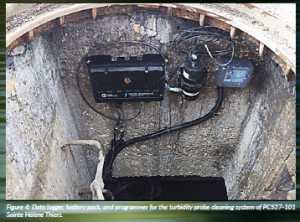
Figure 4: Data logger, battery pack, and programmer for the turbidity probe cleaning system of PC527-101 Sainte Hélène Thiers.
Figure 5: AQDV UD infrastructure schematic.